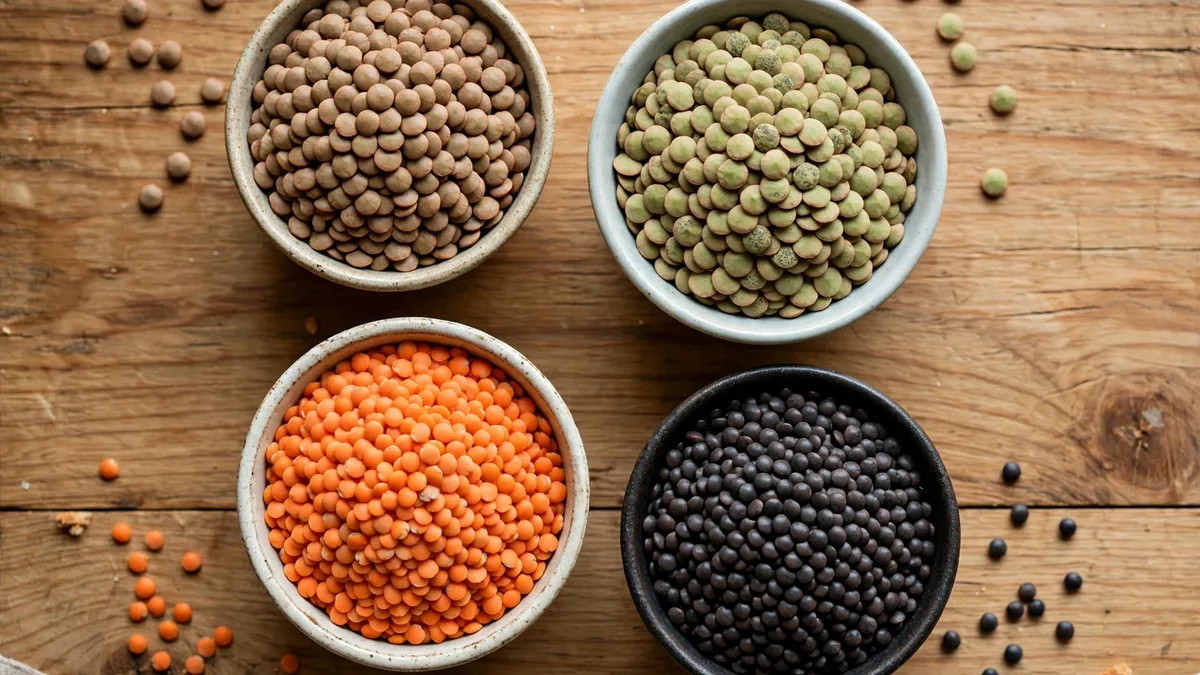

Dried lentils are the dried seeds of the lentil plant, a small, lens-shaped legume that has been eaten for thousands of years across the Middle East, South Asia and the Mediterranean. Dried lentils are cheap, filling and quick to cook, and they need no soaking, which makes them one of the most forgiving staples in the kitchen. The short answer to the question behind this guide is that dried lentils are a pantry essential: rinse them, simmer them in water until tender, season them at the end, and you have the base for soups, salads, curries and stews.
Lentils come in several colours and sizes, and the type you choose decides how the finished dish looks and feels. Some hold their shape and suit salads, while others fall apart into a thick, creamy texture that suits soups and dals. They are naturally rich in fibre and plant protein, and they provide iron and folate, which is one reason they appear in so many cuisines. This guide covers the main types, how to cook each one, and how to store dried lentils so they stay at their best.
Key takeaways
- Dried lentils are the dried seeds of the lentil plant, a lens-shaped legume.
- They need no soaking, unlike dried beans, and most types cook in 15 to 30 minutes.
- Brown and green lentils hold their shape, red and yellow lentils break down into a creamy texture.
- Puy lentils and beluga lentils are small, firm varieties that suit salads.
- Rinse dried lentils and pick out any stones or debris before cooking.
- Store dried lentils in an airtight container in a cool, dark place, away from moisture.
What dried lentils are
The lentil is a member of the legume family, related to beans, peas and chickpeas, and it grows in pods on a small bushy plant. The seeds are dried after harvest, which is what makes them a pantry staple: with the moisture removed, they keep for many months without refrigeration, and they are light and cheap to transport. The name comes from the Latin word for lens, and the resemblance is clear when you hold a dried lentil up to the light, because it is a small, flat disc with a rounded edge.
Lentils have been grown since ancient times, and archaeologists have found them in some of the earliest farming settlements in the Fertile Crescent, the region that covers parts of the modern Middle East. They spread through the Mediterranean, into India and across Europe, and they remain a staple in many of those cuisines today. In India, split lentils are the base of dal, and in France, the small green lentils of Le Puy have a protected reputation for flavour and texture. You can read the botanical background in the Wikipedia article on the lentil.
Nutritionally, dried lentils are a useful food. They are high in fibre and a good source of plant protein, and they provide iron, folate and other minerals.
The main types of dried lentils
Brown lentils are the most common type in British and American shops, and they are the most versatile. They are a plain brown colour, they cook in around 20 to 30 minutes, and they hold their shape reasonably well, though they can soften if they are overcooked. They suit soups, stews, shepherd’s pie fillings and simple side dishes, and they are a good first choice if you are new to cooking lentils.
Green lentils are similar to brown lentils, but they are slightly larger and a little firmer, with a peppery flavour that some cooks prefer. They hold their shape better than brown lentils, which makes them a good choice for salads and for dishes where you want the lentils to stay distinct. They take around 20 to 30 minutes to cook. French green lentils, often called Puy lentils after the region of Le Puy in France, are smaller, darker and firmer still, with a distinctive speckled appearance and a rich, earthy flavour. They are more expensive than brown or green lentils, and they are worth buying for salads and for dishes where texture matters.
Red and yellow lentils are split lentils, meaning the seed coat has been removed and the seed has been split in half. They cook much faster than whole lentils, usually in 15 to 20 minutes, and they break down into a soft, creamy texture. That makes them ideal for dals, soups and purees, but a poor choice for salads, because they will not hold their shape. Red lentils turn a golden yellow as they cook, which surprises first-time cooks, but the colour change is normal.

Beluga lentils are small, black and round, and they are named for their resemblance to beluga caviar. They hold their shape well, they have a firm texture and an earthy flavour, and they take around 20 to 25 minutes to cook. They look striking on a plate, which makes them a favourite for salads and for serving as a bed for fish or roasted vegetables. They are less widely stocked than brown or red lentils, and they usually cost more, but a small bag goes a long way as a side dish.
| Type | Colour and size | Cooking time | Best for |
|---|---|---|---|
| Brown lentils | Plain brown, medium | 20 to 30 minutes | Soups, stews and everyday cooking |
| Green lentils | Green-brown, medium-large | 20 to 30 minutes | Salads and dishes where shape matters |
| Puy lentils | Dark green, speckled, small | 25 to 30 minutes | Salads and refined side dishes |
| Red lentils | Orange-red, split | 15 to 20 minutes | Dals, soups and purees |
| Yellow lentils | Yellow, split | 15 to 20 minutes | Dals and creamy soups |
| Beluga lentils | Black, small and round | 20 to 25 minutes | Salads and elegant side dishes |
How to cook dried lentils
Start by measuring the lentils and tipping them into a sieve or a colander. Rinse them under cold running water, and pick out any small stones, shrivelled seeds or debris as you go. Stones are rare in modern packets, but they do occur, and a single stone can damage a tooth, so the check is worth the minute it takes. There is no need to soak dried lentils before cooking, which is one of their advantages over dried beans.
Put the rinsed lentils in a saucepan with around three times their volume of water, and bring the pan to the boil. Skim off any foam that rises to the surface, then turn the heat down and simmer gently. Test the lentils a few minutes before the end of the stated cooking time, because the exact time depends on the age of the lentils and the hardness of your water.
Seasoning is a matter of timing. Salt and acidic ingredients, such as tomatoes, vinegar or lemon juice, can toughen the skins if they are added too early, so add them near the end of cooking, once the lentils are tender. A bay leaf or a clove of garlic in the cooking water will add flavour without slowing the cooking.
How much to cook, and what to do with leftovers
As a rough guide, 100 grams of dried lentils makes a generous portion for one person as a main dish, or a side dish for two.
Cooked lentils keep well in the fridge for three to four days in a covered container, and they freeze well for up to three months. Freeze them in portions, and defrost them in the fridge overnight before reheating. Reheat them gently until they are piping hot throughout. For more ideas for food to take out and about, see our best picnic recipes, several of which work well with a lentil salad.
How to store dried lentils
Dried lentils should be stored in an airtight container in a cool, dark, dry place, such as a cupboard or a pantry. A glass jar with a tight lid is ideal, because it keeps out moisture and lets you see how much is left, but a sealed plastic container or a resealable bag will do just as well. Keep them away from heat and sunlight, and keep them dry, because moisture is the main enemy of dried lentils.
Stored this way, dried lentils will keep for a year or more, but they do slowly lose quality. Older lentils take longer to cook, and they may never soften as fully as fresh ones, so it is worth using up older stock first. Check the packet for a best-before date, and if the lentils smell musty or show signs of damp, throw them away.
A checklist for cooking dried lentils
Use this checklist each time you cook dried lentils, and the results will be consistent.
- Rinse the lentils in a sieve and pick out any stones or debris.
- Use around three parts water to one part lentils by volume.
- Bring the pan to the boil, skim the foam, then simmer gently.
- Test the lentils a few minutes before the end of the cooking time.
- Add salt, tomatoes, vinegar or lemon juice only once the lentils are tender.
- Drain the lentils unless the cooking liquid is part of the dish.
- Cool leftovers quickly and refrigerate them within two hours.
- Store dried lentils in an airtight container in a cool, dark, dry place.
Frequently asked questions
Do dried lentils need soaking?
No, dried lentils do not need soaking before cooking, which is one of their advantages over dried beans. Rinsing them and picking out any stones is enough. Most recipes are written for unsoaked lentils.
How long do dried lentils take to cook?
Most dried lentils cook in 15 to 30 minutes. Red and yellow split lentils are the fastest, at 15 to 20 minutes, while brown, green and beluga lentils take 20 to 30 minutes, and Puy lentils take 25 to 30 minutes. Test the lentils before the end of the stated time.
Why do red lentils turn yellow when cooked?
Red lentils turn a golden yellow as they cook because the orange-red colour comes from pigments in the seed that change with heat and water. The change is normal and does not affect the flavour. Red lentils also break down into a soft, creamy texture as they cook, which is why they are used for dals and soups.
Can you eat dried lentils raw?
No, dried lentils should not be eaten raw. Like other dried legumes, they contain compounds that can cause stomach discomfort when raw, and they are hard and indigestible in that state. Always cook dried lentils thoroughly before eating them.
How long do dried lentils last?
Dried lentils stored in an airtight container in a cool, dark, dry place will keep for a year or more, but they slowly lose quality with age. Older lentils take longer to cook and may not soften fully, so use older stock first.
Are dried lentils better than tinned lentils?
Neither is better in every way. Dried lentils are cheaper, they keep longer, and they let you control the texture and the seasoning, but they need cooking time. Tinned lentils are ready to eat and convenient, but they cost more per portion and often contain added salt.
The bottom line
Dried lentils are one of the simplest and most useful foods in the kitchen. They need no soaking, they cook in under half an hour, and a small bag can become a soup, a salad, a curry or a stew. Learn the difference between the types, rinse them, simmer them gently and season them at the end, and they will reward you every time. To cook with them more often, keep a jar in the cupboard beside your rice and spices, and try a lentil dish alongside a food lorry favourite or a homemade soup. For kitchen care after cooking, our guide to how to clean soapstone countertops will help keep your worktops in good order.