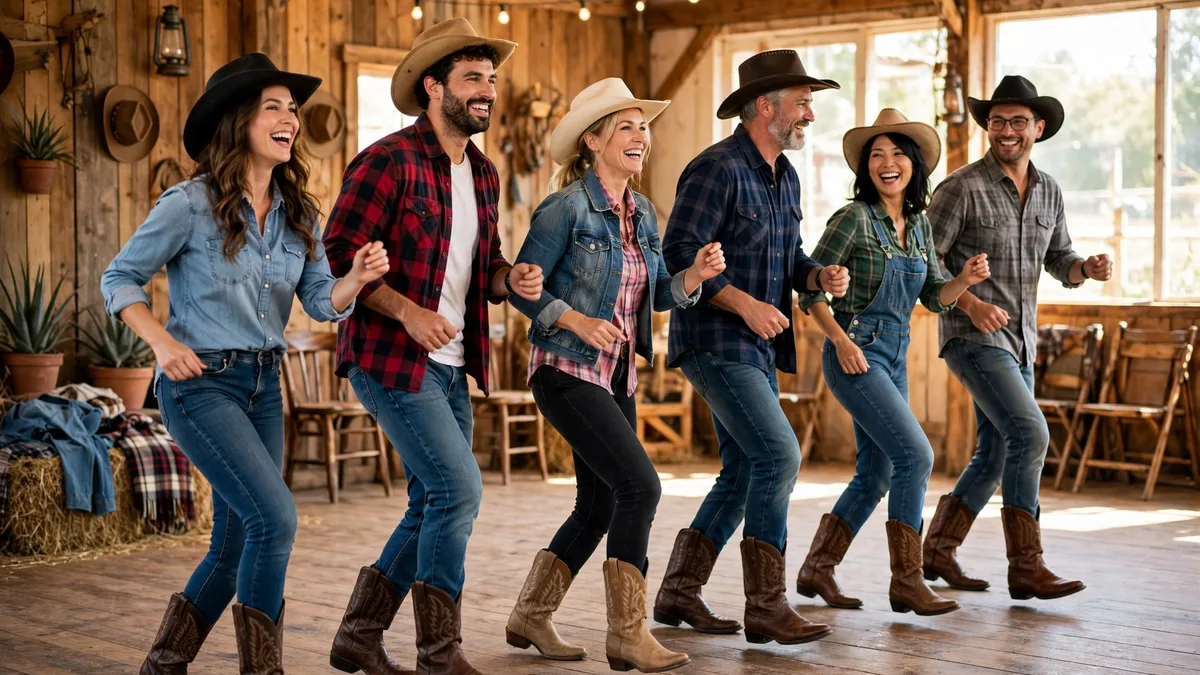

Line dancing is a form of group dance in which a group of people dance in rows, all facing the same way and performing the same sequence of steps, without partners. Line dancing is easy to start, because you do not need a partner, you do not need to be able to dance already, and the steps are taught slowly and repeated until they feel natural. The short answer to the question behind this guide is that line dancing is a sociable, low-pressure way to learn to dance: turn up, stand in a row, follow the caller or the teacher, and enjoy the music.
Most line dances are performed to country music, but they are also danced to pop, rock, Latin and even classical tunes, and the dances themselves range from gentle beginner routines to fast, complex sequences. A single dance is a short pattern of steps, usually counted in eights, which repeats until the song ends, and the dancers turn to face a new wall each time the pattern repeats. This guide covers the basic steps, what to wear, how to find a class and what your first session will feel like.
Key takeaways
- Line dancing is a group dance where everyone in the rows performs the same steps, without a partner.
- You do not need dance experience, a partner or special clothes to start.
- Most dances are counted in eights, and the pattern repeats until the song ends.
- Basic steps include the grapevine, the shuffle, the pivot turn and the jazz box.
- Comfortable shoes with a smooth sole and a low heel are the best choice for beginners.
- Classes are usually welcoming to newcomers, and teachers expect beginners to make mistakes.
What line dancing is
Line dancing has its roots in the folk dances of Europe, which settlers brought to North America, where they blended with other traditions and with the music of the American West. The modern form took shape in the twentieth century, and it became widely popular in the 1970s and 1980s, when dances such as the Electric Slide spread from clubs and dance halls to weddings and community centres. The Wikipedia article on line dance gives a good overview of the form and its history.
A line dance is a choreographed sequence of steps, usually between 16 and 64 counts long, which the whole group performs together. The dancers stand in lines or rows, all facing the same direction, which is called the front wall. When the sequence finishes, the dancers turn, usually by a quarter turn, and repeat the sequence facing a new wall.
Because the steps are the same for everyone, line dancing is a shared activity rather than a performance. There is no lead and no follow, and no need to match a partner’s timing. It is also good exercise, because an hour of dancing involves a surprising amount of walking, turning and stepping.
The basic steps
Almost every line dance is built from a small set of basic steps, and once you know them, new dances become much easier to learn. The grapevine is one of the most common: step to the side with one foot, cross the other foot behind it, step to the side again, and then touch or close the feet together. It is a travelling step, and it appears in dozens of dances, often with a turn or a clap at the end.
The shuffle, also called the triple step, is a quick step in three parts: step, together, step, counted as one-and-two. It is used to move forward, backwards or to the side, and it gives a dance its bounce. The pivot turn is a half turn made by stepping forward and turning on the ball of the foot, and it is how many dances change direction. The jazz box is a four-step pattern that makes a square on the floor: cross one foot over the other, step back, step to the side and step forward again. It sounds complicated, but it becomes automatic after a few repetitions.
Other steps you will meet include heel digs, where you tap the heel forward, toe touches, kicks, stomps and claps. Most beginner dances use only a handful of these steps, arranged in a simple pattern, and the teacher will break the pattern into short sections and repeat each one until the group is confident.

What to wear and what to bring
There is no dress code for a beginner line dance class, and you do not need a cowboy hat or boots to take part, though many regulars do wear them for fun. The most important thing is comfort. Wear clothes you can move in, and avoid anything tight around the waist or the legs, because you will be stepping, turning and bending.
Footwear matters more than clothing. The best shoes for line dancing have a smooth sole that lets you turn without sticking to the floor, and a low, stable heel. Leather-soled shoes work well, and many dancers wear boots with a smooth sole and a small heel, which is where the cowboy boot association comes from. Trainers with a grippy rubber sole are a poor choice for a wooden floor, because they grip too well and make turning hard on the knees, though they are fine for a first visit if that is all you have. Bring a bottle of water, because dancing is thirsty work, and our guide to the best water bottle will help you choose one that fits in a dance bag.
How to find a class
Line dance classes run in community centres, village halls, sports clubs, pubs and dance studios in most towns and cities, and they are usually listed in local community noticeboards, on social media and on the websites of dance schools. Search for line dancing classes in your area, and look for a class described as beginners, improvers or absolute beginners, because those are the ones that will teach the steps from the start. Some classes are drop-in, which means you can turn up without booking, while others ask you to book a place, so check before you travel.
Community classes are often inexpensive, and some are free or run by volunteers, while studio classes may charge a little more. A typical class lasts an hour to ninety minutes, with a break in the middle, and many classes run a social dance afterwards, where the group dances through the routines they have learned.
| Step | What it is | Where you will meet it |
|---|---|---|
| Grapevine | Side step, cross behind, side step, touch | Almost every beginner dance |
| Shuffle | Quick three-part step, counted one-and-two | Forward, back and side movements |
| Pivot turn | Step forward and turn on the ball of the foot | Changing direction and facing a new wall |
| Jazz box | Cross, back, side, forward in a square | Intermediate dances and turns |
| Heel dig | Tap the heel forward without weight | Styling and rhythm sections |
| Rock step | Step forward or back, then rock back onto the other foot | Starting and ending patterns |
What to expect at your first class
Your first class will probably start with a warm-up and a simple dance, and the teacher will walk the group through the steps slowly, without music, before adding the music at a gentle pace. Do not worry if you feel lost: everyone in the room has been a beginner.
You will make mistakes, and that is expected. If you go the wrong way, just turn and rejoin at the next wall, or stop and watch for a few counts until you find the pattern again. Nobody minds, and the regulars will usually help, because they remember their own first class. The atmosphere at most line dance classes is relaxed and friendly, and the social side is as important as the dancing: people come as much for the company as for the steps.
After the class, you may be surprised by how much exercise you have had. Dancing for an hour works the legs, the balance and the memory, because you are learning a sequence and moving at the same time. Take it gently at first, sit out a dance if you need to, and build up over a few weeks.
A checklist for starting line dancing
Use this checklist before your first class, so that you arrive prepared and relaxed.
- Find a beginners or absolute beginners class in your area and check whether you need to book.
- Wear comfortable clothes you can move in, in layers you can remove as you warm up.
- Choose shoes with a smooth sole and a low heel, and avoid grippy trainers on a wooden floor.
- Bring a bottle of water and a small towel.
- Arrive a few minutes early and introduce yourself to the teacher.
- Stand in the middle of a row, where you can see the teacher and follow the dancers in front.
- Keep your steps small and watch the counts if you lose your place.
- Do not worry about mistakes: stop, watch, and rejoin at the next wall.
Frequently asked questions
Do I need a partner for line dancing?
No, you do not need a partner for line dancing. Everyone dances in rows, all facing the same way and performing the same steps, so you can turn up on your own and join in. That is one of the reasons line dancing is popular with people who want to dance without the pressure of finding a partner.
Is line dancing hard to learn?
Line dancing is not hard to learn at a beginner level. The basic steps are simple, the dances are taught in short sections, and the pattern repeats until the song ends, so you get many chances to practise.
What music is line dancing danced to?
Line dancing is most often danced to country music, but it is also danced to pop, rock, Latin, soul and other styles. Many modern line dances are choreographed to current pop songs, and the music at a class or a social dance will usually cover a wide range. The steps are counted to the beat, so any song with a clear, steady rhythm can work.
What shoes should I wear for line dancing?
Wear shoes with a smooth sole and a low, stable heel, so that you can turn without sticking to the floor. Leather-soled shoes and smooth-soled boots are ideal. Trainers with a grippy sole can make turning hard on the knees, though they are acceptable for a first visit.
How long does it take to learn line dancing?
Most people can follow a simple beginner dance by the end of their first class, and they feel comfortable with the basic steps after a few weeks of regular classes. Regular practice, even for a few minutes at home, will speed things up considerably.
Is line dancing good exercise?
Yes, line dancing is good exercise. An hour of dancing involves walking, stepping, turning and balancing, and it works the legs and the core while raising the heart rate. It also exercises the memory, because you are learning and recalling sequences. Like any group activity, it is a good way to meet people, and our guide to a golf driving range covers another sociable way to spend an active afternoon.
The bottom line
Line dancing is one of the friendliest ways to learn to dance. You need no partner, no experience and no special clothes, just comfortable shoes, a bottle of water and a willingness to follow the steps. Find a beginners class, stand in the middle of a row, keep your steps small and enjoy the music, and within a few weeks you will know the basic steps and a handful of dances. For more ideas for sociable days out, see our best picnic recipes for a gathering after the dancing.