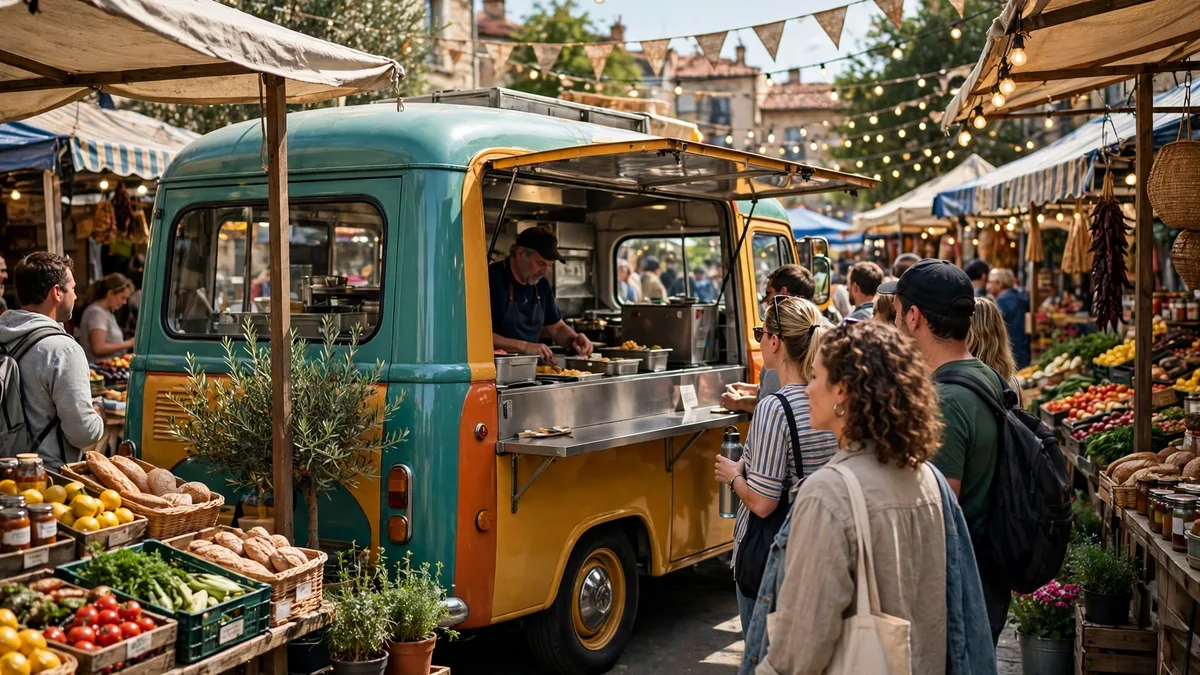

A food lorry is a kitchen on wheels: a van or lorry fitted out to cook, prepare and serve food directly to customers, usually from a hatch in its side. The term is British, and in the United States the same vehicle is called a food truck, but the idea is identical, a small mobile restaurant that can trade at a market one day, a festival the next and a street corner the day after. This guide explains what a food lorry is, how one works, what the rules are and what to look for when you are deciding where to eat.
The simplest way to think of a food lorry is as a restaurant with the dining room removed. Inside is a compact commercial kitchen, with a grill or fryer, refrigeration, a hand-washing sink and a serving counter, all packed into a vehicle that must also be safe to drive. Most lorries serve a short menu built around one speciality, such as burgers, tacos, noodles or wood-fired pizza, because a small kitchen does its best work when it does a few things well.
Key takeaways
- A food lorry is a mobile kitchen, called a food truck in the United States, serving food from a hatch in the vehicle.
- Most lorries specialise in a short menu, such as burgers, tacos, noodles or pizza, cooked to order.
- In the United Kingdom a food lorry must register as a food business with the local council at least 28 days before trading.
- Operators must follow the same food hygiene rules as restaurants, including declaring 14 regulated allergens.
- A lorry cannot trade anywhere it likes: streets are licensed, consent or prohibited, and pitches need permission.
- Look for a clean hatch, a displayed hygiene rating, clear allergen information and food cooked fresh to order.
Food lorry, food truck or food van?
The words change with the place, but the vehicle does not. In Britain, food lorry and food van are both common, with lorry suggesting the larger converted vehicles and van the smaller ones. In the United States, food truck is the standard term, and it covers everything from a small taco truck to a large purpose-built catering vehicle. In Australia and New Zealand, food truck is used too, while in much of Europe you will hear food truck as a borrowed phrase. The differences are in language, not in what the vehicle does.
There are a few close cousins worth telling apart. A catering trailer looks similar but has no engine of its own: it is towed to a pitch and unhitched, which leaves the towing vehicle free for other work. A market stall has no vehicle at all, just a gazebo and tables, and suits traders who only cook at regular weekly markets. An ice cream van is a specialist food vehicle with its own long history on British streets.

How a food lorry works
A working day for a food lorry starts long before the hatch opens. The operator stocks up, prepares ingredients, checks temperatures and drives to the pitch, where the vehicle is levelled and set up. Power is one of the first questions: in Britain most food vans cook on gas, usually LPG, for the grill, fryer and water heater, while electricity runs the fridges, lights, extraction fan, water pump and card reader. Some pitches offer a mains hook-up; others rely on the vehicle’s own supply, and a few use a generator, which is noisy and best kept away from customers.
Water is the other lifeline. A food lorry carries fresh water for cooking and hand-washing and a separate tank for waste water, and both need managing through the day. Food safety is built into the routine: fridges must hold cold food at the right temperature, hot food must be kept hot or served straight away, and surfaces are cleaned between tasks.
A short history of mobile food
Mobile food is much older than the modern food lorry. In the nineteenth century, chuck wagons carried cooking equipment to feed cattle drivers on the American plains, and pushcarts sold hot food on city streets in London and New York. Ice cream vans became a familiar sight in Britain in the middle of the twentieth century, their chimes announcing their arrival on housing estates.
The modern food lorry, as a stylish, chef-led business, took shape in the late 2000s, when American cities saw a wave of trucks serving inventive food at prices below restaurant levels, and the idea spread quickly through social media and food festivals. In Britain, street food markets and festivals gave the same idea a home, and converted vehicles became a familiar part of city centres and country shows.
The rules a food lorry must follow
A food lorry is a food business, and in the United Kingdom it must follow the same rules as a restaurant. The operator must register as a food business with the local authority at least 28 days before starting to trade, and registration is free. They must also have a food safety management system based on HACCP principles, which means written procedures for keeping food safe, from storage temperatures to cleaning schedules. Local authority officers can inspect the vehicle, and the food hygiene rating they award is the one customers should look for on display.
Allergens are a large part of those rules. There are 14 regulated allergens that must be declared, including gluten, milk, eggs, peanuts, tree nuts, fish, mustard and sesame, and the rules cover food that is prepacked for direct sale as well as food made to order. Where a lorry can trade is a separate question: streets are classed as licensed, consent or prohibited, and trading on a prohibited street is never allowed. Even on a licensed street, the operator needs the right permission, and private pitches such as festivals, markets and business parks each need their own agreement with the landowner or organiser. You can check the official requirements in the government guidance on registering a food business.
| Format | How it works | Best for |
|---|---|---|
| Food lorry | Self-contained kitchen with its own engine | Festivals, street pitches and moving between sites |
| Food van | Smaller converted van with a compact kitchen | Markets, business parks and regular weekly pitches |
| Catering trailer | Towed unit, unhitched on site | Long events where the towing vehicle is needed elsewhere |
| Market stall | Gazebo and tables, no vehicle kitchen | Regular markets and simple menus |
| Restaurant | Fixed premises with seating and full facilities | Longer meals, large menus and all-weather dining |
What food lorries serve, and why menus stay short
Walk through a street food market and you will see the same pattern at every pitch: a short menu, built around one idea and done well. Burgers, tacos, kebabs, noodles, fried chicken, wood-fired pizza and loaded fries are common, because they cook fast, travel well and suit eating while standing. You will also find specialists, such as vegan traders, dessert lorries serving churros or soft-serve ice cream, and coffee vans that do nothing but hot drinks and pastries. The short menu is not a limitation; it is the point.
A short menu lets a small team keep ingredients fresh, cook everything to order and keep the queue moving. It also keeps waste down, because the operator can predict how much of each item a day’s trading will need. For the customer, the trade-off is simple: fewer choices, but each one cooked by someone who makes it all day.
A checklist for choosing a good food lorry
Use this checklist the next time you are standing in front of a row of food lorries and deciding where to spend your money.
- Look at the hatch and the serving area: clean surfaces and tidy storage are a good sign.
- Check for a food hygiene rating on display, and ask if you cannot see one.
- Read the menu board for allergen information, and tell the trader about any allergy before you order.
- Choose food cooked fresh to order rather than food that has been sitting under a heat lamp.
- Watch the queue: a steady flow of returning customers is the best recommendation a lorry can have.
- Check that hot food is served hot and cold food is served cold, with no lukewarm middle ground.
- Look for clear prices on the menu board before you join the queue.
- Check how payment works: most lorries take cards, but a few are cash only, so ask first.
Frequently asked questions
What is a food lorry?
A food lorry is a van or lorry fitted out as a mobile kitchen, serving food directly to customers from a hatch in its side. It is the British name for what Americans call a food truck. Inside is a compact commercial kitchen with cooking equipment, refrigeration and a serving counter, and outside is a menu board and a queue. Most lorries trade at markets, festivals, street pitches and private events.
Is a food lorry the same as a food truck?
Yes, the two terms describe the same thing, and the difference is only in language. Food lorry and food van are the common British terms, while food truck is the standard term in the United States and Australia. A catering trailer is a different vehicle, since it has no engine and must be towed, and a market stall has no vehicle kitchen at all.
Do food lorries need a licence?
In the United Kingdom, a food lorry operator must register as a food business with the local authority at least 28 days before trading, and must have a food safety management system based on HACCP principles. Where they trade matters too: streets are licensed, consent or prohibited, and trading on a prohibited street is never allowed. Private pitches need permission from the landowner or event organiser.
What food do food lorries sell?
Most lorries specialise in a short menu built around one idea, such as burgers, tacos, kebabs, noodles, fried chicken, wood-fired pizza or loaded fries. There are also specialists, including vegan traders, dessert lorries and coffee vans. The short menu is deliberate: it lets a small team keep ingredients fresh, cook to order and keep the queue moving.
How do food lorries keep food safe?
They follow the same food hygiene rules as restaurants. Fridges hold cold food at safe temperatures, hot food is kept hot or served immediately, surfaces are cleaned between tasks, and hand-washing facilities are part of the vehicle. Operators must declare 14 regulated allergens, and local authority officers can inspect the lorry and award a food hygiene rating, which customers should look for on display.
Can I hire a food lorry for an event?
Yes, many food lorry operators take private bookings for weddings, parties, corporate events and festivals. Book early, especially for summer weekends, and agree the menu, the number of guests and the serving time in advance. Ask about power and water on site, since some lorries need a mains hook-up and others are self-sufficient, and confirm whether they can cater for allergies and dietary requirements in your party.
The bottom line
A food lorry is a small restaurant on wheels, and the best ones succeed for the same reason good restaurants do: a short menu, fresh ingredients, careful hygiene and food cooked to order. The rules behind them are the same as for any food business, from registration with the council to allergen labelling, and the pitch rules mean they cannot simply park anywhere and start trading. Judge a lorry by its hygiene rating, its allergen information and the freshness of what comes out of the hatch, and you will rarely go wrong. For more on eating out, read our guide to Puerto Rican food, our collection of the best picnic recipes, and our guide to breakfast burritos near me.