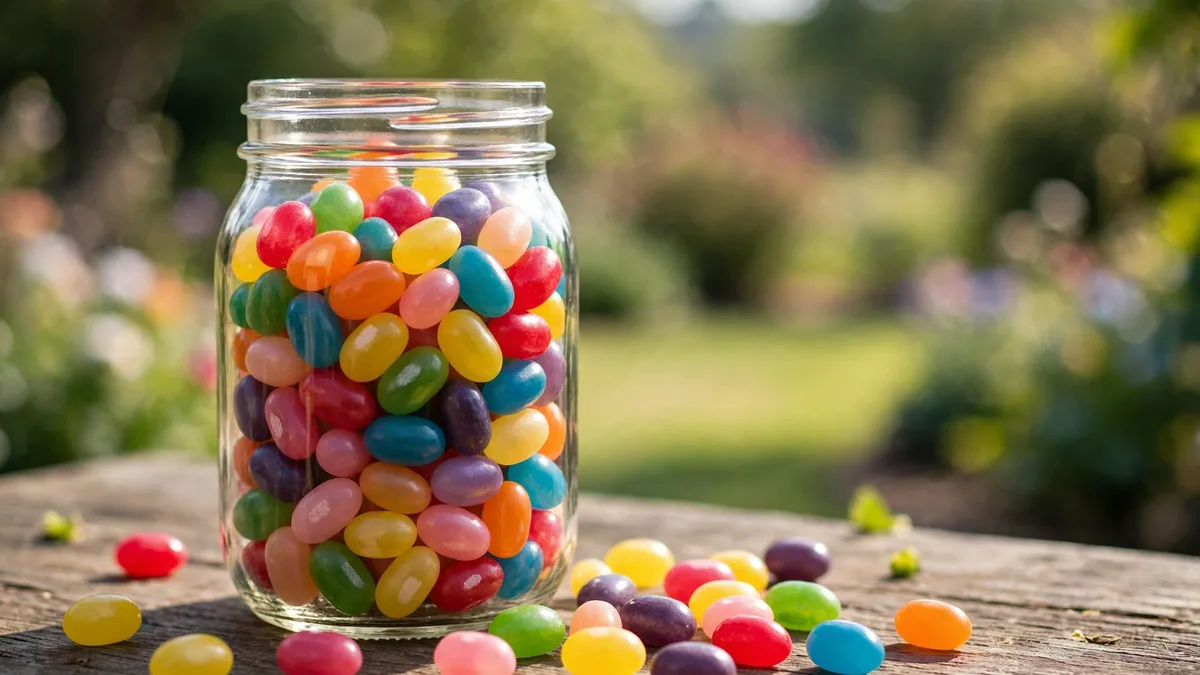

Jelly beans are small, bean-shaped sweets with a crisp sugar shell and a soft, chewy centre, and they are one of the most recognisable sweets in the world, sold by the jar, by the bag and by the handful. In short, they are made by building up layers of sugar syrup around a soft centre in a revolving pan, a process that takes days. They are simple sweets, made from sugar, starch, flavourings and colours, yet the flavours now run from cherry and lemon to buttered popcorn and liquorice.
This guide traces where jelly beans came from, how they are made, what the main types are, which flavours people reach for first, and how to store them so they stay fresh. Panning is industrial work, done in factories with revolving copper pans.
Key takeaways
- Jelly beans have a soft, chewy centre and a crisp sugar shell, built up layer by layer.
- They were first advertised in the United States in the nineteenth century, and became an Easter sweet in the twentieth.
- They are made by panning: centres are tumbled in revolving pans while sugar syrup is added in thin coats.
- The shell is polished with a food-grade glaze, which gives jelly beans their shine.
- Flavours range from classic fruit, such as cherry and lemon, to gourmet flavours such as buttered popcorn.
- Stored in a cool, dry, airtight container, jelly beans keep for months.
Where jelly beans came from
The exact origin of the jelly bean is uncertain, which is fitting for a sweet that has been copied, renamed and reinvented so often. It is usually traced to the United States in the nineteenth century, and the first known mention in print dates to 1861, when a Boston confectioner advertised jelly beans for soldiers serving in the Civil War. The sweet is thought to descend from Turkish delight, which gave it the chewy centre, and the Jordan almond, which gave it the idea of a hard, shiny shell.
By the early twentieth century, jelly beans were a familiar sight in American sweet shops, sold loose by weight and eaten by the handful. Their Easter association grew in the 1930s, when they began to appear in Easter baskets, helped by their egg-like shape and bright spring colours. Easter remains the biggest season for jelly beans in the United States. President Ronald Reagan was famously fond of Jelly Belly jelly beans, with jars of them on his desk in the White House, while Harry Truman was also known to enjoy them.
How jelly beans are made
Making jelly beans starts with the centre. A mixture of sugar, corn syrup, corn starch and water is cooked and flavoured, then poured into corn starch moulds, where it sets into the bean shape. The centres are left to firm up overnight, then removed from the starch and brushed clean. At this stage they are soft, pale and sticky.
The next stage is panning, and it is what gives the jelly bean its shell. The centres are placed in large revolving pans, and as the pans turn, thin sugar syrup is sprayed over them, coating each bean in a fine layer. The beans are dried, and another layer is added, and the process is repeated many times over several days. Colour and flavour go into the later coats, so the flavour sits in the shell as well as the centre. Finally, the beans are polished with a food-grade glaze, often beeswax or shellac, for their smooth shine. A batch can take a week or more from start to finish.

The rise of gourmet jelly beans
For most of their history, jelly beans came in a handful of fruit flavours and were a cheap, everyday sweet. That changed in 1976, when the Jelly Belly brand was launched in the United States by David Klein, who sold jelly beans in individual flavours that tasted like real foods rather than generic fruit. The early range included cherry, lemon, orange and liquorice, sold in small bags priced well above ordinary jelly beans.
The idea caught on, and the flavour range grew rapidly. Buttered popcorn became one of the best-known flavours, followed by toasted marshmallow, cinnamon, bubble gum, watermelon and green apple. Other makers followed, and the gourmet jelly bean became a category of its own, sold in gift boxes and mixed assortments. One best-known novelty range is BeanBoozled, in which identical-looking beans carry either a pleasant flavour or an unpleasant one.
Flavours, colours and what they mean
The classic jelly bean flavours are fruit: cherry, strawberry, lemon, lime, orange and grape, with the colour of the shell giving a clue to the flavour inside. Red usually means cherry or strawberry, yellow means lemon, green means lime or apple, orange means orange, and purple means grape. Liquorice, in black, and cinnamon, in a deep red, are the two traditional non-fruit flavours, and both have loyal followings. The flavour is in both parts: the shell gives the first taste, and the centre carries it through as the bean is chewed.
Gourmet makers have pushed the range far beyond fruit. Buttered popcorn, toasted marshmallow, chocolate pudding, coconut, mango, watermelon, bubble gum and root beer are all established flavours, with seasonal ranges adding candy corn for autumn and peppermint for winter. Some makers produce unusual flavours, including jalapeño and draft beer, although those are novelties. A mixed bag is the easiest way to find which flavours you like.
Are jelly beans vegan, and what is in them?
The ingredients of jelly beans are simple, but they are not the same for every maker, so the label is the only reliable guide. The usual ingredients are sugar, corn syrup, modified food starch, flavourings, colours and a glazing agent. The glaze matters most to people who avoid animal products, because it is often shellac, from insects, or beeswax, from bees, and neither is vegan. Some makers use a plant-based glaze, and some beans are labelled vegan, but many are not.
Gelatine is another ingredient to check. Some jelly bean centres are made with gelatine, which is an animal product, while others are made with starch alone and are gelatine-free. People with allergies should also check the label, because jelly beans are often made where nuts, milk, wheat and soy are handled. Nutritionally, jelly beans are almost entirely sugar and starch, so they are best treated as an occasional sweet rather than a snack. A small handful is a reasonable serving, best followed by brushing or rinsing.
| Type | Centre | Flavours |
|---|---|---|
| Classic jelly beans | Starch and sugar jelly | Fruit, liquorice and cinnamon |
| Gourmet jelly beans | Starch and sugar jelly | Buttered popcorn, toasted marshmallow, mango |
| BeanBoozled and novelty beans | Starch and sugar jelly | Pleasant and unpleasant pairs |
| Sugar-free jelly beans | Starch with sugar substitutes | Fruit flavours, no sugar |
| Spiced jelly beans | Starch and sugar jelly | Cinnamon, clove and peppermint |
How to store jelly beans
Jelly beans keep well, but they do not like heat, moisture or air. Stored in a cool, dry place in an airtight container, they stay fresh for months, and an unopened bag can keep even longer. Once a bag is opened, transfer the beans to a jar with a tight lid, because air makes the shells go soft and sticky, and moisture can make them clump. Keep them away from sunlight, radiators and cookers, since heat can melt the glaze and make the beans stick together.
If jelly beans have gone hard, they have usually dried out, and if they have gone sticky, they have usually absorbed moisture; in both cases they are still safe to eat if they are within their date, but the texture will not be at its best. A jar in a cool cupboard is the best home for them, and a small scoop is better than pouring straight from the jar, which can introduce moisture. For Easter baskets and party bowls, fill the container shortly before it is needed, so the beans stay glossy and separate.
A checklist for buying jelly beans
- Check the flavour list, and buy single-flavour bags for flavours you like.
- Look for beans that are glossy, firm on the outside and evenly coloured.
- Read the ingredients if you are vegan or have allergies, and check the glaze and gelatine.
- Check the best-before date, and avoid bags where beans look dull, sticky or clumped.
- Store opened beans in an airtight jar in a cool, dry cupboard.
- Keep to a small handful, and rinse or brush your teeth afterwards.
- Try a mixed bag first if you are new to a brand.
- For parties, fill bowls shortly before guests arrive.
Frequently asked questions
What are jelly beans made of?
Jelly beans are made from sugar, corn syrup, modified food starch, flavourings, colours and a glazing agent. The centre is a soft jelly of sugar and starch, and the crisp shell is built up from thin layers of sugar syrup in a revolving pan. The final polish comes from a food-grade glaze, often beeswax or shellac. Some makers use gelatine in the centre, and some use a plant-based glaze, so the label is the best guide to any particular brand.
When were jelly beans invented?
The first mention in print dates to 1861, when a Boston confectioner advertised jelly beans among sweets he was sending to soldiers in the Civil War. They are thought to descend from Turkish delight and the Jordan almond, which gave them the chewy centre and the hard shell. They became a familiar American sweet in the early twentieth century and an Easter sweet in the 1930s.
How long does it take to make jelly beans?
A batch can take a week or more. The centres are made first and left to firm up, then tumbled in revolving pans while thin layers of syrup are added, dried and added again over several days. Colour and flavour go into the later coats, and the beans are polished at the end with a food-grade glaze.
Are jelly beans vegan?
Many are not vegan, because the glaze is often shellac, from insects, or beeswax, from bees, and some centres are made with gelatine. Some makers use a plant-based glaze and starch-only centre, and those beans are labelled vegan. If you avoid animal products, check the ingredients on the bag.
How long do jelly beans last?
In a cool, dry, airtight container, jelly beans keep for months, and an unopened bag can keep even longer. Once opened, they are best kept in a jar with a tight lid, away from heat, sunlight and moisture. Beans that have gone hard have dried out, and beans that have gone sticky have absorbed moisture.
Why are jelly beans associated with Easter?
Jelly beans began to appear in Easter baskets in the 1930s, helped by their egg-like shape and bright spring colours. Easter is now the biggest season for jelly beans in the United States. Jelly beans were not invented for Easter, but their shape and colours made them a natural fit.
The bottom line
Jelly beans are a small sweet with a long history, from a Boston advertisement in 1861 to the gourmet ranges of today, and their appeal has always been the same: a crisp shell, a soft centre and a flavour in two parts. The making is slow work, layer upon layer of sugar syrup in a revolving pan, and that patience gives the finished bean its shine. Whether you buy a classic fruit mix or buttered popcorn, keep them cool, dry and airtight, and enjoy them a handful at a time. For more on food and drink, read our guide to the food lorry, our guide to grape must, and our guide to Cabernet grapes.