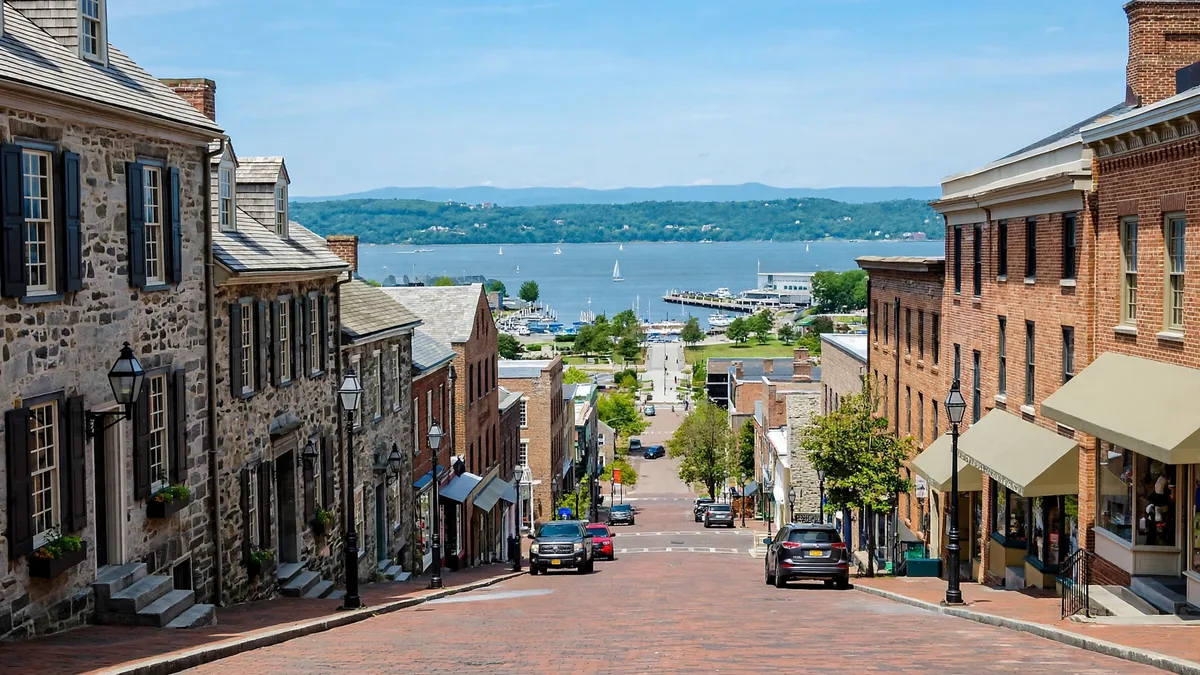

Kingston NY is a small historic city on the west bank of the Hudson River, about halfway between New York City and Albany, and it was the first capital of New York State. Kingston NY rewards a slow visit: stone houses from the Dutch colonial era stand a short drive from a working waterfront, and the whole city can be explored comfortably in a day or two. The short answer to the question behind this guide is that Kingston is worth visiting for its history, its riverside setting and its compact, walkable neighbourhoods.
The city sits in Ulster County, in the Hudson Valley. It grew up in two distinct parts, the Stockade District on the hill and the Rondout waterfront down by the creek, and those two areas still give Kingston its character today. Between them lies a midtown stretch of shops, restaurants and galleries, so a visitor can move from seventeenth-century stonework to a riverside cafe in a matter of minutes.
Key takeaways
- Kingston NY was the first capital of New York State, and its Senate House is where the first state senate met in 1777.
- The city has two historic hearts: the Stockade District uptown and the Rondout waterfront on Rondout Creek.
- Kingston sits on the west bank of the Hudson River in Ulster County, with the Catskills across the water.
- Highlights include the Senate House, the Hudson River Maritime Museum, the Stockade District and Forsyth Nature Center.
- The city is compact and walkable in parts, but a car makes it much easier to move between its districts.
- Spring, summer and autumn are the most rewarding seasons to visit, when the waterfront and outdoor spaces are at their best.
A short history of Kingston
Kingston began as a Dutch settlement in the middle of the seventeenth century, when the area was part of the colony of New Netherland. The Dutch built a stockaded village they called Wiltwyck, and several stone houses from that era still stand in the streets around the Stockade District today. The English took over the colony in the 1660s, the settlement’s name changed to Kingston, and the town grew as a trading and farming centre on the Hudson.
Kingston’s most famous moment came during the American Revolution. In 1777, the year the first New York State constitution was adopted, Kingston became the state’s first capital, and the first state senate met in the stone house now known as the Senate House. Later that same year, British troops burned much of the town, and the capital moved elsewhere, first to Hurley and then to Albany. The stone houses that survived the fire are among the reasons Kingston feels so old, and they are a large part of what visitors come to see. You can read the full account in the Wikipedia history of Kingston, New York.
In the nineteenth century, Kingston found a second life on the water. Rondout, at the mouth of Rondout Creek, became a busy port and the eastern end of the Delaware and Hudson Canal, which carried coal from Pennsylvania to the Hudson. The canal closed in the early twentieth century, the port declined, and for decades the waterfront was quiet. In recent years the Rondout has come back to life with restaurants, galleries, museums and a marina, and it is now one of the most pleasant places in the city to spend an afternoon.
The three neighbourhoods to know
Uptown Kingston is the Stockade District, a grid of streets around Wall Street, North Front Street and John Street, where stone houses from the 1600s and 1700s sit beside later brick buildings. This is the oldest part of the city and the best place to feel its history. The Senate House State Historic Site is here, along with the Old Dutch Church, the Ulster County courthouse and a cluster of small museums, shops and cafes. Walking the Stockade is easy, and the streets reward a slow pace, because the details are in the stonework, the doorways and the small plaques on the older houses.
Downtown Kingston is the Rondout, the waterfront district at the foot of Broadway, where Rondout Creek meets the Hudson River. Here the atmosphere is quite different: former warehouses and canal-era buildings now hold restaurants, bars, galleries and shops, and the streets run down to a promenade along the creek. The Hudson River Maritime Museum stands here, telling the story of the river’s steamboats, tugboats and barges, and a small fleet of historic vessels is usually moored nearby. On a fine day the Rondout is the place to sit outside with a coffee and watch the boats.

Things to do in Kingston
Start in the Stockade District, where a morning can easily be spent between the Senate House, the Old Dutch Church and the streets of stone houses. The Senate House site includes the house itself and a museum, and it gives the clearest sense of Kingston’s role in 1777. From there, the Old Dutch Church, built in the early nineteenth century on the site of an earlier church, is worth a look for its architecture and its graveyard, where some of the city’s earliest families are buried.
Then head down to the Rondout for the afternoon. The Hudson River Maritime Museum is the anchor attraction, with exhibits on the river’s working history and on the steamboats that once connected Kingston to New York City and Albany. Outside, the museum’s dock is home to historic vessels, and river cruises run in the warmer months. The streets around the museum are lined with places to eat and drink, and the walk along the creek is one of the city’s simple pleasures, especially in the late afternoon when the light falls across the water.
For a change of pace, Forsyth Nature Center, on Lucas Avenue, is a small park and wildlife centre with animals, gardens and walking paths, and it is a good stop for families. If you plan to do a lot of walking between districts, bring a reusable water bottle, because the hills between the Rondout and the Stockade are steeper than they look on a map.
Kingston’s districts compared
| District | What it is known for | Best for |
|---|---|---|
| Stockade District, Uptown | Seventeenth- and eighteenth-century stone houses, the Senate House and the Old Dutch Church | History, architecture and a slow morning walk |
| Rondout, Downtown | Canal-era waterfront, the Hudson River Maritime Museum, restaurants and the creek promenade | Waterfront views, museums and an evening meal |
| Midtown | Broadway shops, services, murals and creative businesses | Everyday life, galleries and lunch stops |
| Kingston Point | Parkland at the mouth of Rondout Creek, with river views and open space | A quiet walk and a picnic by the water |
Getting there and getting around
Kingston is reached by road on the New York State Thruway, Interstate 87, which runs along the east bank of the Hudson, and by the Kingston-Rhinecliff Bridge, which crosses the river just north of the city. Drivers coming from New York City take the Thruway north and cross the bridge, while drivers from Albany head south on the same road. The drive from New York City usually takes around two hours, depending on traffic, and the drive from Albany is roughly an hour.
There is no Amtrak station in Kingston itself. The nearest station is Rhinecliff, across the river on the east bank, served by Amtrak trains running between New York City and Albany. From Rhinecliff, a taxi or a ride across the Kingston-Rhinecliff Bridge brings you into the city in a few minutes, so rail is a realistic option for visitors without a car. Bus services also connect Kingston with nearby towns, but they are limited, and most visitors find a car the easiest way to move between the Stockade, Midtown and the Rondout, which are spread out along the hill.
When to visit Kingston
Kingston is a year-round city, but the seasons change it a great deal. Spring brings the Hudson Valley back to life, with blossom, farmers markets and the first river cruises, and it is one of the best times to walk the Stockade without the summer crowds; see our guide to the best places to visit in spring. Summer is the busiest season on the Rondout, when the restaurants fill their outdoor tables, the museums are in full swing and the river is at its most inviting. Autumn is the season many regular visitors prefer, because the Hudson Valley’s foliage is famous, the air is cooler and the light over the river is at its best.
A checklist for visiting Kingston
Use this checklist when you plan a day or a weekend in Kingston, so that you see both of the city’s historic districts and leave time for the river.
- Start in the Stockade District and allow a full morning for the Senate House, the Old Dutch Church and the stone-house streets.
- Walk or drive down to the Rondout in the afternoon for the Hudson River Maritime Museum and the creek promenade.
- Check the museum, trolley and river cruise seasons before you travel, since some run only in the warmer months.
- Wear comfortable shoes, because the hill between the Rondout and the Stockade is steep.
- Allow time for a meal in the Rondout, where many of the city’s best restaurants are gathered.
- Visit Kingston Point for river views and open space if the weather is fine.
- Consider combining Kingston with a drive into the Catskills or a stop in a neighbouring Hudson Valley town.
- Book accommodation early if you are visiting in autumn, when foliage season fills the valley’s hotels.
Frequently asked questions
Where is Kingston NY?
Kingston NY is a city in Ulster County, New York, on the west bank of the Hudson River, roughly halfway between New York City and Albany. It is reached by the New York State Thruway and the Kingston-Rhinecliff Bridge.
What is Kingston NY known for?
Kingston is known as the first capital of New York State, a title it held in 1777, when the first state senate met in the Senate House. It is also known for its Stockade District of old stone houses and its Rondout waterfront on the Hudson River.
Is Kingston NY worth visiting?
Yes, for most visitors it is. Kingston packs colonial history, a working waterfront, museums, restaurants and river views into a small city. It works well as a day trip from New York City or Albany, or as an overnight stop on a Hudson Valley tour.
How many days do you need in Kingston?
One full day is enough to see the Stockade District, the Rondout waterfront and the main museums at a comfortable pace. Two days allow a slower visit, with time for Kingston Point and a drive into the Catskills.
What is the Rondout in Kingston?
The Rondout is Kingston’s waterfront district, at the mouth of Rondout Creek where it meets the Hudson River. It was the city’s port and the eastern end of the Delaware and Hudson Canal, and today it holds the Hudson River Maritime Museum, restaurants and a marina.
Can you visit Kingston without a car?
You can, but it takes more planning. Amtrak serves Rhinecliff station across the river, and taxis cross the Kingston-Rhinecliff Bridge into the city. Once there, each district is walkable, but moving between them without a car means a steep walk or a taxi.
The bottom line
Kingston NY is a small city with an outsized history: the first capital of New York State, a Dutch colonial town of stone houses, a canal-era port and a Hudson River waterfront that has found new life. Visit for the Stockade District in the morning and the Rondout in the afternoon, allow time for the river, and you will have seen the best of it. If you enjoy historic places and wide-open landscapes, our guide to Saguaro National Park is a good next read.