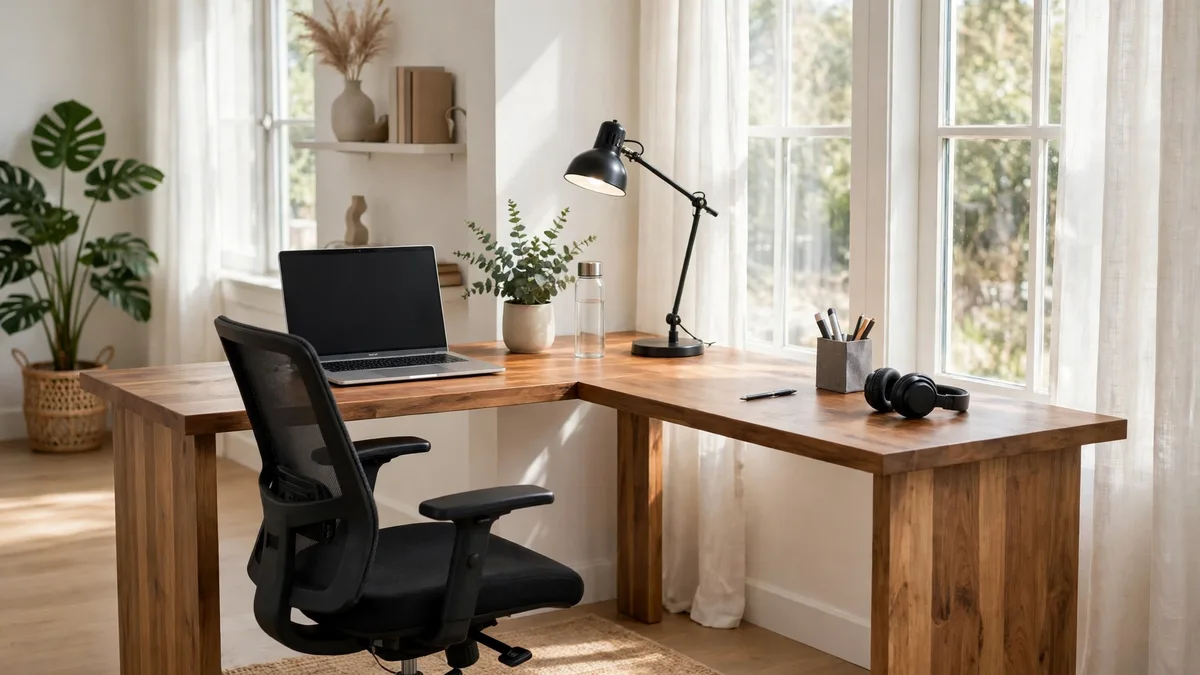

An L-shaped desk is a desk with two work surfaces joined at a right angle, so that it fits into a corner and gives you a main workspace plus a return. An L-shaped desk is the simplest way to gain a second surface without taking over a whole room, and it suits anyone who works with two screens, spreads out papers, or shares a desk with a second task. The short answer to the question behind this guide is that the right L-shaped desk is the one that fits your corner, leaves room for your chair, and puts your screen, keyboard and papers within easy reach.
The design is popular in home offices because it uses space that is otherwise wasted. A corner is often the hardest part of a room to furnish, and an L-shaped desk turns it into the most useful part. The longer run usually holds the computer, while the shorter return holds a printer, notebooks or a second monitor.
Key takeaways
- An L-shaped desk has two surfaces at a right angle, with a main run and a shorter return.
- It fits corners well and gives more usable surface than a straight desk of the same footprint.
- Measure the corner, the doorways and the chair space before you order anything.
- Standard desk height is around 73 to 76 centimetres, and depth is usually 50 to 60 centimetres.
- Reversible desks let you choose whether the return sits on the left or the right.
- Choose materials for durability and cleaning, not just looks, especially if the desk will be used every day.
What an L-shaped desk is, and when it works best
The L shape comes from two rectangular desktops joined at a corner, forming a right angle. Some models are a single piece, moulded or cut into the L shape, while others are two separate desks pushed together, or a main desk with a return unit that bolts on..
An L-shaped desk works best when you need more surface than a straight desk can offer and you have a corner to spare. It suits people who work with a monitor and a laptop side by side, who need space for reference books or paperwork next to a keyboard, or who want a dedicated spot for a printer or a second screen. It also suits rooms where the desk must share space with other furniture, because the corner placement keeps the middle of the room clear.
It works less well in very small rooms, where the return can block a door or a walkway, and in rooms where the only free corner is dark or far from a power socket. If your work is mostly a laptop on a table for an hour a day, a smaller straight desk may serve you better.
How to measure your space
Start by measuring the corner itself. An L-shaped desk is described by the length of each run, measured along the wall. A common size is 150 centimetres on the long run and 120 centimetres on the short run, but sizes vary widely. Measure both walls, and note where the skirting boards, radiators and power sockets sit.
Then measure the space in front of the desk. You need room for your chair to slide back, and for you to stand up and walk away without squeezing past furniture. A clearance of around 90 centimetres behind the chair is a good guide. Check the door swing too, because a return close to a door can stop it opening fully.
Finally, measure the height you need. Standard desk height is around 73 to 76 centimetres, which suits most adults when paired with an adjustable chair, but it is worth checking against your own body. When you sit at the desk, your elbows should rest at roughly the height of the keyboard, and your feet should rest flat on the floor. If you are taller or shorter than average, an adjustable-height desk, or a desk with adjustable feet, is worth considering, because a desk that is the wrong height will cause discomfort over a working day.

Sizes, shapes and layouts
L-shaped desks come in several layouts, and the differences matter more than they first appear. A symmetrical L has two runs of similar length, which suits a corner where both walls are free and you want equal space on each side. An asymmetrical L has one long run and one short return, which is the most common layout, and it suits most home offices, because the long run holds the main work and the short return holds the extras.
Some desks have a return on the left and some on the right, and many are reversible, meaning the return can be fitted on either side. Reversible desks are the safest choice if you are unsure about your layout, or if you may move the desk to another corner later. Corner desks with a curved or angled front are another option: they give a little more legroom at the join and a smoother look, but they can waste a small amount of surface at the curve, and they are harder to push flat against a wall.
Depth matters as much as length. A depth of 50 centimetres is workable for a laptop, but a monitor, keyboard and papers need more room, and 60 centimetres is more comfortable for a main workstation. A return can be shallower, because it usually holds a printer or papers rather than a screen.
| Desk type | Typical size | Best for |
|---|---|---|
| Compact L-shaped desk | 120 by 90 centimetres | Small rooms and laptop-only work |
| Standard L-shaped desk | 150 by 120 centimetres | A home office with a monitor and papers |
| Large L-shaped desk | 180 by 150 centimetres | Two screens, a printer and spread-out work |
| Standing L-shaped desk | 150 by 120 centimetres, height adjustable | People who want to alternate sitting and standing |
| Modular L-shaped desk | Two desks joined at a right angle | Rooms with narrow doorways and changing layouts |
Materials and build quality
Most L-shaped desks are made from one of four materials, and each has trade-offs. Laminate over chipboard or medium-density fibreboard is the most common and the most affordable. It comes in many finishes, it resists stains and it is easy to wipe clean, but it can chip at the edges and it does not cope well with water damage. Solid wood is the most attractive and the most durable, and it can be sanded and refinished, but it is heavy and expensive, and it needs more care. If you choose wood, our guide on how to polish wood furniture will help you keep the surface in good condition.
Metal-framed desks with a wooden or laminate top are a popular middle ground. The steel frame makes the desk sturdy and stable, which matters for an L-shaped desk, because the long runs can flex if the frame is weak. Glass tops look light and modern, but they show every mark, they need frequent cleaning, and they are a poor choice if you have young children or you rest heavy equipment on the desk. Whatever the material, check the weight rating, look at how the legs and the corner joint are made, and read the assembly instructions before you buy, because a desk that wobbles at the corner will annoy you every day.
Setting up your L-shaped desk
Place the main run where the light is best, ideally with a window to the side rather than directly behind or in front of the screen. Light from behind causes glare on the screen, and light from the front shines into your eyes. The return should hold the things you reach for less often, such as a printer, reference books or a charging station, so that the main run stays clear for the work in front of you.
Put your monitor at arm’s length, with the top of the screen at or just below eye level, and keep the keyboard and mouse close enough that your elbows stay near your body. If you use a laptop as your main screen, a separate keyboard and a laptop stand will help you sit more upright, and a monitor arm can free up surface space. The Health and Safety Executive’s guidance on display screen equipment sets out the same principles for a comfortable workstation, and it is worth reading before you settle your layout.
A checklist for choosing an L-shaped desk
Work through this checklist before you buy, and you will avoid the most common disappointments.
- Measure both walls of the corner, including skirting boards, radiators and sockets.
- Mark the desk footprint on the floor with tape and check the walking space around it.
- Leave around 90 centimetres behind the chair for sliding back and standing up.
- Check that the desk fits through your doorways, hallways and stairwell.
- Confirm whether the return is on the left or the right, or whether the desk is reversible.
- Choose a depth of at least 60 centimetres for the main run if you use a monitor.
- Check the weight rating, the frame and the corner joint for stability.
- Look for cable management, such as a tray or a cable hole.
- Test the desk height against your chair, and consider an adjustable model if you are taller or shorter than average.
- Keep the receipt and the assembly instructions until the desk is built and tested.
Frequently asked questions
What is an L-shaped desk?
An L-shaped desk is a desk with two work surfaces joined at a right angle, forming the shape of the letter L. The longer run is the main workspace, usually holding the computer, and the shorter run, called the return, holds a printer, papers or a second screen. It is designed to fit into a corner.
How much space do you need for an L-shaped desk?
You need the length of both runs along the walls, plus around 90 centimetres of clear space in front of the desk for your chair to slide back. Measure your corner and mark the footprint with tape before you buy.
Are L-shaped desks good for home offices?
Yes, for most home offices they are a good choice, because they give more surface than a straight desk without taking over the room. They suit people who use two screens or spread out papers, but they are less suited to very small rooms.
Which side should the return be on?
The return should be on the side that suits your corner and your working habits. The shape of your room matters more than handedness. If you are unsure, choose a reversible desk, which lets you fit the return on either side.
Can an L-shaped desk fit in a small room?
Yes, compact models of around 120 by 90 centimetres are made for small rooms. Measure carefully and mark the footprint on the floor first. If the desk leaves no room to walk past or to pull the chair out, it is too big.
What is the standard height of an L-shaped desk?
Most L-shaped desks are around 73 to 76 centimetres high, which suits most adults when paired with an adjustable chair. If you are much taller or shorter than average, look for a desk with adjustable feet or a height-adjustable model.
The bottom line
An L-shaped desk is a practical answer to a common problem: how to get more working surface without giving up the room. Measure your corner, check the handedness, choose a depth of at least 60 centimetres for the main run, and pick a frame sturdy enough to stay steady at the join. Get those four things right, and the desk will serve you well for years. For the room around it, see our guide to how to clean cork flooring and our notes on heat damage on a MacBook Pro screen.