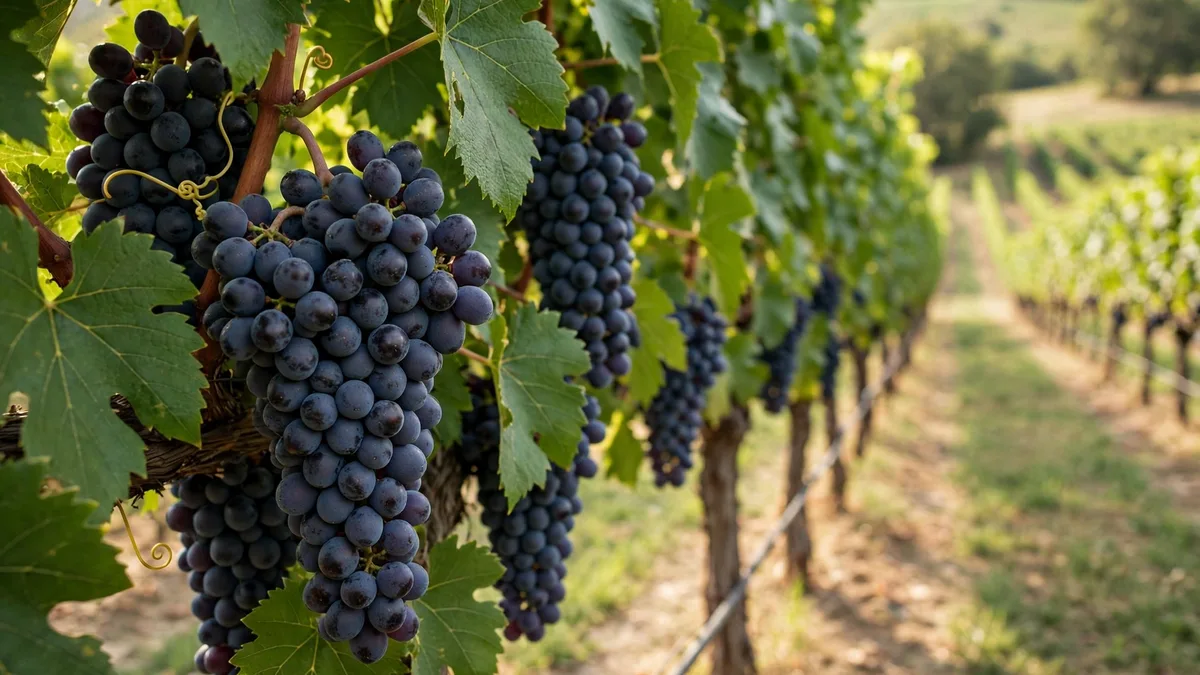

The grape Cabernet is Cabernet Sauvignon, the world’s most widely planted red wine grape and the variety behind the great red wines of Bordeaux. It is a small, thick-skinned black grape that makes deep-coloured, full-bodied wines with firm tannin and a signature flavour of blackcurrant, often with notes of cedar and green pepper. This guide explains where the grape came from, what it tastes like, where it grows best and how to choose a bottle made from it.
Cabernet Sauvignon is not an ancient variety, even though it feels like one. DNA research at the University of California, Davis, published in 1997, showed that it is the offspring of a natural crossing between Cabernet Franc, a red grape, and Sauvignon Blanc, a white grape, which happened in the vineyards of south-west France in the seventeenth century. From that accidental beginning, it spread to every serious wine region on Earth, and it is now grown on five continents.
Key takeaways
- The grape Cabernet is Cabernet Sauvignon, the world’s most widely planted red wine grape.
- It is a natural seventeenth-century crossing of Cabernet Franc and Sauvignon Blanc, confirmed by DNA research in 1997.
- Its berries are small and thick-skinned, giving deep colour, firm tannin and long ageing potential.
- Classic flavours are blackcurrant, black cherry, cedar, tobacco and, in cooler climates, green pepper.
- Its home is Bordeaux’s Left Bank, but it also thrives in Napa Valley, Chile, Australia and South Africa.
- In Bordeaux it is almost always blended, usually with Merlot and Cabernet Franc, while elsewhere it is often bottled alone.
Where the grape Cabernet comes from
Cabernet Sauvignon was born in Bordeaux, in the south-west of France, where its two parents were already growing side by side. Cabernet Franc gave it dark fruit and herbal notes, Sauvignon Blanc gave it acidity and tension, and the crossing itself gave it something neither parent had in the same measure: thick skins, packed with tannin and colour. For centuries, nobody knew this parentage, and theories credited the grape to Roman or Spanish origins. The DNA work of John Bowers and Carole Meredith at UC Davis settled the question in 1997.
The grape’s rise was tied to the gravel soils of the Médoc, the peninsula north of Bordeaux city, where the Left Bank communes of Pauillac, Margaux, Saint-Julien and Saint-Estèphe lie. Gravel drains well and holds the day’s heat, which helps a late-ripening grape finish in a cool maritime climate. By the middle of the nineteenth century, Cabernet Sauvignon was the most important variety on the Left Bank, and the great classified estates of Bordeaux were built on it. From there, cuttings travelled the world, and the grape became the benchmark red variety almost everywhere wine is made.

What Cabernet Sauvignon tastes like
A young Cabernet Sauvignon is usually dry, full-bodied and deeply coloured, with firm tannins that can feel gripping on the tongue. The classic fruit flavours are blackcurrant, also called cassis, black cherry and plum, often with herbal notes of green bell pepper or mint, and hints of graphite. The green pepper character comes from a compound called pyrazine, and it is strongest in cooler climates or in grapes that were picked before they were fully ripe. In warmer regions, the fruit turns riper and darker, with blackberry and jammy notes taking over.
With age, the best examples change in the glass. The fruit softens and the tannins mellow, and new flavours appear: cedar, tobacco, leather, cigar box, dried herbs and forest floor. Oak ageing adds its own notes, including vanilla and spice, which is why many Cabernet Sauvignons spend a year or more in barrel. A good bottle can develop for decades, and the finest Bordeaux from great vintages are among the longest-lived red wines in the world, although most bottles on a shop shelf are made to be drunk within a few years.
Where the grape grows
Bordeaux’s Left Bank remains the spiritual home of the grape, where it is the dominant variety in blends built for structure and age. A typical Pauillac may contain 60 to 80 per cent Cabernet Sauvignon, with Merlot adding roundness, Cabernet Franc adding aroma and Petit Verdot adding colour and spice. Across the Atlantic, Napa Valley in California makes a riper, more powerful style, with generous black fruit and new oak, and its best wines are among the most sought-after in the world.
Further afield, the grape shows different faces. In Chile’s Maipo Valley it makes structured, cassis-driven wines at good value; in Australia’s Coonawarra, with its red terra rossa soil, it makes minty, elegant wines; and in South Africa’s Stellenbosch it makes savoury, full-bodied reds. The variety also grows in Tuscany, where it is used in the wines known as Super Tuscans, and in many other regions besides. Its ability to keep its character while expressing each place is a large part of why it spread so far. You can read more in the Wikipedia entry on Cabernet Sauvignon.
| Grape | Body and tannin | Typical flavours | Ageing |
|---|---|---|---|
| Cabernet Sauvignon | Full-bodied, high tannin | Blackcurrant, cedar, green pepper | Often 10 to 30 years for top wines |
| Merlot | Medium to full, softer tannin | Plum, cherry, chocolate | Usually 5 to 15 years |
| Pinot Noir | Light to medium, silky tannin | Red cherry, raspberry, earth | Usually 5 to 15 years |
| Syrah | Full-bodied, firm tannin | Blackberry, black pepper, smoke | Often 10 to 20 years |
How Cabernet Sauvignon is made
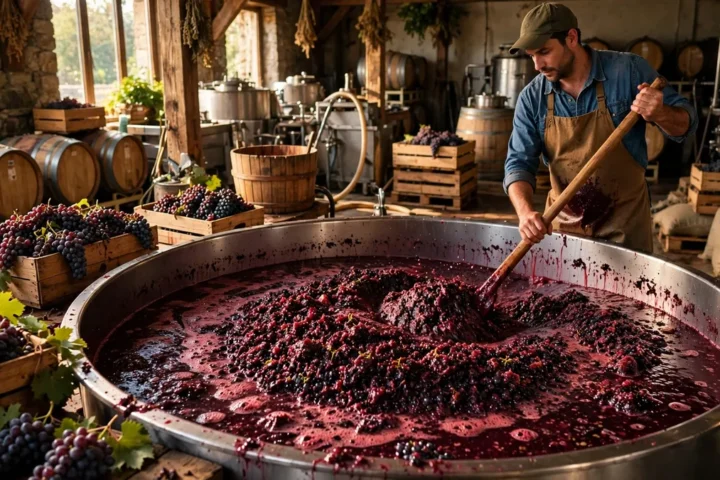
The grape’s thick skins shape everything in the winery. Because colour, tannin and flavour compounds live in the skin, Cabernet Sauvignon wines are fermented in contact with their skins, and the longer that contact lasts, the deeper and more structured the wine becomes. Some winemakers hold the crushed grapes cold for a few days before fermentation, a step called cold soaking, to draw out colour and aroma before any alcohol is made. During fermentation, the skins rise to the surface and form a cap, which must be pushed back down or pumped over regularly to keep it wet and extract flavour evenly.
After fermentation, the wine is drained from the skins and pressed, and the best wines then go into oak barrels, often French oak and often new, for a year or more. Oak softens the tannin, adds vanilla and spice, and lets the wine breathe slowly. In Bordeaux, the finished wine is a blend of varieties and often of vineyard parcels, assembled by tasting. Elsewhere, the wine may be bottled as a single variety, which lets the character of Cabernet Sauvignon speak without support from its blending partners.
Food to serve with Cabernet Sauvignon
Cabernet Sauvignon’s firm tannin and full body make it a natural partner for rich food. The classic match is red meat: a grilled ribeye steak, roast lamb with rosemary, or a slow-cooked beef stew all give the tannin something to work against, and the fat in the meat softens the wine’s grip. Hard aged cheeses, such as an aged cheddar or a firm Comté, work in the same way, and mushroom dishes, especially those with a dark, savoury sauce, suit the wine’s earthy side.
There are matches to avoid as well. Delicate fish and lightly dressed salads will be overwhelmed by a full-bodied Cabernet, and very spicy food can clash with the tannin and alcohol, making the wine taste bitter. Serve the wine at around 16 to 18 degrees, a little below room temperature, and give a young bottle time in a decanter, an hour or so, so it can open up. An older bottle needs gentler handling, since its sediment should be left in the bottle and its aromas fade faster once poured.
A checklist for buying your first Cabernet Sauvignon
Use this checklist when you are choosing a bottle, whether it is your first or your fiftieth.
- Decide on a budget first, and ask the shop for the best Cabernet at that price rather than reaching for a familiar label.
- Look for the region on the label: Bordeaux, Napa Valley, Maipo, Coonawarra and Stellenbosch are reliable starting points.
- Check the vintage, and remember that a good producer in a modest year often beats a weak producer in a great year.
- Read the back label for the blend: a Bordeaux will list several grapes, while a New World bottle may be pure Cabernet Sauvignon.
- Think about food: buy a fuller, riper style for steak, and a more restrained one for lamb or hard cheese.
- Plan to decant a young bottle for about an hour before serving.
- Store the bottle on its side in a cool, dark place if you plan to keep it rather than drink it soon.
- Keep a note of what you liked, so the next bottle can build on it.
Frequently asked questions
What does Cabernet Sauvignon taste like?
It is a dry, full-bodied red wine with firm tannins and flavours of blackcurrant, black cherry and plum, often with cedar, tobacco and graphite. In cooler climates you may notice green pepper or mint, while warmer regions give riper blackberry fruit. With age, the flavours turn towards leather, cigar box, dried herbs and forest floor.
Where does Cabernet Sauvignon come from?
It comes from Bordeaux in south-west France, where it arose as a natural seventeenth-century crossing of Cabernet Franc and Sauvignon Blanc. Its parentage was confirmed by DNA research at the University of California, Davis, in 1997. It is now the world’s most widely planted red wine grape, grown on five continents.
Why is Cabernet Sauvignon so tannic?
The grape has small berries with thick skins, and tannin lives mainly in the skins. That gives a high skin-to-juice ratio, so the wine picks up a great deal of tannin and colour during fermentation on the skins. The tannin is also why the wine can age for so long: it acts as a preservative, and it softens slowly over years in bottle.
Is Cabernet Sauvignon always blended?
Not always, but in Bordeaux it almost always is. On the Left Bank it is blended with Merlot, Cabernet Franc and Petit Verdot, which round out its structure and add aroma and colour. In Napa Valley, Chile, Australia and South Africa, it is often bottled on its own as a single variety, although blending is common there too.
How long can Cabernet Sauvignon age?
The finest examples, especially from top Bordeaux estates, can develop for 30 years or more, and some for 50. Most bottles are made to be drunk much sooner, within a few years of release, and they will not improve with long cellaring. If you are unsure, check the producer’s guidance or ask the shop, and store any bottle you keep on its side in a cool, dark place.
What food goes with Cabernet Sauvignon?
Rich, savoury food suits it best: grilled steak, roast lamb, slow-cooked beef and hard aged cheeses such as aged cheddar. The fat and protein in these foods soften the wine’s firm tannin. Avoid delicate fish and very spicy dishes, which the wine can overwhelm or clash with. Serve at around 16 to 18 degrees, and decant a young bottle for about an hour.
The bottom line
The grape Cabernet is Cabernet Sauvignon, a seventeenth-century accident of nature that became the world’s most planted red wine grape. Its small, thick-skinned berries give deep colour, firm tannin and a blackcurrant character that can age for decades, and it expresses itself differently in every region it reaches, from the gravel of Bordeaux to the valleys of Napa and Chile. Start with a bottle from a region you like, pair it with something rich, and give it time to open up. For more on wine, read our guide to the best inexpensive wines, our article on the best wineries in Napa, and our guide to the best white wine for cooking.
Please drink responsibly: if you drink alcohol, do so in moderation and never drink and drive.