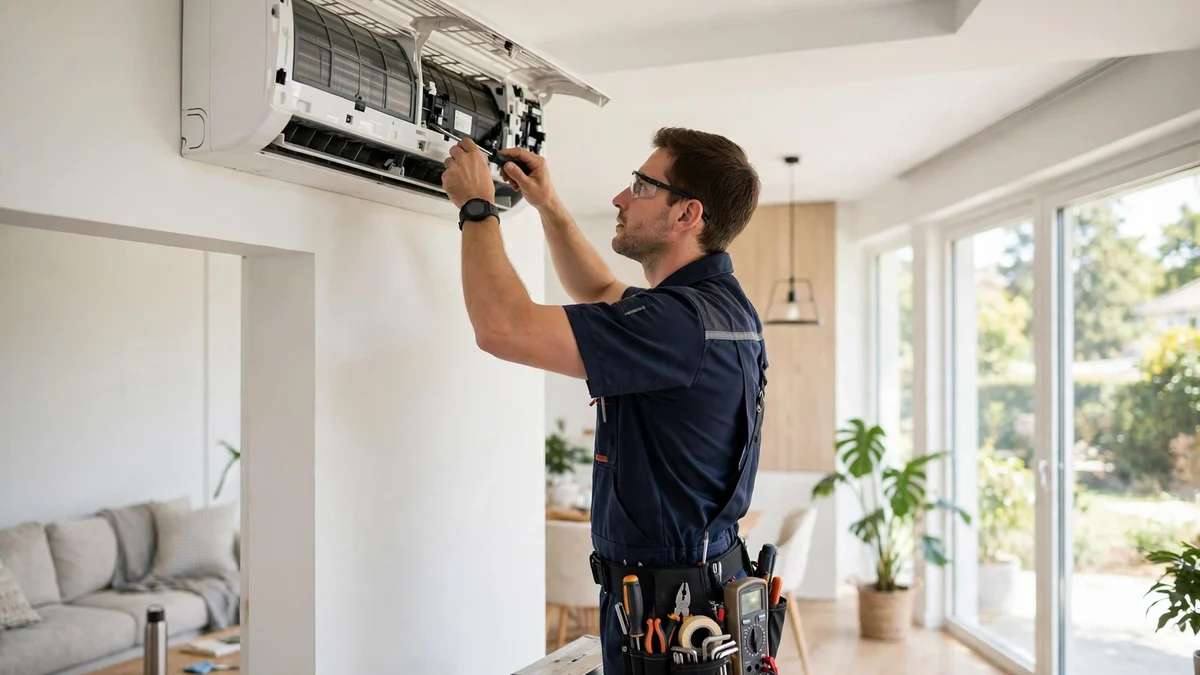

Air conditioning repair services fix faults in cooling systems, restore comfort to a home, and keep the equipment running safely and efficiently. The central question is straightforward: when your air conditioning stops cooling properly, makes an odd noise or leaks water, what should you do, and how do you find a repair service you can trust? The short answer is to switch the system off if anything seems unsafe, note the symptoms, and call a qualified engineer who can diagnose the fault before quoting for the work. This guide explains what these services cover, how a repair visit works, and how to choose the right one.
Most homes with air conditioning rely on it heavily in warm weather, which is exactly when faults tend to appear. A system that worked well all winter can struggle on the first hot day of the year, and a small fault left alone can turn into a larger one. Understanding the basics helps you describe the problem clearly and tell the difference between a simple fix and a job that needs a professional.
Key takeaways
- Repair services diagnose faults, fix them and test the system afterwards.
- Common faults include refrigerant leaks, electrical problems, blocked drains and worn fans.
- Switch the system off if you smell burning, hear loud banging or see sparking.
- Choose an engineer with proper qualifications, clear pricing and a written quote.
- Regular servicing prevents many of the faults that lead to emergency call-outs.
- Cost depends on the fault, the parts needed, the age of the system and access.
What air conditioning repair services cover
A repair service covers the whole cooling system, from the indoor unit on the wall to the outdoor condenser and the pipework between them. The engineer starts by finding the fault, which is often the hardest part of the job. A system that blows warm air might have a refrigerant leak, a failed compressor, a faulty sensor or a blocked filter, and each of those needs a different fix. Proper diagnosis matters, because replacing a part without finding the cause usually means the fault returns.
Refrigerant work is one of the most common reasons to call a professional. Refrigerant is the fluid that carries heat out of your home, and if it leaks, the system cannot cool properly. Topping it up without finding the leak is a short-term fix at best, so a good engineer will trace the leak, repair it and then recharge the system to the correct level. Refrigerant is a controlled substance in many countries, which is one reason this work should never be attempted at home.
Electrical faults are another frequent cause of breakdowns. Capacitors, contactors, circuit boards and wiring can all fail, especially after a power cut or a storm. A qualified engineer can test these parts safely and replace the failed one. Fan motors, drain pumps and condensate pipes round out the usual list: a blocked drain can cause water to drip inside the house, while a worn fan motor can make the unit noisy or stop the air moving altogether.
Signs your system needs repair
The clearest sign is warm air. If the unit runs but the room does not cool, something is wrong, and the longer it runs in that state, the more strain it puts on the compressor. Weak airflow is another warning: it can mean a clogged filter, a failing fan or ice building up on the coils. A filter is easy to check yourself, and cleaning it may solve the problem, but if airflow stays weak after cleaning, call an engineer.
Unusual noises deserve attention too. A gentle hum is normal, but grinding, squealing or loud banging usually means a mechanical part is failing. Water where it should not be is another sign: a small amount of condensation outside is normal, but water dripping from the indoor unit or pooling on the floor means a blocked drain or a cracked tray. A sudden rise in energy use, without any change in how you use the system, can also point to a fault, since a struggling system works harder for less cooling.
Smells are worth noting as well. A musty smell often means mould or bacteria in the drain pan or on the coils, which a service can clean. A burning smell is more serious and means the system should be switched off straight away. If you are unsure whether a symptom is serious, describe it to the repair service when you call; a good company will tell you honestly whether it needs an urgent visit.
How a repair visit usually works
| Stage | What happens | What you can do |
|---|---|---|
| Booking | You describe the symptoms and agree a time | Note the model, the symptoms and when they started |
| Inspection | The engineer checks the indoor and outdoor units | Clear access to both units before the visit |
| Diagnosis | Tests identify the faulty part or leak | Ask what was found and what caused it |
| Quote | You receive a written price for the repair | Ask what is included and whether parts are guaranteed |
| Repair | The faulty part is replaced or repaired | Keep children and pets out of the work area |
| Testing | The system is run and checked for cooling | Check the room cools and no warning lights show |

How to choose a repair service
Start with qualifications. Air conditioning work involves electricity and refrigerant, so the engineer should hold the relevant certifications for your country and be able to show them. In Britain, for example, engineers who handle refrigerant should hold an F-Gas certificate, and electrical work should be carried out by someone competent to do it. Ask about qualifications before booking, and be wary of any company that cannot answer the question.
Reputation is the next check. Look for reviews from real customers, and pay attention to comments about punctuality, clear pricing and whether the repair lasted. A company that has been trading locally for several years is usually a safer choice than one with no track record. Ask friends or neighbours for recommendations too, since a personal referral often tells you more than a dozen online reviews. The Wikipedia page on air conditioning gives a useful overview of how these systems work, which can help you follow what the engineer tells you.
Clear pricing matters as much as skill. A good service will explain its call-out charge, give a written quote before starting work, and tell you what happens if the first repair does not solve the problem. Ask whether parts and labour are guaranteed, and for how long. A written guarantee is a sign of a company that stands behind its work. Homeowners who look after other household systems face the same choices, and our guide to heat pump repair covers similar ground for a closely related system.
What affects the cost of a repair
The biggest factor is the nature of the fault. A blocked drain or a dirty filter is usually a quick job, while a failed compressor or a leaking coil takes longer and needs a more expensive part. The age of the system matters too: parts for older models can be harder to find, and an engineer may need more time to work on a unit that has not been serviced for years. Access also plays a part, since a unit mounted high on a wall or in a tight loft space takes longer to reach safely.
Timing can affect the cost as well. An emergency call-out on a hot weekend will usually cost more than a scheduled weekday visit, which is one reason to book a service before the warm season starts. The number of units matters too: a home with several indoor units will take longer to check than a home with one. For a larger job, it is sensible to get a second opinion, especially if the first engineer suggests replacing the whole system. If other household systems need attention at the same time, our guides to water heater installation and septic system repair explain how to approach those jobs in the same careful way.
A checklist before you call a repair service
- Write down the symptoms: warm air, weak airflow, noise, water, smells or error codes.
- Note the make and model of the indoor and outdoor units.
- Check and clean the filters, and see whether that improves the airflow.
- Clear access to both units so the engineer can work safely.
- Switch the system off if you smell burning, hear loud banging or see sparking.
- Ask about qualifications, call-out charges and written quotes before booking.
- Check reviews and ask neighbours for a personal recommendation.
- Book a routine service before the warm season to prevent emergency call-outs.
Frequently asked questions
How do I know if my air conditioning needs repair or just a service?
A service is routine maintenance: cleaning, checking and testing a system that is working. A repair is needed when something has actually gone wrong, such as warm air, water leaks, loud noises or a system that will not start. If cleaning the filters does not help, or if the problem appeared suddenly, it is usually a repair job rather than a service.
Can I fix an air conditioner myself?
You can safely clean or replace filters, clear leaves from around the outdoor unit, and check that the remote and power supply are working. Anything involving refrigerant, wiring or opening the unit should be left to a qualified engineer, because it carries a risk of electric shock and can damage the system.
How long does an air conditioning repair usually take?
Simple jobs such as clearing a blocked drain or replacing a capacitor often take an hour or two. More involved work, such as finding and repairing a refrigerant leak, can take longer, and may need a follow-up visit if a part has to be ordered. The engineer should be able to give you a time estimate once the fault has been diagnosed.
Why does my air conditioner keep freezing up?
Freezing usually means restricted airflow or low refrigerant. A dirty filter is the most common cause, so clean it first. If the problem returns, the refrigerant level may be low because of a leak, or the fan may not be moving enough air. Switch the system off to let the ice melt, and call an engineer rather than running it while frozen.
Should I repair or replace an old air conditioner?
That depends on the age of the system, the cost of the repair and how often it breaks down. A single repair on a system that has otherwise been reliable is usually worth doing. If breakdowns keep happening, parts are hard to find, or the system is very old, replacement may work out better over time.
How often should air conditioning be serviced?
Most manufacturers and engineers recommend a professional service once a year, ideally before the warm season. Regular servicing keeps the system efficient, catches small faults early, and can extend the life of the equipment. Between services, clean the filters regularly and keep the outdoor unit clear of leaves and debris.
The bottom line
Air conditioning repair services exist to diagnose faults, fix them properly and test the system afterwards, so that your home stays cool and the equipment lasts. Describe the symptoms clearly, choose a qualified engineer with clear pricing and a written quote, and do not leave small faults to grow into large ones. Regular servicing is the simplest way to avoid emergency call-outs.
Safety note: never open an air conditioning unit, work on its wiring, or handle refrigerant yourself. Electrical parts can carry a dangerous voltage even when the unit looks switched off, and refrigerant can cause cold burns and harm the environment if released. If you smell burning, see sparking or suspect a leak, switch the system off at the isolator and call a qualified engineer.