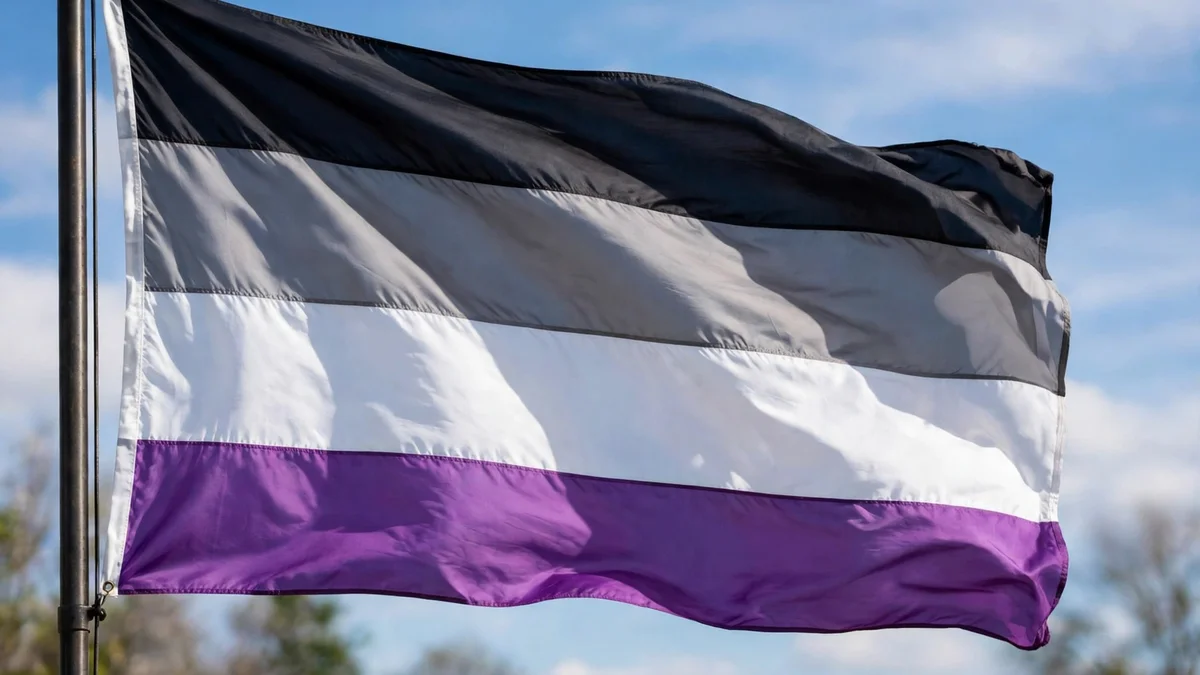

The asexual flag is the pride flag of the asexual community, and it is made of four horizontal stripes in black, grey, white and purple. It was created in 2010, when members of the Asexual Visibility and Education Network, known as AVEN, voted on a design to represent asexual people at Pride events and in everyday life. This guide explains what each stripe means, how the flag came to exist, and how it is used today.
Asexuality means experiencing little or no sexual attraction to other people. That is a matter of attraction, not of behaviour: many asexual people date, fall in love and marry. The flag gives that experience a visible symbol, in the same way that other pride flags do for other communities.
Key takeaways
- The asexual flag has four equal horizontal stripes: black, grey, white and purple, from top to bottom.
- It was created in 2010 by an AVEN member using the alias standup, and chosen by a community vote.
- The black stripe stands for asexuality, the grey stripe for grey-asexuality and demisexuality, the white stripe for allosexuality, and the purple stripe for community.
- The colours come from the AVEN triangle, an earlier symbol designed by AVEN founder David Jay.
- The final result of the vote was announced on 10 August 2010, with the winning design taking 41 per cent of the votes.
- The flag is now flown at Pride marches, displayed online, and used on badges, clothing and artwork around the world.
What does the asexual flag look like?
The asexual flag is a simple rectangle divided into four horizontal stripes of equal size. From the top, the stripes are black, grey, white and purple. There are no symbols, letters or emblems on it, and the design is deliberately plain so that it is easy to recognise at a distance, easy to draw, and easy to reproduce on flags, badges and clothing.
The simplicity is part of the point. Many pride flags use horizontal stripes, and the asexual flag was designed to sit naturally alongside them. The four colours are taken from the AVEN triangle, the symbol that represented asexuality before the flag existed. At a Pride march, the flag’s black top stripe makes it easy to pick out among many others.
What do the asexual flag colours mean?
Each stripe of the asexual flag has an accepted meaning, and together they describe the breadth of the asexual community. The black stripe represents asexuality itself, the grey stripe represents the experiences that sit between asexuality and allosexuality, the white stripe represents allosexuality, and the purple stripe represents the community as a whole.
Allosexuality is the term for experiencing sexual attraction, and it is the counterpart to asexuality. The white stripe is sometimes described instead as standing for non-asexual allies and partners, which amounts to a similar idea. The grey stripe covers grey-asexuality and demisexuality, identities in which sexual attraction is rare, weak, or felt only after a strong emotional bond has formed. The purple stripe is about belonging, and it is the colour most closely tied to AVEN and to the community’s shared identity.
| Stripe | Colour | What it represents |
|---|---|---|
| Top | Black | Asexuality, and the absence of sexual attraction |
| Second | Grey | Grey-asexuality and demisexuality, between asexuality and allosexuality |
| Third | White | Allosexuality, and non-asexual allies and partners |
| Bottom | Purple | The asexual community as a whole |
The table above is the standard reading of the flag, used by AVEN, by the Wikipedia page for the asexual flag, and by most community guides. The black and purple stripes are described the same way almost everywhere, which has helped the flag become a reliable shorthand for asexual identity.
How the asexual flag was created
Before 2010, asexual people had no flag of their own. The AVEN triangle was the main symbol, and a half-filled heart was also used, but both had problems. The triangle was closely tied to one website, and the half-filled heart suggested romantic attraction, which did not suit aromantic asexual people. In the summer of 2010, an AVEN member using the alias standup decided the community needed a flag of its own, and opened a forum for people to submit designs.
The process ran as a month-long competition with three separate rounds of voting. Designs were posted on the AVEN message boards, discussed, and voted on, and the final round was opened up beyond the forum to other asexual communities, including forums in languages other than English. The final results were announced on 10 August 2010 by a user called bristrek, and the winning design, the four stripes in black, grey, white and purple, took 41 per cent of the votes.
The winning design was standup’s own. It drew its colours directly from the AVEN triangle, keeping a link to the symbol people already knew. Within months it was being flown at Pride events and shared online, and it has remained the community’s flag ever since.
Where the colours came from
The colours of the asexual flag come from the AVEN triangle, which was designed by David Jay, the founder of AVEN. AVEN itself was founded in 2001, and it grew into the best-known community and resource for asexual people. Jay’s original triangle was a black-bordered white triangle with the bottom third filled in black. In 2004 Jay stepped back from that original model, describing it as too simple and too restrictive, and in 2005 the triangle was replaced by a gradient, to represent a spectrum rather than a single point.
The gradient triangle remained the main symbol of asexuality for several years, but it was still a website’s logo more than a community’s flag. The half-filled heart that some people used instead had its own difficulty, since a heart implies romantic feeling, and many asexual people are aromantic as well. The flag solved both problems at once: it belonged to the whole community rather than to a single site, and it made no claim about romance at all.
The asexual spectrum in brief
Asexuality is best understood as a spectrum rather than a single fixed experience. At one end are people who never experience sexual attraction. In the middle are grey-asexual people, who experience it rarely or weakly, and demisexual people, who experience it only after forming a strong emotional bond with someone. The flag’s grey stripe is there for those middle experiences, and it is an important part of what the flag communicates: asexuality is not one identical experience shared by everyone who uses the word.
It also helps to separate asexuality from aromanticism, although the two often overlap. Asexuality is about sexual attraction, while aromanticism is about romantic attraction, and a person can be one, the other, or both. Another symbol worth knowing is the black ring, which some asexual people wear on the middle finger of their right hand as a quiet sign of identity. Meeting new people is easier when a shared symbol does some of the talking first, and our guide on where to meet people has practical advice for anyone looking for community, whether online or in person.

How the flag is used today
The asexual flag is now flown at Pride marches around the world, often alongside the rainbow flag and other pride flags. Asexual people took part in their first Pride parade entry in 2009, at the San Francisco Pride Parade, a year before the flag was adopted, and the flag has been part of those marches ever since.
Online, the flag is used as a profile picture, a banner image, and a small badge next to a username, and its four colours are used as a colour scheme for artwork, websites and merchandise. It is also common at community gatherings away from Pride, including picnics and social meet-ups, where a flag on a table marks a friendly space. If you are planning an outdoor gathering of your own, our best picnic recipes will help with the food, and our guide to the best water bottle will help you stay hydrated on a long day outdoors.
A checklist for using the asexual flag respectfully
- Learn the stripe order before you fly or display the flag: black, grey, white and purple from the top.
- Use the correct meanings when you explain it: black for asexuality, grey for grey-asexuality and demisexuality, white for allosexuality, purple for community.
- Remember that asexuality is a spectrum, and do not assume every asexual person has the same experience.
- Do not treat the flag as a statement about romance: asexuality is about sexual attraction, not romantic attraction.
- Ask before photographing someone holding the flag at a small or local event, since not everyone is open about their identity.
- Do not use the flag to advertise a product or service without a genuine link to the community.
- Pair the flag with accurate language, and correct yourself kindly if you get a term wrong.
- Respect that some asexual people choose not to use the flag at all, and that choice is part of the community too.
Frequently asked questions
What do the colours of the asexual flag mean?
From top to bottom, the black stripe stands for asexuality, the grey stripe stands for grey-asexuality and demisexuality, the white stripe stands for allosexuality, and the purple stripe stands for the community as a whole. The white stripe is sometimes described as standing for non-asexual allies and partners instead.
When was the asexual flag created?
The asexual flag was created in 2010. An AVEN member using the alias standup opened a forum for design submissions on 30 June 2010, and the community voted through three rounds. The final results were announced on 10 August 2010, and the winning design took 41 per cent of the votes.
Who designed the asexual flag?
The flag was designed by an AVEN member using the alias standup, who also organised the competition that chose it. Its colours come from the AVEN triangle, an earlier symbol designed by David Jay, the founder of AVEN.
Is the asexual flag the same as the aromantic flag?
No, they are two different flags for two different things. The asexual flag is about sexual attraction, and it has black, grey, white and purple stripes. The aromantic flag is about romantic attraction, and it is a separate design. A person can be asexual, aromantic, or both, and some people fly both flags together.
What is the difference between asexuality and celibacy?
Asexuality is about attraction: an asexual person experiences little or no sexual attraction to other people. Celibacy is about behaviour: a celibate person chooses not to have sex, whatever their attractions may be. An asexual person may or may not have sex, and a celibate person may or may not be asexual.
Where can I buy an asexual flag?
Asexual flags are sold by many general flag sellers and by community shops, in sizes from small hand flags to large banners, and they also appear on badges, clothing and stickers. When buying, check that the stripe order is black, grey, white and purple from the top.
The bottom line
The asexual flag is four equal stripes in black, grey, white and purple, chosen by the asexual community in a vote held on AVEN in the summer of 2010. Its colours come from the earlier AVEN triangle, and each stripe has a meaning: black for asexuality, grey for grey-asexuality and demisexuality, white for allosexuality, and purple for the community. In the years since 2010 it has become the most widely recognised symbol of asexual identity in the world.