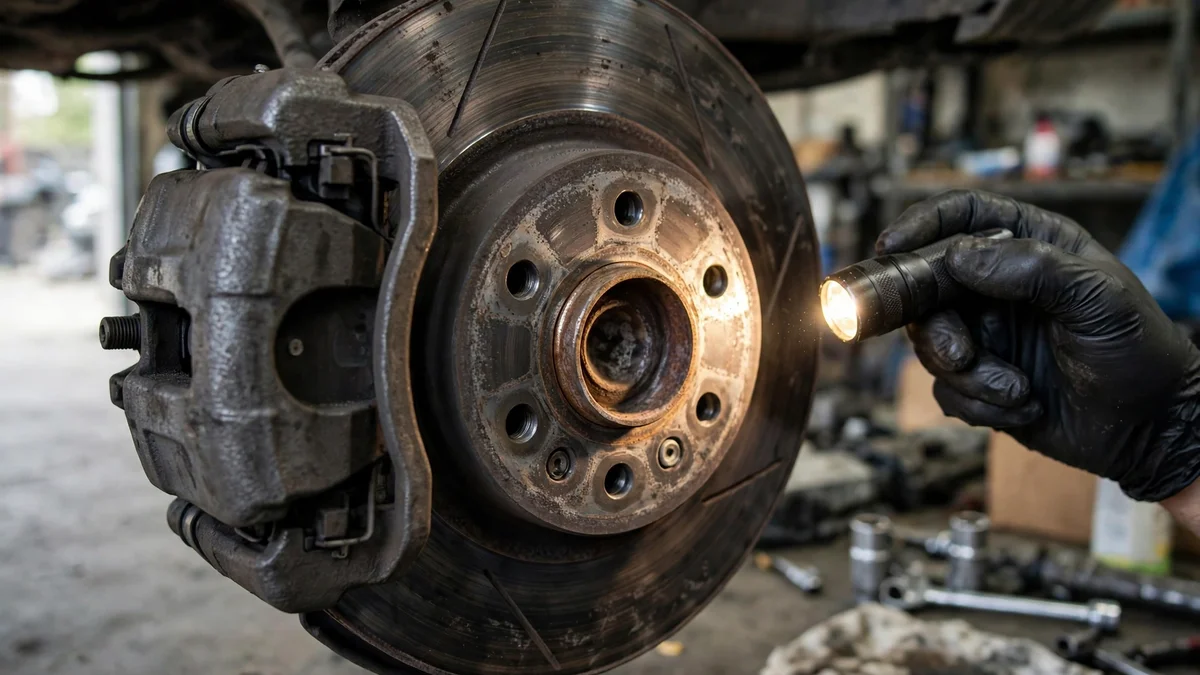

Brake disc warping is the first thing most drivers blame when the steering wheel shakes under braking, but the disc has very rarely bent at all. In most cases the judder comes from something else: friction material from the pads laid down in patches on the disc, so the disc is a fraction thicker in some places than in others. This guide explains what really causes the shake, how to tell pad deposits from real damage, and what fixes it.
Key takeaways
- Brake discs very rarely warp: judder is most often caused by uneven pad deposits.
- Patchy deposits create disc thickness variation, which you feel as a pulsing pedal or shaking wheel.
- Skipped bedding-in and holding the brakes on a hot disc are common ways deposits form.
- Blue spots, a visible pad outline or scoring on the disc face point to the cause.
- A workshop can measure thickness variation and run-out to confirm the diagnosis.
- Light deposits can sometimes be cleared by re-bedding; worn or cracked discs need replacing.
The warped disc myth
The phrase has been in use for decades, in racing and on the road alike. A driver reports a vibration under braking, the discs are checked for cracks and none are found, and the fault is put down to a disc that has warped in the heat. The discs are then resurfaced, the shake goes away, and a few weeks later it comes back, which is taken as proof that the disc warped again. The cycle has gone on for so long that few people stop to ask whether the diagnosis was right in the first place.
Race engineer Carroll Smith spent more than forty years in professional racing, including work on the Ford GT40 programme, and he wrote that he had never seen a warped brake disc in all that time. What he did see, case after case, was friction pad material transferred unevenly to the surface of the disc. Cast iron discs are tough, and they can crack, cone slightly when hot, or wear thin, but a disc bending like a potato crisp under normal braking heat is not what the evidence shows. The Wikipedia page on disc brakes sets out how the parts work together. So when a road car judders, the useful question is not whether the disc has warped, but what has made its thickness uneven.
What usually causes the judder
The main culprit is the pad itself. Modern pads stop the car in two ways at once: part of the braking comes from abrasive friction, where pad and disc wear against each other, and part comes from adherent friction, where a thin, even layer of pad material transfers onto the disc and the pad then grips that layer. When the layer is even, braking is smooth. When it is patchy, the disc is effectively thicker where the patches sit, and the pads ride up and down over them once every turn of the wheel. That once-per-turn rise and fall is the judder you feel.
Patches form in a few familiar ways. New pads that never get a proper bedding-in period can lay the layer down unevenly from the start. Holding the brakes on after a hard stop, with a hot pad pressed against one spot on a hot disc, can leave a clear imprint of the pad on the disc face. A sticking calliper can drag one pad against the disc and overheat a patch of it, and corrosion can do similar damage where a car has sat unused. On top of that, a disc with run-out, a slight wobble as it turns, can wear unevenly over time and grow into thickness variation of its own. Heat makes all of this worse: hard spots and blue patches on the disc face are signs that part of the disc has run far hotter than the rest.
Symptoms and what they mean
Judder is not one symptom but several, and the details matter. A shake in the steering wheel points to the front brakes, while a pulsing pedal can come from the front or the rear. Vibration that appears only when the brakes are hot and fades as they cool is different from a shake that is there from the first stop of the day. The table below matches the common symptoms to their usual causes, so you can narrow the fault down before a spanner comes out.
| Symptom | What it points to | What to check | Likely fix |
|---|---|---|---|
| Steering wheel shakes when braking | Uneven deposits on the front discs | Disc faces for blue spots or a pad outline | Re-bed pads, or resurface or replace discs |
| Brake pedal pulses under your foot | Thickness variation, front or rear | Thickness at several points round the disc | Resurface or replace discs and pads |
| Judder only after hard driving, fades as brakes cool | Hot spots and patchy deposits | Blue patches and hard spots on the disc | Re-bed, or replace if the spots stay |
| Squeal or grinding with the shake | Worn pads, scoring or rust | Pad thickness and the disc surface | Replace pads and discs as a pair |
| Shake all the time, braking or not | Wheel balance, tyres or worn suspension | Wheels, tyres and bearings | Balance wheels and check suspension parts |

How to diagnose it step by step
Start with a careful road test, in a safe place and at ordinary speeds. Note when the vibration appears: only under braking, or all the time? Through the steering wheel, the pedal, or the seat? At low speed, at motorway speed, or both? Judder that appears only when you brake, and grows with braking effort, points at the discs. A shake that is there with your foot off the pedal points elsewhere, usually at the wheels, tyres or suspension, and no amount of brake work will cure it.
Next, look at the discs with the wheels off, if you are comfortable doing so, or ask a workshop to. A healthy disc face is a fairly even grey with fine circular marks. Blue or dark patches mean local overheating. A clear outline of a pad on the face means material has transferred in one spot. Deep scoring, a heavy rust lip at the edge, or visible cracks are all signs the disc is past its best. A workshop can go further, measuring the disc for run-out with a dial gauge and checking its thickness at several points round the face with a micrometer, then comparing the readings with the maker’s limits. That measurement is what turns a guess into a diagnosis. While you are there, it is worth checking the basics too: the how to check car fluids guide covers the simple under-bonnet checks that go with any brake inspection, and a vehicle inspection will look at the callipers, hoses and suspension as well.
Fixes that work
Light, fresh deposits can sometimes be cleared by re-bedding the pads: a series of firm stops from moderate speed, with time between them for the brakes to cool, following the pad maker’s instructions. The idea is to lay down a fresh, even transfer layer over the patchy one. It costs nothing but a quiet stretch of road, and it is the first thing to try when the judder is mild and the discs look sound. If the shake stays, or the disc face shows deep blue spots and hard patches, re-bedding will not save it.
The next step is resurfacing, where a lathe skims a thin layer off each face of the disc to make it flat and even again. That only works if the disc is still thick enough after skimming, and it is a job for a workshop with the right kit. If the disc is scored, cracked, heavily corroded or worn close to its limit, replacement is the answer, and the pads should be replaced at the same time, since old pads carry the old deposits with them. The hub face and the wheel mating face should be cleaned before the new disc goes on, the calliper slides should move freely, and the wheel nuts should be tightened evenly and in sequence. New discs and pads then need a proper bedding-in, so the transfer layer forms evenly from the start. If you are buying rather than repairing, the used car guide explains what to check before you hand over any money, brakes included.
Your brake judder checklist
- Note exactly when the shake appears: only under braking, or all the time.
- Feel where it comes through: steering wheel, brake pedal, or the seat.
- Look at the disc faces for blue spots, a pad outline, scoring or cracks.
- Check the pads for wear and the callipers for sticking or seized slides.
- Have a workshop measure thickness variation and run-out before replacing parts.
- Try re-bedding first for mild judder on discs that still look sound.
- Replace discs and pads together if the disc is scored, cracked or worn thin.
- Bed new pads in properly, and get help promptly if the pedal feels spongy or the brakes grind.
Can a brake disc really warp?
Almost never in the way people picture it. Cast iron discs are stiff, and what feels like warping is nearly always uneven pad material on the disc face, which makes the disc thicker in patches. True bending of a disc is rare, and cracks, heat spots and wear are far more common forms of disc damage.
Why does my steering wheel shake when I brake?
Because the front discs are not the same thickness all the way round. As the thick patches pass between the pads, the pads are pushed apart and the vibration travels up through the steering. Uneven pad deposits are the most common cause, and thickness variation from wear is the next.
What are pad deposits?
Pad deposits are patches of friction material transferred from the brake pads onto the disc face. A thin, even layer is normal and helps the brakes work. When the layer is patchy, the disc measures thicker where the patches sit, and that uneven thickness causes judder.
Can I fix brake judder myself?
Sometimes. Mild judder on sound discs can clear up with a careful re-bedding, following the pad maker’s instructions. Anything involving new discs, resurfacing or calliper work is a workshop job, and brakes are safety-critical, so if you are unsure, leave it to a professional.
Should I replace the pads with the discs?
Yes, when the discs are replaced. Old pads carry the old deposits and the old wear pattern, and fitting them against a new or resurfaced disc can bring the judder straight back. New discs and new pads, bedded in together, give the even transfer layer the brakes need.
How do I stop it happening again?
Bed new pads in properly, avoid holding the brakes on hard after a heavy stop while the discs are still hot, and keep the callipers free and the car in regular use. Cars that sit for weeks can grow rust patches on the discs, so a short drive now and then helps keep the faces clean.
The bottom line
Brake disc warping is mostly a myth. The shake that drivers blame on a bent disc is usually uneven pad material on the disc face, making the disc thicker in patches and pushing the pads about once every turn. Check the symptoms, look at the disc faces, measure before you replace anything, and try re-bedding before you spend money. Get the diagnosis right, and the fix is often far simpler than a new set of discs.