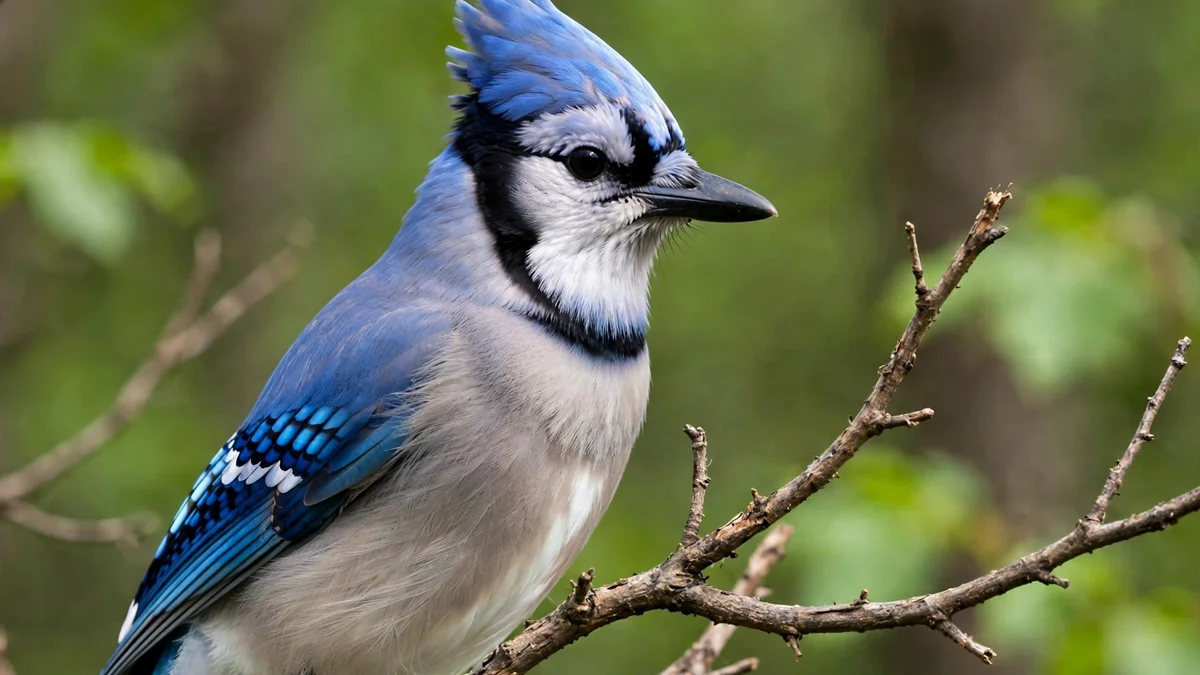

Blue jay vs Steller’s jay is one of the easier bird puzzles in North America, because the two birds barely share the same ground. The blue jay belongs to the east, the Steller’s jay to the west, and both are loud, crested members of the crow family with blue feathers and bold manners. Tell them apart by the head and the belly: a blue jay has a blue crest, a white face and a black necklace, while a Steller’s jay has a black head and crest with a deep blue body and no white at all.
Key takeaways
- The blue jay lives in eastern and central North America; the Steller’s jay lives in the west.
- A blue jay has a blue crest, a white face, a black necklace and a pale belly.
- A Steller’s jay has a black head and tall dark crest, with a deep blue body and no white belly.
- The Steller’s jay is the bigger bird, at 30 to 34 centimetres against the blue jay’s 25 to 30.
- Blue jays call a loud jay-jay and mimic hawks; Steller’s jays give a harsher shook-shook-shook.
- Where the two ranges meet along the eastern Rockies, the birds sometimes interbreed.
The two jays at a glance
Both birds are jays, which means they belong to the crow family, and both carry a crest they can raise or lower. They are the only two North American jays with a prominent crest, which is why they get mixed up in the first place. Put them side by side, though, and the difference is plain: one is a pale-bellied bird with black-and-white markings, and the other is a dark-headed bird in solid blue and black. The table below sets out the main contrasts in one place.
| Feature | Blue jay | Steller’s jay | Telling clue |
|---|---|---|---|
| Range | Eastern and central North America | Western North America | Where you are settles most cases |
| Size | 25 to 30 cm, 70 to 100 g | 30 to 34 cm, 100 to 140 g | The Steller’s jay looks chunkier |
| Head and crest | Blue crest, white face | Black head, tall dark crest | Black hood means Steller’s jay |
| Underparts | White to pale grey belly | Deep blue chest and belly | White belly means blue jay |
| Wings and tail | Black barring, white patches | Blue with little white | White wing bars mean blue jay |
| Voice | Loud jay-jay, whistles | Harsh shook-shook-shook | The call gives it away by ear |
| Habitat | Deciduous woods, suburbs | Conifer forests, mountains | Evergreen slopes point west |

Range: east against west
Range is the single most useful clue, and for most people it settles the question on its own. Blue jays live across eastern and central North America, from the Atlantic coast to the Great Plains and into southern Canada. They are common in towns, parks, woodlots and forest edges, and they turn up at garden feeders all through the year. East of the Mississippi, a crested blue jay is a blue jay, and there is no need to look further.
Steller’s jays live in the west, from Alaska and western Canada through the Rockies and along the Pacific coast, south into Mexico and Central America. They are birds of coniferous and mixed forest, mountain slopes, parks and campgrounds, and they are just as bold around people as their eastern cousins. West of the Rockies, a crested blue jay is a Steller’s jay. The two ranges meet only in a narrow band along the eastern Rockies, and it is there, and only there, that a birder has to work at the identification.
Looks: crest, face and belly
The head tells the story. A blue jay has a bright blue crest, a white face, and a black marking that runs across the throat like a necklace and up behind the eyes. Its underparts are white to pale grey, and its wings and tail carry bold black barring with white patches, including white corners on the tail that flash in flight. The Wikipedia page on the blue jay describes these marks in full. There is a neat trick to the blue itself: the feathers hold no blue pigment, and the colour comes from the way light scatters inside the feather structure.
A Steller’s jay is a darker bird from the front. Its head, neck and tall triangular crest are charcoal black, and the deep blue of the body runs across the chest and belly with no white break. The wings and tail are blue with far less white than a blue jay shows, and some birds have pale blue streaks on the forehead. The crest is the tallest of any North American jay, and it often sweeps forward, giving the bird a sharp, angular profile. If the front half of the bird is blackish and there is no white on the wings, it is a Steller’s jay. If you see a white belly and a black necklace, it is a blue jay. The Steller’s jay takes its name from the naturalist Georg Wilhelm Steller, who first described it on an expedition to Alaska in the 1740s.
Voice: jay-jay against shook-shook
Both jays are noisy, and both are gifted mimics, so listening helps as much as looking. The blue jay is famous for its loud jay-jay call, a ringing note it repeats from a high perch, and it also gives whistles, gurgles and a soft whisper song of clicks and liquid notes. It is a keen mimic of hawks, above all the red-shouldered hawk, and a blue jay screaming like a hawk over a garden can clear every smaller bird from a feeder in seconds.
Steller’s jays are harsher. Their usual call is a repeated shook-shook-shook, lower and rougher than the blue jay’s cry, and they add guttural growls, rattles and creaks to the mix. They mimic hawks too, often the red-tailed hawk, and they use the trick the same way, to scatter other birds from food. The two voices are easy to tell apart once you have heard both: the blue jay rings, the Steller’s jay rasps.
Habitat and habits
The two birds live in different kinds of woodland, which follows from their ranges. Blue jays favour deciduous and mixed woods, especially where oaks grow, because acorns are a staple food. They are at home in suburbs and parks, they visit feeders for peanuts and sunflower seeds, and they bury acorns by the thousand each autumn, hiding them in the ground and in tree bark for the winter. Many of the acorns they never come back for grow into oak seedlings, so blue jays quietly plant the woods they live in.
Steller’s jays favour evergreen forest: pines, firs and spruces on mountain slopes, and the mixed woods of the Pacific coast. They eat seeds, nuts, berries, insects and the occasional egg, and they cache food just as blue jays do, tucking it away in bark and on the ground. They are curious and quick to investigate anything new, from a picnic table to a campsite, and they are regulars at mountain feeders. Both species are intelligent, social and long-lived for songbirds, and both will mob owls and hawks without much fear. If you like watching bold wild birds up close, the fennec fox guide covers another clever animal that thrives around people, and the Saguaro National Park guide is a good starting point for a western wildlife trip.
Where they meet: the hybrid zone
The ranges of the two jays touch along the eastern side of the Rocky Mountains, in a band running through the foothills of the United States and Canada. There the birds meet, and they sometimes interbreed, producing hybrids that mix the field marks: a bird with a dark head but a pale belly, or a blue crest with a dusky face. These hybrids are uncommon, and they stay close to the contact zone, so a mixed-looking jay in Colorado or Montana is no surprise, while the same bird in Ohio or Oregon would be.
For a birder standing in the overlap zone, the safest approach is to note several marks at once rather than trusting one. Check the head colour, the belly, the wing pattern and the call, and let the weight of the evidence decide. A single odd mark can be a trick of the light or a young bird, but three or four pointing the same way are hard to argue with. Outside the overlap zone, geography does the work, and a single good look is usually enough.
Your two-jay identification checklist
- Start with where you are: east of the Great Plains points to blue jay, west of the Rockies to Steller’s jay.
- Look at the head: a blue crest and white face mean blue jay, a black head and crest mean Steller’s jay.
- Check the belly: white or pale grey is a blue jay, deep blue is a Steller’s jay.
- Look for the black necklace across the throat: it belongs to the blue jay only.
- Check the wings and tail: bold white patches and barring mean blue jay, mostly plain blue means Steller’s jay.
- Listen to the call: a ringing jay-jay is a blue jay, a harsh shook-shook-shook is a Steller’s jay.
- Note the habitat: deciduous woods and suburbs suit the blue jay, conifer forest and mountains suit the Steller’s jay.
- In the Rockies overlap zone, use several marks together, since hybrids mix the field marks.
Which jay is bigger?
The Steller’s jay is the bigger bird. It measures about 30 to 34 centimetres long and weighs 100 to 140 grams, while the blue jay measures 25 to 30 centimetres and weighs 70 to 100 grams. The Steller’s jay also looks chunkier, with a heavier body and a taller crest.
Do blue jays and Steller’s jays live in the same places?
Almost never. Blue jays live in eastern and central North America, and Steller’s jays live in the west. The two ranges meet only in a narrow band along the eastern Rockies, where the birds sometimes interbreed.
What is the easiest way to tell them apart?
Look at the head and the belly. A blue jay has a blue crest, a white face, a black necklace and a pale belly. A Steller’s jay has a black head and crest with a deep blue body and no white belly. Those two marks settle most identifications.
Are blue jays really blue?
Not in the way paint is blue. Blue jay feathers hold no blue pigment: the colour comes from light scattering inside the feather structure, so the bird can look brighter or duller as the light changes. Steller’s jays get their blue the same way.
Do both jays mimic hawks?
Yes. Blue jays often copy the red-shouldered hawk, and Steller’s jays often copy the red-tailed hawk. Both use the trick to startle other birds away from food, and both are convincing enough to fool people as well as birds.
Where is the best place to see a Steller’s jay?
In western conifer forests, mountain parks and campgrounds, from Alaska down the Pacific coast and through the Rockies. They are bold around picnic areas and feeders, so a quiet morning in a mountain park is often enough. For trip ideas, the best places to visit in spring guide covers the season when both jays are at their most active.
The bottom line
Blue jay vs Steller’s jay comes down to three things: where you are, the colour of the head, and the colour of the belly. East, blue crest, white belly: blue jay. West, black head, blue belly: Steller’s jay. Learn those marks, listen for the jay-jay against the shook-shook, and you will rarely be caught out, except in the narrow strip of the Rockies where the two birds meet and mix.