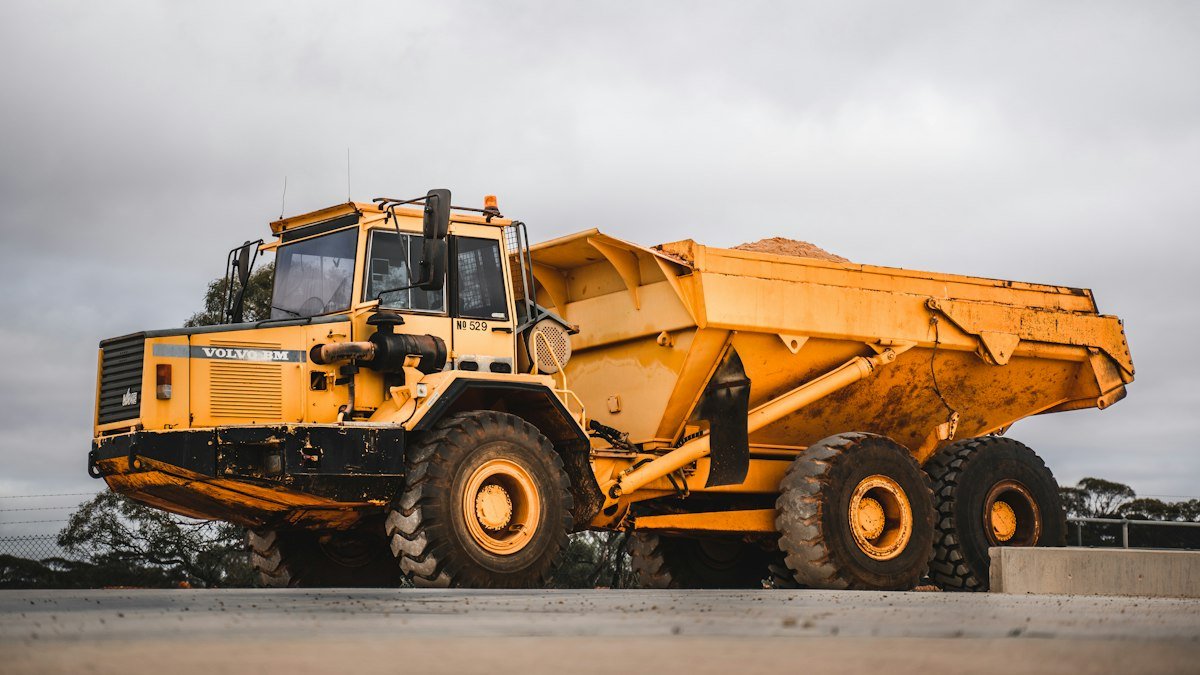
A dump truck is a heavy vehicle built to carry loose material, such as sand, gravel, soil or rubble, and tip it out exactly where it is needed. The open bed sits on a chassis behind the cab, and a hydraulic ram lifts the front of the bed so gravity slides the load out through the tailgate.
Dump trucks turn up on building sites, roadworks, quarries and farms, and the right type depends on the ground, the distance and the weight of the load. This guide explains how a dump truck works, the main types in use today, and what to ask before hiring or buying one.
Key takeaways
- A dump truck carries loose material in an open bed and unloads it by tipping the bed with hydraulics.
- Standard trucks suit short road hauls; articulated trucks suit soft, steep or muddy ground.
- Transfer trucks and side dumps move more material per trip on road and paving work.
- Off-highway rigid and mining trucks are not road legal and work only inside quarries and mines.
- Before hiring, match the truck to the load, the ground and the access to your site.
What is a dump truck and how does it work?
A dump truck is a lorry with an open-topped bed that can be raised at the front to tip its load out of the back. The bed, sometimes called the body or box, is mounted on the truck chassis and hinged at the rear. When the driver operates the controls, a hydraulic cylinder pushes the front of the bed upward, the tailgate opens, and the material slides out.
Most dump trucks unload from the rear, but some tip to the side and a few discharge through a gate in the floor. The hydraulic system runs off the truck engine through a power take-off, and the driver controls the lift from the cab. Once the bed is empty, the ram lowers it back onto the chassis and the tailgate is latched shut.
What makes a dump truck different from an ordinary lorry is that it is built for loading and unloading loose material quickly, again and again. The steel bed floor is strong enough to take a full bucket load dropped in by an excavator or a wheel loader.
Best for: moving loose material in bulk — sand, gravel, soil, rubble, asphalt and demolition waste — and dropping it where it is needed.
Standard dump trucks
The standard dump truck is the type most people picture: a rigid chassis with the cab at the front and a tipping bed behind it. It is the most common dump truck on public roads, and it is also the most manoeuvrable, which matters on tight urban sites and housing estates.
A standard truck typically carries between about 9 and 16 tonnes, depending on the number of axles and local weight limits. Two-axle models suit smaller jobs, while three-axle and four-axle versions, sometimes called tri-axle or super dump trucks, carry more and spread the weight across extra wheels. They are used for aggregate delivery, road repairs, house building and general construction.
Because the frame is rigid, a standard truck is happiest on firm, level ground. Soft mud and steep slopes are jobs for an articulated machine instead.
Best for: short road hauls and tight sites — aggregate delivery, urban construction and general building work.
Articulated dump trucks
An articulated dump truck, often shortened to ADT, is built in two parts: a tractor unit with the cab, and a separate trailer section carrying the bed. The two halves join at a hydraulic pivot, so the front and rear can twist independently over uneven ground.
The articulated design was pioneered by Volvo BM in the 1960s and became the standard machine for soft-ground earthmoving. An ADT typically carries between 25 and 45 tonnes, and its large tyres and all-wheel drive give it grip on mud, clay and steep slopes where a rigid truck would sink or slide.
Articulated trucks are off-highway machines. They work on large civil engineering sites, opencast mines and landfill projects, loaded by an excavator and driven a short distance to a tipping point. They are not built for long-distance hauling.
Best for: soft, steep or muddy ground — large earthmoving jobs, quarries and landfill work.
Transfer dump trucks
A transfer dump truck is a standard rigid truck that tows a separate trailer with its own dump box. The truck deposits the trailer, dumps its own load, then picks the trailer up again, or the trailer dumps independently, so one vehicle moves two loads in a single trip.
Transfer trucks typically carry between 15 and 25 tonnes in total, and they are popular on paving and aggregate work where material must be dropped at several points along a route. Because the trailer can be left behind, the truck can also work in tighter spaces than a full semi-trailer combination.
Best for: high-cycle aggregate runs and paving jobs that need several drops along one route.
Side dump and end dump trailers
Not every dump truck tips from the rear. A side dump trailer tilts its whole body to the left or right, dropping the load in a neat windrow beside the vehicle.
That makes it fast to unload and stable on uneven ground, because the truck never has to raise a tall bed in the air. Side dumps are common on road building and embankment work.
An end dump trailer is a semi-trailer pulled by a tractor unit, with a body that lifts from the front and dumps out of the back. End dumps carry 22 tonnes or more and suit longer hauls at road speeds, such as moving aggregate between a quarry and a distant site. They need a firm, level surface to tip safely, because a raised body can become unstable if the ground slopes.
A bottom dump trailer, sometimes called a belly dump, discharges through gates in the floor while driving slowly forward, laying material in a controlled strip for road surfacing.
Best for: side dumps for fast, stable unloading on roadwork; end dumps for longer road hauls; bottom dumps for laying material in a strip.
Off-highway rigid trucks and mining trucks
At the top end of the scale sit the off-highway rigid dump trucks, also called rigid haulers. These have a single solid frame, a fixed cab and a huge bed, and they carry between 40 and 100 tonnes. They work in quarries and mid-size mines, moving rock from the face to a crusher.
The largest machines of all are the ultra-class mining trucks used in open-pit mines. These carry between 200 and 363 tonnes per load and stand several storeys tall. They run on private haul roads inside the mine and never use public roads.
Best for: quarries and mines — moving very large volumes of rock over short distances on private haul roads.

| Type | Typical payload | Where it works best | Best for |
|---|---|---|---|
| Standard rigid truck | 9 to 16 tonnes | Public roads, tight sites | Aggregate delivery, urban building |
| Tri-axle and super dump | 16 to 25 tonnes | Public roads, longer hauls | Long-haul aggregates, paving feed |
| Transfer dump truck | 15 to 25 tonnes | Public roads, multiple drops | Paving, high-cycle aggregate runs |
| Side dump trailer | 15 to 30 tonnes | Paved or compacted ground | Fast unloading, road building |
| Articulated dump truck | 25 to 45 tonnes | Soft, steep, muddy ground | Earthmoving, quarries, landfill |
| Off-highway rigid truck | 40 to 100 tonnes | Quarries, mines | Moving rock to a crusher |
| Ultra-class mining truck | 200 to 363 tonnes | Open-pit mines only | Very large-scale mining |
Hiring or buying a dump truck: a checklist
Whether you hire a truck with a driver for a day or buy one for a fleet, the same questions decide whether it will do the job. Work through them before you commit.
- Measure the load by weight, not just volume, and check the truck’s legal payload for your roads.
- Look at the ground: firm and level suits a standard truck, while soft or steep ground needs an articulated machine.
- Check the access: can the truck turn, reverse and tip safely where you need the material?
- Ask how the truck unloads — rear, side or bottom dump — and whether the tipping area is level.
- Confirm the material: wet clay, rock and asphalt weigh very different amounts per cubic metre.
- Check the hire terms: who supplies the driver, the fuel and the insurance, and what happens if the truck is delayed?
- For a purchase, inspect the bed, the hydraulics and the chassis for cracks, wear and leaks.
- Make sure the driver is licensed and trained for the size of truck and the site conditions.
Site work is thirsty work, so the guide to the best water bottles covers bottles that survive a building site, and the roundup of the best thermoses for coffee has flasks that keep a hot drink warm through a long shift. For a hot meal waiting at home after a day on site, the guide to the best slow cooker explains which models suit family-sized stews and casseroles.
Frequently asked questions
What is a dump truck used for?
A dump truck carries loose material, such as sand, gravel, soil, rubble or asphalt, and tips it out where it is needed. It is used on building sites, roadworks, quarries, farms and demolition jobs, anywhere bulk material has to be moved and dropped in a heap.
How does a dump truck unload?
A hydraulic cylinder lifts the front of the open bed, the tailgate opens, and gravity slides the load out of the back. Side dump trucks tilt the whole body sideways instead, and bottom dump trailers discharge through gates in the floor while driving slowly forward.
What is the difference between a standard and an articulated dump truck?
A standard dump truck has one rigid frame with the cab and bed fixed together, and it works best on firm ground and public roads. An articulated dump truck has a pivot joint between the cab and the bed, so it can twist over soft, steep or muddy ground, but it is an off-highway machine.
How much can a dump truck carry?
A standard rigid truck typically carries 9 to 16 tonnes, an articulated truck 25 to 45 tonnes, and an off-highway rigid truck 40 to 100 tonnes. The largest mining trucks carry 200 to 363 tonnes. Always check the legal payload, because wet material weighs more than dry material.
Can a dump truck be driven on public roads?
Standard, transfer, side dump and end dump trucks are built for public roads and must follow the same weight and licensing rules as other lorries. Articulated and off-highway rigid trucks are not road legal and work only inside quarries, mines and large sites.
Should I hire a dump truck with a driver?
For most one-off jobs, yes. A hired truck with an experienced driver removes the licensing, insurance and maintenance questions, and the driver knows how to position the truck and tip safely. Buying only makes sense if you need a truck regularly.
The bottom line
A dump truck is a simple idea done well: an open bed, a hydraulic ram and gravity, scaled from a 9-tonne road truck to a 363-tonne mining machine. The type you need depends on the ground, the distance and the weight of the load, and getting that choice right saves time, money and trouble on site.
For most jobs, a standard rigid truck or a transfer truck does the work. When the ground turns soft or steep, an articulated truck takes over, and very large volumes call for off-highway rigid trucks. Match the machine to the material, check the access, and hire with a driver unless you have regular work for one of your own.