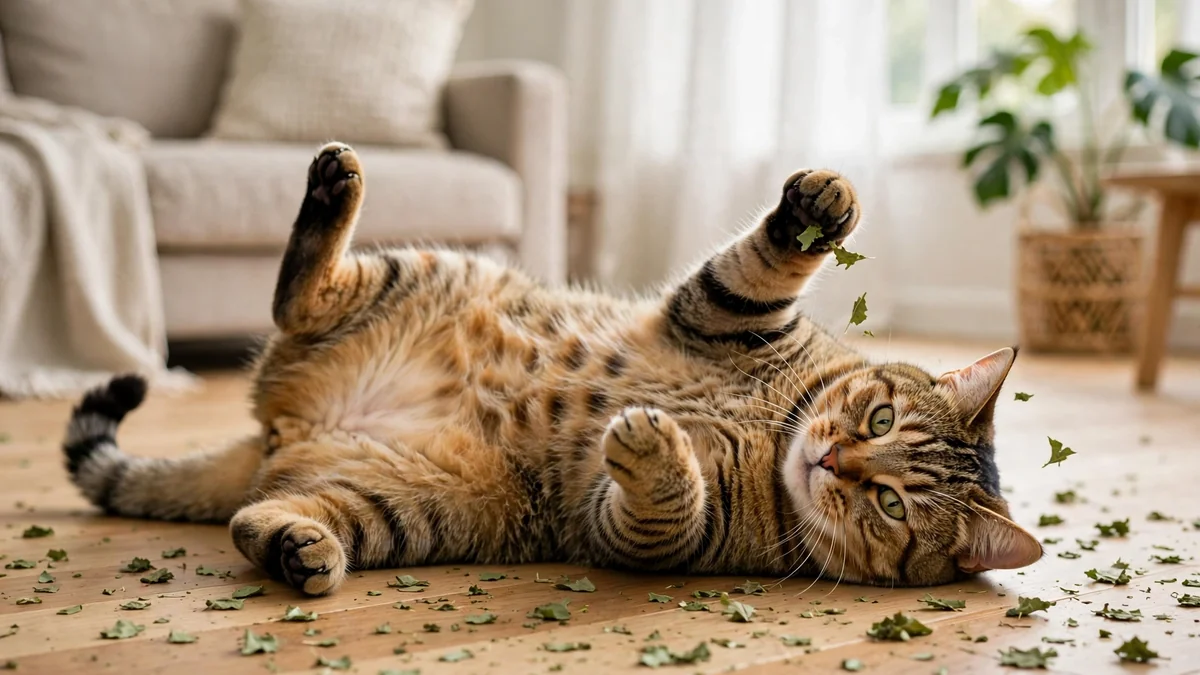

What does catnip do to cats? For about six in ten of them, it triggers ten minutes of joyful madness: rolling on the floor, rubbing their cheeks on everything, purring, drooling, and leaping at invisible prey. For the rest, it does nothing at all, and no amount of coaxing will change that. The difference comes down to one plant chemical and one gene.
Key takeaways
- Catnip is a mint-family herb, Nepeta cataria, and its active chemical is nepetalactone, found in the leaves and stems.
- About six in ten cats respond to catnip, and the reaction is inherited, so a cat either has the gene for it or does not.
- The effect lasts around ten to fifteen minutes, then wears off, and most cats ignore catnip for about thirty minutes afterwards.
- Typical signs are rolling, rubbing, licking, chewing, purring, drooling and wide pupils, sometimes followed by a long nap.
- Smelling catnip excites most cats, while eating it tends to calm them, and the herb is not addictive.
- Kittens under about six months usually do not react, and silvervine and valerian work for many cats that ignore catnip.
What catnip actually is
Catnip is a perennial herb, Nepeta cataria, and a member of the mint family, which makes it a cousin of the mint in your garden and the basil on your windowsill. It grows wild across Europe and Asia and has naturalised in North America. It has soft, grey-green leaves with toothed edges and small lavender-white flowers in summer. The magic is in tiny oil glands on the leaves, stems and seed pods, which hold a chemical called nepetalactone. When those glands break open, the oil evaporates into the air, and that vapour is what your cat smells. Dried catnip is the leaves and flowers dried and crumbled, and it keeps its potency for months in an airtight container. Fresh catnip works too, and many cats prefer it, since the oil is strongest just after picking. Catnip is not a drug in any serious sense. It makes a chemical shaped a little like the pheromones cats use to communicate, and the feline brain mistakes one for the other. Our guide to the best cat breeds covers the many kinds of cats that may fall for it.
How it works in the brain
When a cat sniffs catnip, nepetalactone lands on receptors in the nose and signals the brain areas that handle emotion and behaviour. The response comes within seconds, and it looks like happiness mixed with mischief. The cat may sniff hard, lick and chew the catnip, rub its face against it, roll on the floor, and shake its head. Some cats become suddenly playful and tear around the house, while others go soft and dreamy. A few become vocal, and a small number get overstimulated and turn grumpy, which is a sign to take the catnip away. The effect lasts around ten minutes, then fades on its own. After that, most cats will not respond again for about thirty minutes, because the receptors need time to reset. Eating catnip works differently: once swallowed, nepetalactone is broken down quickly, and the result is usually drowsiness, which is why cats that chew a lot of catnip often curl up for a nap. The reaction is inherited through a single gene, which is why it runs in families. If your cat is one of the lucky ones, it will enjoy catnip for its whole life.
What it looks like when it works
Your cat sniffs the catnip, then drops onto its side and rolls, rubbing its head and neck into the floor. Its pupils widen, and it may drool a little, lick the air, and knead with its paws. Then comes the playful phase, with sudden sprints, pounces on toys, and wrestling with a catnip mouse. Some cats get deeply affectionate during this phase, head-butting your hand and purring loudly. After ten minutes or so, the energy drains away and the cat wanders off, often to sleep. A cat on catnip is not in pain, not frightened, and not out of control, even when the rolling and the wide eyes look dramatic. Watch for overstimulation: if play turns rough, with biting and bunny-kicking your hand, or if your cat starts growling, the session is over. Give it space and fresh water, and it will be back to normal within the hour. The catnip page on Wikipedia describes the chemistry and the behaviour in more detail.

Catnip vs silvervine vs valerian
Catnip is the famous one, but it is not the only plant that affects cats this way. Silvervine, a plant from East Asia, contains several active chemicals, including actinidine, and works on most cats, including many that ignore catnip. Owners often say the reaction is stronger and lasts longer than catnip’s. Valerian root, the same plant used in herbal sleep remedies for people, excites some cats first and then makes them sleepy. None of these plants is better in any absolute sense; the only way to find your cat’s favourite is to try them one at a time. The table below compares the three easiest to buy.
| Plant | Who responds | What it does |
|---|---|---|
| Catnip | Around 6 in 10 cats | Rolling, rubbing, purring, then calm |
| Silvervine | Most cats, including many that ignore catnip | Like catnip, often stronger and longer |
| Valerian root | Some cats, including some non-responders | Excitement first, then sleepiness |
How to use it well
A pinch of dried catnip, about a tablespoon at most, sprinkled on the floor or on a scratching post is plenty, and you can stuff it into a small cloth toy or rub it on a new bed. Sprinkling it on a scratching post is the most useful trick of all, because it draws the cat away from your sofa. Fresh catnip is even better: pick a few leaves, crush them gently to release the oil, and offer them to your cat. If you grow it yourself, protect the plant with a wire cage, because a determined cat will flatten it in a single afternoon. Catnip spray is a good option for cats that get an upset stomach from eating the dried herb, and it works well on toys and bedding. Once or twice a week is enough for most cats, and daily use is fine too, though the effect may seem weaker without a break. Store dried catnip in a sealed jar away from light, and replace it every few months. Our guide to the best cat food brands covers the everyday side of keeping a cat happy.
When catnip does nothing
If your cat sniffs catnip and walks away, it is not broken, and you have not bought a bad batch. Around four in ten cats simply lack the gene that makes them respond. The trait is inherited, so a cat that ignores catnip will ignore it for life. Kittens are a special case: most do not react until they are three to six months old, and some not until they are closer to a year. The best move for a non-responder is to try silvervine, which works for about three quarters of cats that ignore catnip, or valerian root. You can also try fresh catnip instead of dried, since the oil is stronger. If none of it works, your cat is simply not a catnip cat, and it will find its fun elsewhere. Our guide to cat breeders in Scotland explains what to ask before you bring a kitten home.
Your catnip checklist
- Offer a pinch of dried catnip, about a tablespoon at most, and watch what happens.
- Let your cat sniff first, since smelling is what triggers the classic reaction.
- Keep sessions to ten or fifteen minutes, then let your cat walk away.
- Take the catnip away if play turns rough, or if your cat starts growling.
- Try silvervine or valerian if your cat ignores catnip completely.
- Sprinkle catnip on a scratching post to draw your cat away from the sofa.
- Store dried catnip in a sealed jar away from light, and replace it every few months.
- Wait until a kitten is at least six months old before deciding it does not respond.
How long does catnip last?
About ten to fifteen minutes, in most cats. The effect fades on its own, and most cats will not respond again for about thirty minutes, because the receptors in the nose need time to reset.
Is catnip safe for cats?
Yes, catnip is safe and not addictive, and cats cannot overdose on it. Too much at once can cause a mild upset stomach, so keep portions small.
Why does my cat not react to catnip?
About four in ten cats lack the gene that makes them respond to nepetalactone. Try silvervine, which works for many cats that ignore catnip, or valerian root.
Can kittens have catnip?
Yes, catnip is safe for kittens, but most will not react to it until they are three to six months old, and some not until they are closer to a year. There is no need to keep offering it to a kitten that shows no interest.
Can cats eat catnip?
Yes, cats can safely eat catnip, and it may even settle their stomach. Eating it tends to make cats drowsy rather than excited, so do not expect a big reaction.
How often can I give my cat catnip?
Once or twice a week is plenty for most cats, and daily use is fine too. If you offer it every day, the effect may seem weaker, so a short break now and then keeps it special.
The bottom line
What catnip does to cats is simple: for about six in ten of them, it switches on ten minutes of rolling, rubbing, purring joy, and then it switches off again, leaving a sleepy cat and a floor full of dried leaves. It is safe, it is not addictive, and it is one of the cheapest pleasures you can give a cat. Offer a pinch, watch the show, and if your cat is one of the four in ten that walk away unimpressed, try silvervine instead.