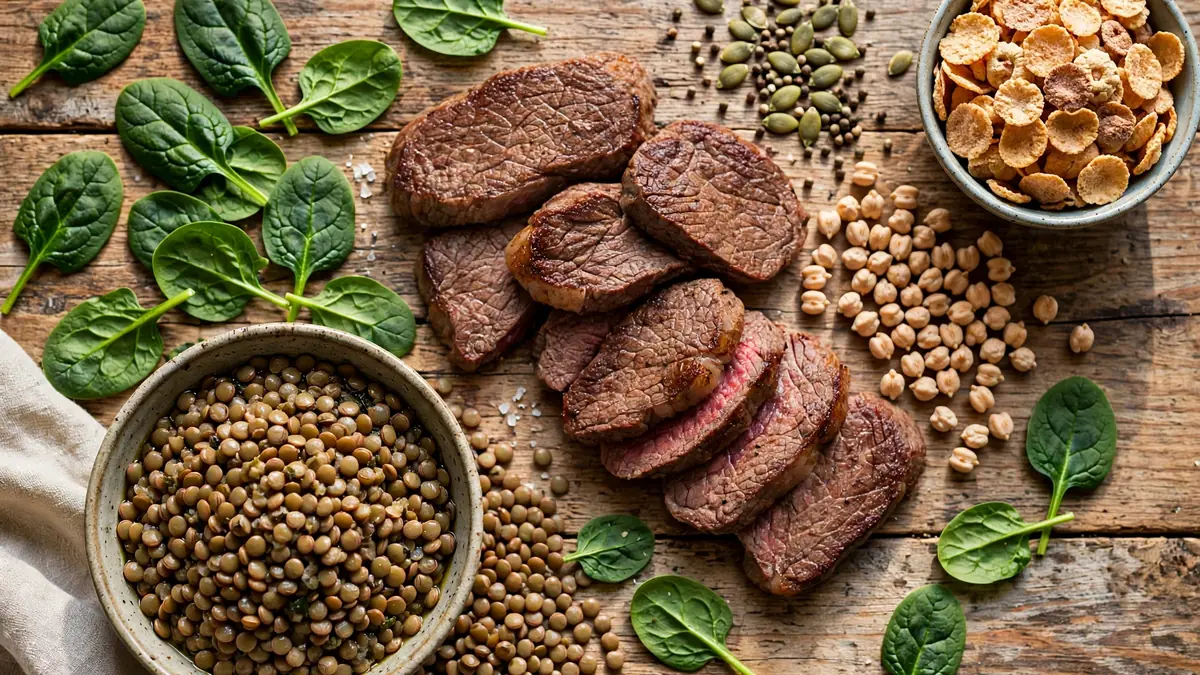

What foods are high in iron? The short answer is that red meat, liver, oysters, beans, lentils, spinach and fortified cereals sit at the top of the list, and a few of them deliver a surprising amount in a single serving. Iron is the mineral your body uses to carry oxygen around in your blood, and when you run low you usually feel it first as tiredness, pale skin and breathlessness on the stairs. Most people can cover their needs from ordinary food, once they know which foods pull their weight.
Key takeaways
- Red meat, liver, oysters, lentils, beans, spinach, tofu and fortified cereals are among the foods highest in iron.
- Iron from animal foods is absorbed far more easily than iron from plants.
- Vitamin C eaten in the same meal helps your body absorb plant iron.
- Tea, coffee and calcium-rich foods can hold iron absorption back when taken with a meal.
- Adult men need about 8 mg of iron a day, and women aged 19 to 50 need about 18 mg.
- A varied diet usually covers iron needs, and supplements are best discussed with a doctor first.
Why iron matters more than you think
Iron does quiet, unglamorous work. It sits at the centre of haemoglobin, the protein in red blood cells that carries oxygen from your lungs to your muscles, your brain and every other tissue. Without enough iron, your body cannot make enough healthy red blood cells, and low iron so often shows up as fatigue, weakness, pale skin, headaches and a racing heart.
Iron deficiency is one of the most common nutritional shortfalls in the world. Women of childbearing age, teenagers in growth spurts, endurance athletes and recent blood donors are all more likely to run low, as the Wikipedia entry on iron deficiency explains. For most of us, though, the fix starts in the kitchen.
Haem and non-haem: the two kinds of iron in food
Not all dietary iron behaves the same way. Iron from animal foods comes mostly as haem iron, named for the haemoglobin and myoglobin it sits inside, and your body absorbs it readily, taking in a much larger share than it manages from plant foods. That is why a modest portion of red meat can do more for your iron levels than a much larger pile of vegetables.
Iron from plants, dairy, eggs and fortified foods is non-haem iron. It is the same mineral, but your body has to work harder to absorb it, and the amount it takes in depends on what else is on the plate. Vitamin C is the great helper here: it converts non-haem iron into a form your gut can absorb, which is why a squeeze of lemon over lentils is more than a flavour choice. The tannins in tea and coffee, and large amounts of calcium taken at the same meal, can hold absorption back. Plant iron just rewards a bit of planning, and the planning is easy once you know the trick.
The animal foods that top the iron charts
Liver is in a league of its own. Beef liver contains about 6.5 mg of iron per 100 g, and a 3 oz serving delivers roughly 5 mg, more than a quarter of a woman’s daily target in a few mouthfuls. Chicken liver is richer still at around 11.6 mg per 100 g. Liver is not an everyday food for most people, and its strong flavour and very high vitamin A content mean small, occasional portions are the sensible approach.
Oysters come next, with about 8 mg of iron in a 3 oz serving, plus zinc and vitamin B12. Lean red meat is the workhorse of the list: lean ground beef carries about 2.6 mg of iron per 100 g, so a modest steak or beef stew delivers a useful amount without fuss. Cooking it low and slow brings out the best in cheaper cuts, and a best slow cooker turns tough beef into a tender, iron-rich dinner with very little effort.
Poultry and fish sit a rung lower. Dark turkey meat has about 2 mg of iron per 100 g, and eggs contribute roughly 1 mg each. Animal foods give you the most iron for the least thought, which is why they dominate every iron ranking.
The plant foods that punch above their weight
Lentils are the quiet heroes of the plant list. Cooked lentils contain about 3.3 mg of iron per 100 g, and a half-cup serving gives you roughly 3 mg, along with plenty of protein and fibre. They are cheap, they keep for months, and they soak up flavour. White beans are stronger still, with about 3.7 mg per 100 g and roughly 8 mg in a full cup of canned beans. Kidney beans and chickpeas sit close behind, at around 2.6 mg and 2.4 mg per half-cup serving, and a plate of rice and beans is one of the great iron-friendly meals of the world, as the guide to Puerto Rican food shows.
Spinach deserves its reputation, with a small correction. Cooked spinach contains about 3.6 mg of iron per 100 g, and a half-cup serving gives you roughly 3 mg. The catch is that raw spinach is mostly water, so you need a large handful of leaves to get that cooked half-cup, and the oxalates in spinach hold some of the iron back. Cooking helps on both counts. Tofu is another strong plant option, with firm tofu carrying around 5.4 mg of iron per 100 g, and cooked soya beans give you about 5.1 mg per 100 g.
Then there are the foods people forget. Pumpkin seeds hold about 8.8 mg of iron per 100 g, so a small handful is a genuinely useful snack. Dark chocolate of 70% cocoa or more carries about 11.9 mg per 100 g, so two or three squares deliver roughly 3.5 mg. Fortified breakfast cereals are the dark horse of the whole list: a single serving fortified to 100% of the daily value contains 18 mg of iron, a full day’s target for a woman in one bowl. Quinoa adds about 2.8 mg per cooked cup.
| Food | Iron per 100 g | Typical serving | Iron per serving |
|---|---|---|---|
| Fortified breakfast cereal | 18–68 mg | 1 serving | 18 mg |
| Chicken liver, cooked | 11.6 mg | 3 oz (85 g) | About 10 mg |
| Oysters, cooked | 9.2 mg | 3 oz (85 g) | 8 mg |
| Pumpkin seeds | 8.8 mg | 1 oz (28 g) | About 2.5 mg |
| Beef liver, cooked | 6.5 mg | 3 oz (85 g) | 5 mg |
| Firm tofu | 5.4 mg | Half a cup | About 6.6 mg |
| Cooked spinach | 3.6 mg | Half a cup | 3 mg |
| Cooked lentils | 3.3 mg | Half a cup | 3 mg |
| Lean beef | 2.6 mg | 3 oz (85 g) | 2 mg |
How to get more iron out of the food you already eat
Knowing the numbers is only half the job. The other half is absorption, and small habits make a real difference. The single most useful trick is to pair plant iron with vitamin C in the same meal: lentils with tomatoes, beans with peppers, spinach with lemon, tofu with broccoli. All of these help your gut take in far more iron than the plant food would give up alone.
Timing matters too. Tea and coffee are best enjoyed between meals, because their tannins bind iron in the gut and carry it away unabsorbed, and the same goes for a large glass of milk or a calcium supplement taken with an iron-rich meal. Cooking in a cast-iron pan adds a small amount of iron to food, particularly acidic dishes such as tomato sauces. None of these tweaks requires a new diet, and together they can lift your iron intake without you noticing the effort.

Your iron-rich week checklist
- Put lentils, beans or chickpeas on the menu at least three times this week.
- Eat one portion of red meat or oily fish, and keep the portion modest.
- Add a vitamin C food to every plant-based iron meal, such as peppers, tomatoes or citrus.
- Keep tea and coffee for between meals, not with your main iron-rich dish.
- Try one new iron-rich food, such as tofu, quinoa or pumpkin seeds.
- Cook a tomato sauce or stew in a cast-iron pan if you own one.
- Check your breakfast cereal label and note how much iron one serving gives you.
- Pack iron-rich snacks for days out, such as pumpkin seeds or dark chocolate.
Which food has the most iron?
Per 100 g, dried herbs and fortified cereals are far ahead of everything else, but nobody eats them by the bowlful. Among foods eaten in real portions, chicken liver, oysters and beef liver lead the list, and a single serving of fortified cereal delivers 18 mg of iron in one go. For everyday eating, lentils, beans and lean red meat are the most practical top sources.
How much iron do I need each day?
The recommended daily amount for adult men is 8 mg, and for women aged 19 to 50 it is 18 mg, reflecting iron lost through menstruation. After 51, women’s needs fall to 8 mg a day, while pregnancy raises the target to 27 mg. The tolerable upper limit from food and supplements combined is 45 mg a day for adults.
Can you get enough iron without meat?
Yes, but it takes a little more planning. Lentils, beans, tofu, spinach, quinoa, pumpkin seeds and fortified cereals can cover your needs if you eat them often and pair them with vitamin C. Vegetarians need roughly 1.8 times as much dietary iron as meat eaters, because plant iron is absorbed less efficiently.
Does spinach really have lots of iron?
Spinach is a good source, but the old stories exaggerate it. Cooked spinach contains about 3.6 mg of iron per 100 g, yet a raw salad gives you far less because the leaves are mostly water. Cook it down, add lemon or tomatoes, and spinach earns its place, but it is not the iron powerhouse the cartoons made it out to be.
What stops your body absorbing iron?
The tannins in tea and coffee are the biggest everyday blockers when they are drunk with a meal, and large amounts of calcium taken at the same time can also hold absorption back. Phytates in whole grains and legumes slow things down too, though soaking and cooking reduce their effect. Vitamin C is the counterweight.
Should I take an iron supplement?
Most people do not need one if they eat a varied diet, and iron supplements can cause constipation, nausea and stomach pain. Talk to a doctor first if you have been told you are deficient, if you feel persistently tired, or if you follow a very restricted diet. A blood test is the only reliable way to know your iron status.
The bottom line
The foods highest in iron are not exotic or expensive. Liver and oysters lead the animal list, lentils and beans lead the plant list, and fortified cereal quietly delivers a full day’s iron before you have finished breakfast. Pair plant iron with vitamin C, keep tea and coffee away from mealtimes, and most of the work is done. A handful of pumpkin seeds travels well on a day out, and the same thinking behind good best picnic recipes applies: a little planning makes the whole day easier.
This article is general information about nutrition, not medical advice. Iron needs vary with age, sex, pregnancy and health conditions, and too much iron can be harmful, so talk to a doctor or a registered dietitian before changing your diet or starting a supplement.