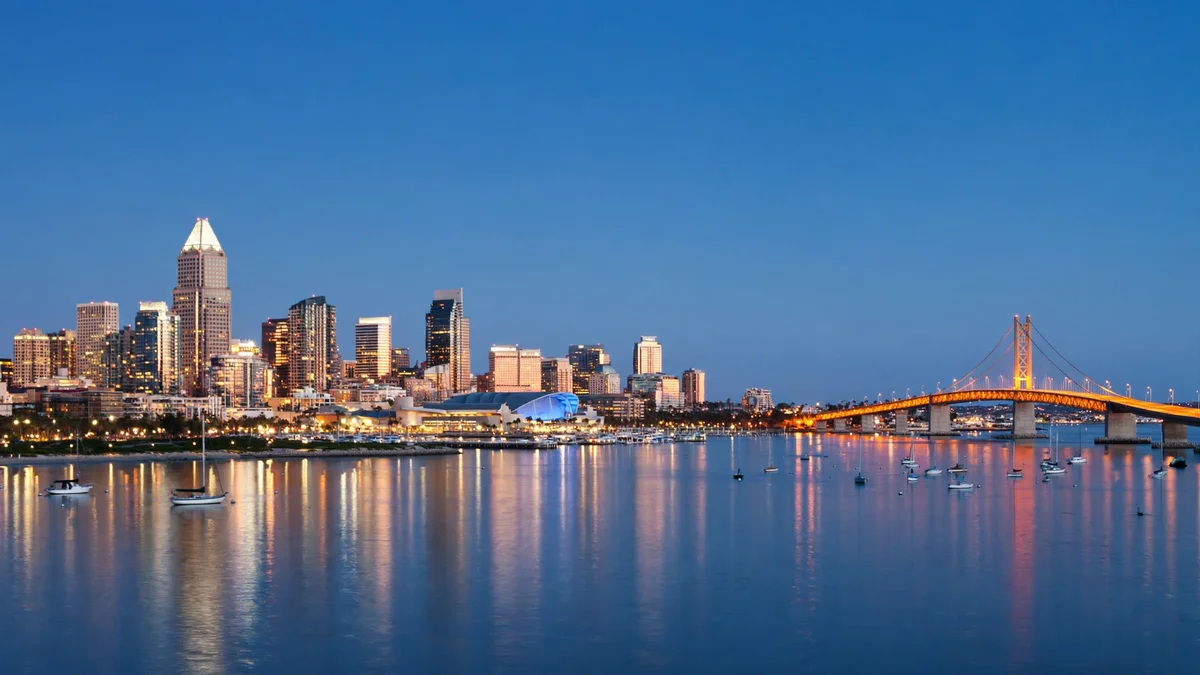

US San Diego time is Pacific Time, the time zone of the west coast of the United States, and it is either eight or seven hours behind Coordinated Universal Time, depending on the time of year. San Diego keeps Pacific Standard Time, UTC-8, in the winter months, and Pacific Daylight Time, UTC-7, from the second Sunday in March to the first Sunday in November. This guide explains the zone, the daylight saving dates, and how to convert San Diego time to anywhere else in the world.
Key takeaways
- San Diego uses Pacific Time, in the America/Los_Angeles time zone.
- Winter time is Pacific Standard Time (PST), which is UTC-8.
- Summer time is Pacific Daylight Time (PDT), which is UTC-7.
- Clocks go forward one hour on the second Sunday in March and back one hour on the first Sunday in November.
- San Diego is three hours behind New York, eight hours behind London in winter, and 18 to 19 hours behind Sydney.
- San Diego has observed daylight saving in step with the rest of California for decades, and the pattern is set by federal law.
What time zone is San Diego in
San Diego sits in the Pacific Time Zone, the westernmost of the four time zones used across the contiguous United States. The zone covers California, Oregon and Washington, most of Nevada, and parts of Idaho, and computers and phones identify it as America/Los_Angeles, which is why the time changes automatically when daylight saving begins and ends.
The Pacific Time Zone is eight hours behind Coordinated Universal Time (UTC) in winter and seven hours behind it in summer. That single fact answers most questions about San Diego time: if it is noon in San Diego in January, it is 20:00 UTC, and if it is noon in San Diego in July, it is 19:00 UTC. The abbreviation PST means Pacific Standard Time, the winter setting, while PDT means Pacific Daylight Time, the summer setting. The plain term Pacific Time covers both, and it is the safest wording when you are not sure which half of the year you are talking about.
Daylight saving in San Diego
San Diego observes daylight saving time, like almost all of California and most of the United States. Clocks move forward one hour at 2:00 am on the second Sunday in March, when 2:00 am becomes 3:00 am, and they move back one hour at 2:00 am on the first Sunday in November, when 2:00 am happens twice. The spring change means one hour less sleep and a later sunset; the autumn change means an extra hour in bed and an earlier sunset.
The dates shift slightly each year because they are defined by the week rather than the calendar date. In 2026, daylight saving begins on Sunday 8 March and ends on Sunday 1 November. In 2027, it begins on Sunday 14 March and ends on Sunday 7 November. The pattern is set by the Energy Policy Act of 2005, which extended daylight saving in the United States from 2007 onwards, moving the start from the first Sunday in April to the second Sunday in March, and the end from the last Sunday in October to the first Sunday in November.
California voters approved Proposition 7 in 2018, which allowed the state legislature to consider staying on daylight saving time all year, but that change would need approval from the United States Congress, and it has not happened. San Diego therefore continues to change its clocks twice a year, in step with the rest of the state. Arizona and Hawaii do not observe daylight saving at all, which is why the gap between San Diego and Phoenix changes by an hour between summer and winter.
Converting San Diego time to other places
The most useful conversions are the ones people make every day: to the east coast of the United States, to Europe, and to Australia and Asia. San Diego is three hours behind New York all year round, because both cities change their clocks on the same dates. It is eight hours behind London in winter, when London is on Greenwich Mean Time, and eight hours behind London in summer too, because London also moves its clocks forward by an hour. The gap to Sydney is larger and changes with the seasons, because the southern hemisphere has summer when San Diego has winter.
Working a conversion out is straightforward once you know the two UTC offsets. Take the time in San Diego, add eight hours in winter or seven in summer to get UTC, then add or subtract the other city’s offset. A meeting at 10:00 am in San Diego in July is 17:00 UTC, which is 18:00 in London and 03:00 the next day in Sydney. The same meeting in January is 18:00 UTC, which is 18:00 in London and 05:00 the next day in Sydney. When in doubt, use a converter rather than mental arithmetic: the southern hemisphere is where mistakes happen.
The table below gives the most common conversions at a glance, for both halves of the year.
| City | San Diego winter (PST, UTC-8) | San Diego summer (PDT, UTC-7) | Difference |
|---|---|---|---|
| New York | 3 hours ahead | 3 hours ahead | Always 3 hours |
| Chicago | 2 hours ahead | 2 hours ahead | Always 2 hours |
| London | 8 hours ahead | 8 hours ahead | Always 8 hours |
| Paris | 9 hours ahead | 9 hours ahead | Always 9 hours |
| Tokyo | 17 hours ahead | 16 hours ahead | Changes by 1 hour |
| Sydney | 19 hours ahead | 17 hours ahead | Changes by 2 hours |

San Diego time for travel, calls and events
If you are visiting San Diego, the time zone affects more than your watch. Flights from the east coast land three hours earlier on the clock than they left, which makes jet lag milder heading west and sharper heading home. The sun sets late in summer, often after 7:30 pm in June and July, which leaves long evenings for the beach and the harbour, while winter sunsets come soon after 5:00 pm. Restaurants, museums and the zoo all run on local time, so a booking made in another time zone needs converting before you set off.
For phone calls and video meetings, the three-hour gap to the east coast is the one that catches people out. A 9:00 am call in New York is 6:00 am in San Diego, and a 5:00 pm call in San Diego is 8:00 pm in New York. For calls to Europe, late morning in San Diego is early evening in London, while calls to Australia usually need one side to accept an early morning or a late evening.
San Diego is also in area code 619, one of the original California area codes, and our guide to the location of area code 619 explains where that code covers. If you are working out times for a trip, our time and date calculator guide covers the tools that do the arithmetic for you, and what time is sunrise explains how sunrise and sunset times shift through the year.
Checklist: getting San Diego time right
Run through this list before you book, call or travel, and the time zone will not catch you out.
- Check whether San Diego is on PST (UTC-8) or PDT (UTC-7) on your date.
- Remember the change dates: second Sunday in March forward, first Sunday in November back.
- San Diego is always three hours behind New York and eight hours behind London.
- Add the other city’s UTC offset rather than guessing from the clock on your wall.
- Use a time zone converter for Australia and Asia, where the gap changes with the seasons.
- Set phones and laptops to America/Los_Angeles and let them change the clocks for you.
- Confirm event times in San Diego local time, not in the time zone you are calling from.
What is the time in San Diego right now?
San Diego keeps Pacific Time: PST (UTC-8) from the first Sunday in November to the second Sunday in March, and PDT (UTC-7) for the rest of the year. The exact current time depends on the date, so check a live clock or a world time site rather than relying on a printed timetable. Your phone will show the right time automatically if its time zone is set to San Diego or America/Los_Angeles.
Is San Diego on Pacific Standard Time or Pacific Daylight Time?
It depends on the date. San Diego is on Pacific Standard Time, UTC-8, in the winter months, roughly early November to mid-March, and on Pacific Daylight Time, UTC-7, in the summer months, roughly mid-March to early November. In 2026, the switch to daylight time falls on Sunday 8 March and the switch back on Sunday 1 November.
How many hours behind New York is San Diego?
Three hours, all year round. Both cities observe daylight saving on the same dates, so the gap never changes. When it is noon in San Diego it is 3:00 pm in New York, whether it is January or July. The same is true of Chicago, where the gap is always two hours.
Does San Diego observe daylight saving time?
Yes. San Diego changes its clocks twice a year, in step with almost all of California and most of the United States. Clocks go forward one hour at 2:00 am on the second Sunday in March and back one hour at 2:00 am on the first Sunday in November. California voters approved a measure in 2018 that could allow year-round daylight saving, but it would need Congress to approve it, and that has not happened.
What is the difference between PST and PDT?
PST is Pacific Standard Time, the winter setting, at UTC-8. PDT is Pacific Daylight Time, the summer setting, at UTC-7, one hour ahead of PST. The two are never used at the same time: San Diego is on one or the other, and the switch happens on the second Sunday in March and the first Sunday in November. The general term Pacific Time covers both.
What time is it in San Diego when it is noon in London?
It is 4:00 am in San Diego, in both winter and summer, because London also observes daylight saving and the gap stays at eight hours. When it is noon in London in January, San Diego is on PST at 4:00 am, and when it is noon in London in July, San Diego is on PDT at 4:00 am. For Tokyo, noon means 7:00 pm the previous day in San Diego in winter and 8:00 pm the previous day in summer.
The bottom line
US San Diego time is Pacific Time, and that is almost everything you need to know: UTC-8 in winter under the name Pacific Standard Time, UTC-7 in summer under the name Pacific Daylight Time, with the clocks changing on the second Sunday in March and the first Sunday in November. The city sits three hours behind New York and eight hours behind London all year, while the gaps to Tokyo and Sydney shift with the seasons. Set your devices to America/Los_Angeles, confirm event times in local time, and check a converter before any call that crosses the Pacific, and San Diego time will never catch you out.