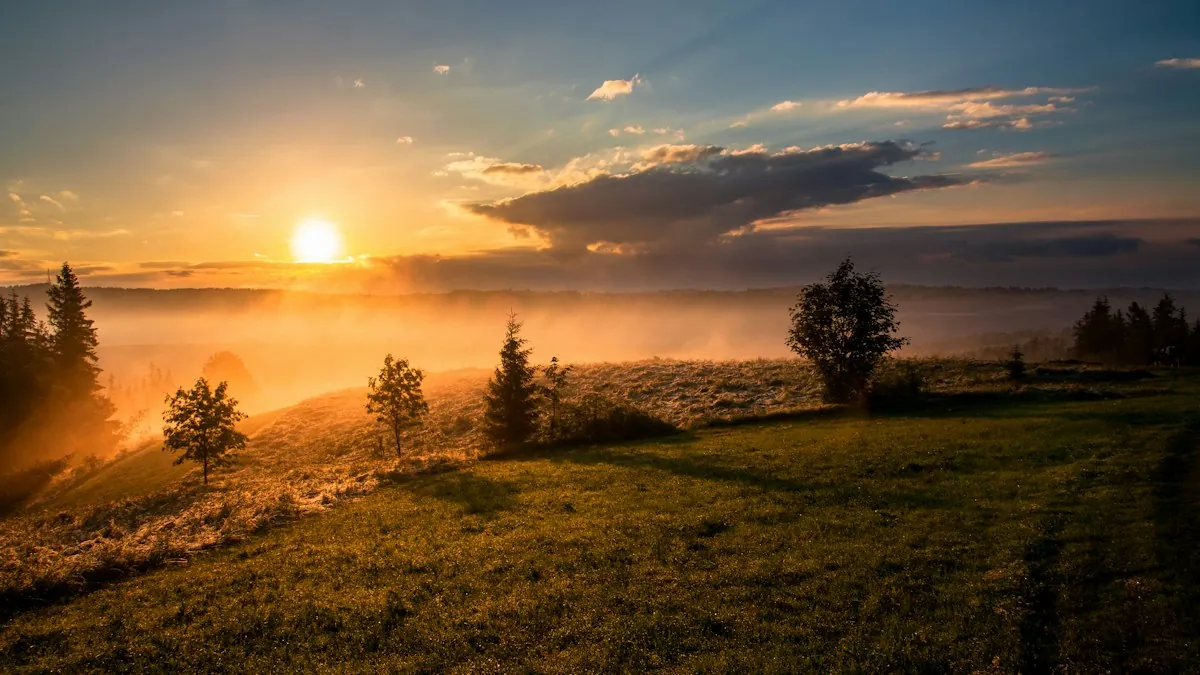

What time is sunrise? There is no single answer, because sunrise changes every day and varies with where you stand on the planet. The time the sun appears depends on your latitude, your longitude, the date, and the time of year, so a sunrise that arrives at 5.30am in one city in June may not arrive until after 8am in the same city in December.
The short answer to the central question is to check a reliable source for your exact place and date, such as your phone weather app, a sunrise calculator, or the website timeanddate.com, rather than memorising one time. This guide explains why sunrise moves, how much it changes through the year, and the simplest ways to find your local time for any day, whether you are planning a photograph, an early run, or a quiet morning outdoors.
Key takeaways
- Sunrise has no fixed time: it shifts daily and differs by location, latitude and season.
- Sunrise is earliest around the summer solstice in June and latest around the winter solstice in December, in the northern hemisphere.
- The sun rises earlier in the east than in the west, even within one time zone.
- Your phone weather app, a sunrise calculator or timeanddate.com gives the exact local time for any date.
- Daylight saving changes the clock time of sunrise by an hour, even though the sun itself does not move.
- Sunrise is defined as the moment the upper edge of the sun appears above the horizon.
What sunrise actually means
Sunrise is the moment the upper edge of the sun first appears above the horizon. Astronomers use that definition because the sun is a disc, not a point, and it takes a couple of minutes for the whole disc to clear the horizon. Weather apps use the same definition, which is why times from different sources usually agree to within a minute or two.
The glow before that moment is dawn, and it comes in stages. Astronomical dawn begins when the sun is 18 degrees below the horizon and the sky is still dark to most eyes. Nautical dawn follows at 12 degrees, when the horizon becomes visible at sea. Civil dawn, at 6 degrees below the horizon, is when there is enough light for most outdoor activity. Photographers care about these stages because the soft light of dawn begins well before the sun itself appears.
Best for: anyone who wants to plan around first light, from photographers chasing soft morning light to runners who prefer to start in daylight.
Why sunrise changes every day
The Earth spins on a tilted axis, about 23.4 degrees from vertical, and that tilt is the reason sunrise moves through the year. As the Earth travels around the sun, the tilt points first towards the sun and then away from it, which changes how long each part of the planet spends in daylight. Near the June solstice, the northern hemisphere leans towards the sun, so days are long and sunrises are early. Near the December solstice, it leans away, so days are short and sunrises are late.
Two other factors add smaller daily shifts. The Earth does not move around the sun at a perfectly steady speed, because its orbit is slightly elliptical, so the sun appears to run a little fast or slow at different times of year. Your longitude matters too: within one time zone, places in the east see the sun before places in the west, sometimes by half an hour or more across a wide zone. Together, these effects mean the earliest sunrise of the year does not fall exactly on the solstice.
Best for: understanding why a sunrise time that was right last week is already a few minutes out, and why times differ between towns in the same time zone.
How sunrise varies by place and season
Latitude decides how dramatic the change is. Near the equator, sunrise stays close to 6am all year, shifting by less than half an hour, because the days stay near twelve hours long. In London, by contrast, sunrise moves from around 4.45am in mid-June to around 8am in late December, a swing of more than three hours. In New York, the range runs from about 5.25am in June to about 7.20am in January.
The effect grows stronger towards the poles. In Edinburgh, sunrise in June arrives before 4.30am, while in December it does not arrive until after 8.40am. North of the Arctic Circle, the sun does not rise at all for part of the winter, the polar night, and does not set at all for part of the summer, the midnight sun. Southern hemisphere seasons are reversed, so the earliest sunrises there fall in December.
Best for: travellers, who should always check local times rather than assuming the pattern from home, especially on trips near the poles or the equator.
Daylight saving and the clock
Daylight saving time, often called summer time, shifts the clock but not the sun. When clocks go forward by an hour in spring, the clock time of sunrise jumps an hour later overnight, even though the sun rose at the same solar time as the day before. When clocks go back in autumn, sunrise suddenly appears an hour earlier on the clock. This is why the latest sunrise of the year in many places falls just before the clocks go back, not on the winter solstice itself.
The dates differ by country. In the United States, clocks move forward on the second Sunday in March and back on the first Sunday in November. In the United Kingdom and the European Union, they move forward on the last Sunday in March and back on the last Sunday in October. Some places, including most of Arizona and Hawaii, do not observe daylight saving at all.
Best for: anyone confused by a sudden jump in sunrise time in spring or autumn, which is almost always the clock change rather than a change in the sun.
How to find your exact local sunrise time
The easiest method is the weather app already on your phone. Most weather apps show sunrise and sunset for the current day, and many let you scroll forward to see the coming week. On an iPhone, the built-in Weather app lists sunrise and sunset near the bottom of the location page, and Android weather views show the same information.
For more detail, a dedicated calculator is better. The website timeanddate.com lets you enter any town or city and shows sunrise, sunset and the stages of dawn for any date, along with day length and the direction of sunrise. Similar tools include the app Sun Surveyor, which photographers use because it also shows where the sun will appear on the horizon. If you are planning a morning outdoors, our guide to the best water bottles covers staying hydrated on an early start, and our guide to the best places to visit in Maine covers a destination known for its early Atlantic sunrises. For a sunrise city break, our guide to the best restaurants in Vegas covers where to eat after a dawn start in the desert.
Best for: anyone who needs an exact time for a specific day, where a calculator beats a remembered time from last month.
Making the most of the morning light
Sunrise is worth planning around because the light is unlike any other time of day. In the first hour after the sun appears, the light is low, warm and soft, with long shadows that give landscapes depth. Photographers call this the golden hour, and it is why many landscape photographs are taken at dawn rather than at midday, when the light is flat and harsh. The colours are often at their best in the minutes before sunrise too, when the sky turns pink, orange and purple.
A little preparation makes an early start easier. Check the time the evening before, set an alarm that leaves room for travel, and check the weather, because cloud on the eastern horizon can hide the sun even when the forecast is clear overhead. Arrive ten or fifteen minutes before the listed time so you are in place for the colours that come first.
Best for: photographers, walkers and anyone who enjoys a quiet start to the day, where arriving early is the whole point.

Your sunrise checklist
Work through this list the evening before an early start, so the morning itself is calm rather than rushed.
- Have you checked the exact sunrise time for your location and date?
- Have you checked whether daylight saving changes apply on that date?
- Have you looked at the cloud forecast for the eastern horizon?
- Have you set an alarm that leaves time to travel to your spot?
- Have you planned to arrive ten to fifteen minutes before sunrise?
- Have you chosen a spot with a clear view to the east?
- Have you packed water, a warm layer and anything you need for the wait?
- Have you charged your phone or camera the night before?
- Have you told someone where you are going, if you are heading out alone?
- Have you checked the return route, so you can get home safely in daylight?
Comparing sunrise times through the year
| Place | Sunrise in June | Sunrise in December | Seasonal swing | Notes |
|---|---|---|---|---|
| Near the equator | Around 6am | Around 6am | Under 30 minutes | Days stay near 12 hours |
| London | Around 4.45am | Around 8am | Over 3 hours | Latest sunrise before clocks change |
| New York | Around 5.25am | Around 7.20am | About 2 hours | Clocks change in March and November |
| Edinburgh | Before 4.30am | After 8.40am | Over 4 hours | Very long summer days |
| Arctic Circle | No sunset | No sunrise | Extreme | Midnight sun and polar night |
Frequently asked questions
What time is sunrise today?
It depends on where you are. Check your phone weather app or a sunrise calculator such as timeanddate.com for your exact town and date, because the time changes daily and varies by location.
Why does sunrise change every day?
The Earth tilts on its axis as it orbits the sun, so the length of daylight changes through the year. Your latitude and longitude add further variation, which is why sunrise times differ from place to place.
What time is sunrise in summer?
In the northern hemisphere, summer sunrises are the earliest of the year, often between 4.30am and 6am depending on latitude. In the southern hemisphere, the earliest sunrises fall in December instead.
Is sunrise the same time everywhere in a time zone?
No. Places in the east of a time zone see the sun before places in the west, sometimes by half an hour or more across a wide zone, because the Earth turns towards the sun from east to west.
Does daylight saving change sunrise?
It changes the clock time of sunrise by an hour, but not the sun itself. When clocks go forward in spring, sunrise appears an hour later on the clock; when they go back in autumn, it appears an hour earlier.
What is the difference between dawn and sunrise?
Dawn is the period of growing light before the sun appears, while sunrise is the moment the upper edge of the sun clears the horizon. Civil dawn, when there is enough light for most outdoor activity, begins well before sunrise.
The bottom line
What time is sunrise is a question with a different answer every day. The sun rises earlier in summer and later in winter, earlier in the east than the west, and almost at the same time all year near the equator. Rather than memorising a time that will be wrong within days, check a reliable source for your place and date, arrive a little early, and enjoy the light.