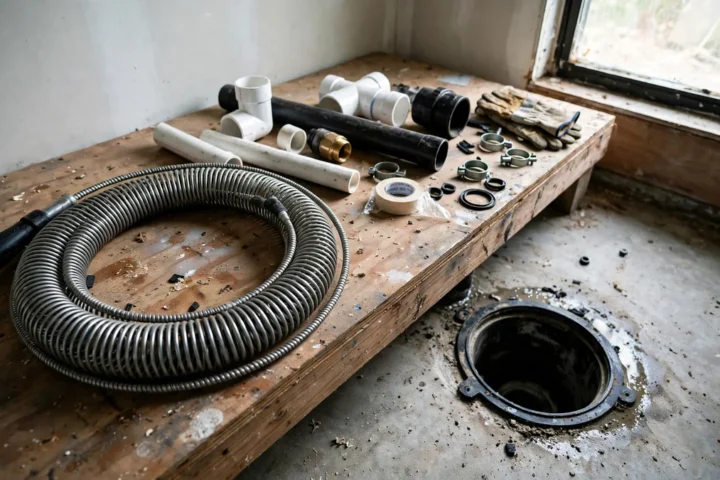

Sewer line repair is the work of fixing the pipe that carries wastewater from your home to the street sewer or septic system. The pipe, called the sewer lateral, runs underground from the house to the main, and when it cracks, breaks or blocks, the symptoms show up inside the house long before anyone sees the pipe itself. The central question is always the same: is this a local clog, or is the main line itself failing?
That distinction decides everything that follows, including the cost. A single slow drain is usually a local problem. Several drains misbehaving at once, sewage smells, gurgling toilets and wet patches in the garden all point to the main line. This guide explains the warning signs, how a camera inspection finds the cause, the repair methods available, what they typically cost, and how to choose a contractor.
Key takeaways
- Multiple slow drains, gurgling toilets and sewage smells together point to the main sewer line.
- A camera inspection is the first step: it shows the cause, location and depth of the problem.
- Common causes are tree roots, cracked or collapsed pipe, ground movement and grease build-up.
- Trenchless lining and pipe bursting repair pipe with little digging; excavation replaces it outright.
- Trenchless methods cannot fix a collapsed pipe or a pipe that has sagged out of shape.
- Get several written quotes, check licences and insurance, and never pay in full up front.
What the sewer line does
Every drain in your home joins a single underground pipe that leaves the house and runs to the public sewer in the street, or to a septic tank where there is no public sewer. That pipe is usually made of clay, cast iron, concrete or plastic, depending on the age of the house, and it slopes gently downwards so wastewater flows away by gravity.
The pipe’s age matters. Older clay pipes are prone to cracking and root intrusion at the joints, cast iron corrodes over decades, and plastic pipes can be damaged by ground movement or poor installation. Knowing what material your line is made of, and roughly how old it is, helps a contractor judge what to expect.
Warning signs your sewer line needs attention
The most useful sign is a pattern across the house. If several fixtures drain slowly at the same time, the problem is downstream of all of them, in the main line, not in any one drain. Gurgling sounds from a toilet or drain when another fixture is used are another clue. Sewage odours indoors or in the garden should never be ignored: even a faint smell can mean a crack or break.
Outside, look for wet or unusually lush patches of lawn above the line’s path, especially in dry weather, because leaking sewage acts as fertiliser. Soft spots or depressions in the garden can mean soil is washing into a broken pipe. Repeated backups after professional clearing, and sewage backing up into a tub when a toilet is flushed, are advanced signs that need prompt action.
What to do first
If sewage is backing up into the house, stop using water, keep children and pets away from the affected area, and call a professional promptly. Raw sewage is a health hazard, and the water should not be used until the problem is resolved. Do not pour chemical drain cleaners down a main line blockage: they rarely reach the problem and they can damage pipes.
How a camera inspection finds the problem
A camera inspection is the standard first step, and it is worth paying for before agreeing to any repair. A contractor feeds a small waterproof camera on a flexible cable through the line, usually through a cleanout access point, and watches the picture on a screen as it travels. The camera shows cracks, root masses, offsets where pipe sections have shifted, bellies where the pipe has sagged, and collapsed sections, along with the exact distance and depth of each problem.
The inspection also settles the question of whether a repair is needed at all. Sometimes the camera shows a simple blockage that can be cleared, and no pipe work is needed. Industry guides typically cite a video inspection at roughly a few hundred dollars, though the figure varies by area and access. Ask for a copy of the recording and a written report: a reputable contractor will provide both, and the report is the basis for any quote that follows.

Repair methods: trenchless and traditional
Once the cause is known, the repair falls into two broad families. Traditional excavation means digging a trench from the house to the damaged section, removing the failed pipe and laying new pipe in its place. It is the only option for a collapsed section, a badly misaligned pipe or a belly that needs regrading. The drawback is the disruption: a trench through the garden, driveway or landscaping, and the cost of putting it all back.
Trenchless methods repair or replace the pipe from the inside, through one or two small access points. Cured-in-place pipe lining, known as CIPP, inserts a resin-soaked liner through the existing pipe, which then hardens into a smooth new pipe inside the old one. It suits cracks, leaking joints and minor root intrusion in a pipe that still holds its shape. Pipe bursting pulls a new pipe through the old one while breaking the old pipe apart, and it is used more for full-length replacement. Neither method can fix a collapsed pipe or regrade a sagging one.
What sewer line repair costs
Costs vary widely with length, depth, access and location, so treat every figure as a range, not a quote. Industry guides based on Angi and HomeAdvisor data put a broken or cracked pipe spot repair at roughly six hundred to a thousand dollars, and clearing a simple clog without pipe repair at roughly two to three hundred dollars. Trenchless lining is usually quoted per linear foot, in the region of eighty to two hundred and fifty dollars a foot.
Full replacement is a bigger job. Traditional excavation replacement for a typical home commonly runs from a few thousand dollars into the low tens of thousands, depending on length and depth, while trenchless full replacement often lands in a similar range. The trenchless premium buys an intact garden, driveway and trees, and it can work out cheaper overall once restoration costs are counted. Always get the quote in writing, with the method, the length of pipe and the restoration work itemised, and get at least three quotes before deciding.
Choosing a contractor
Start with licensed, insured contractors who specialise in sewer work. Ask for proof of licence and insurance, ask how many sewer line repairs they have done, and ask for references from recent jobs. A good contractor will insist on a camera inspection before quoting, explain the options in plain language, and put the quote in writing. Be wary of anyone who quotes a firm price over the phone without seeing the line, or who pressures you to decide on the spot.
Check the warranty too. A reputable contractor will guarantee both the work and, where relevant, the materials, and will explain what the warranty covers and for how long. Ask who is responsible if the repair uncovers a bigger problem once the work starts. Keep every document, the camera report, the written quote, the contract and the warranty, in one folder, and do not pay in full before the work is finished and inspected.
Your sewer line repair checklist
Use this list from the first warning sign.
- Note which fixtures are affected and when the problem started.
- If sewage is backing up, stop using water and call a professional promptly.
- Do not pour chemical drain cleaners into a main line blockage.
- Book a camera inspection and ask for the recording and a written report.
- Ask whether the pipe qualifies for trenchless repair or needs excavation.
- Get at least three written quotes, with method, length and restoration itemised.
- Check the contractor’s licence, insurance and recent references.
- Ask about the warranty on work and materials, and its length.
- Agree who pays if a bigger problem is found once work starts.
- Do not pay in full until the work is finished and inspected.
How the repair methods compare
| Feature | Spot repair by excavation | Trenchless lining (CIPP) | Pipe bursting | Full excavation replacement |
|---|---|---|---|---|
| How it works | Dig and replace one section | Resin liner cures inside old pipe | New pipe pulled through old one | Trench and lay new pipe |
| Best for | One localised break | Cracks, joints, minor roots | Full run under hard surfaces | Collapsed or badly bellied pipe |
| Disruption | Moderate, one trench | Low, small access points | Low, small access points | High, full trench |
| Typical time | A day or two | Often a day | One to two days | Several days plus restoration |
| Restoration needed | Garden or surface repair | Minimal | Minimal | Extensive, can be costly |
| Cannot fix | Nothing, but costly per foot | Collapsed or sagging pipe | Collapsed or sagging pipe | Nothing, the most complete fix |
Frequently asked questions
How do I know if it is the sewer line or just a clog?
A single slow drain is usually a local clog. Several drains slowing at once, gurgling toilets, sewage smells and backups into other fixtures all point to the main line. A camera inspection settles the question.
How long does sewer line repair take?
A trenchless lining job is often finished in a day, and pipe bursting in one to two days. A spot repair by excavation usually takes a day or two, while a full excavation replacement can take several days, plus time for restoration. Access, depth and weather can all extend the work.
Will my home insurance cover sewer line repair?
It depends on the policy and the cause. Many standard home insurance policies do not cover sewer line repair, though some cover sudden damage and others offer a sewer line endorsement as an add-on. Check your policy documents and speak to your insurer before work starts.
Can tree roots be removed without replacing the pipe?
Roots can be cut out mechanically, but if the pipe is cracked at the joints, roots will usually grow back. Lining the pipe seals the joints and stops regrowth, while a badly damaged pipe may need replacement. Removing the tree is rarely the first answer.
Do I need a permit for sewer line repair?
In many places, yes, particularly for work that crosses the boundary between the house and the public sewer. A reputable contractor will usually arrange the permit and any inspection by the local authority as part of the job. Ask who is responsible for permits before the work begins.
How can I prevent sewer line problems?
Do not flush wipes, sanitary products, cotton buds or grease down drains, even if the packaging says flushable. Keep trees with aggressive roots away from the line, and have the line inspected by camera every few years if the house is older. Early signs, such as slow drains across the house, are cheaper to investigate than a full backup.
The bottom line
Sewer line repair starts with a camera inspection, not a shovel: the camera shows whether you need a cleared blockage, a lined pipe, a burst replacement or a full excavation, and it gives you the evidence to compare written quotes fairly. Multiple slow drains, gurgling and sewage smells together mean the main line. Our guide to the best slow cooker covers easy meals while work is under way, while our guide to the best breakfast food covers simple starts on busy mornings, and our guide to the best single-serve coffee maker covers quick coffee when the kitchen is disrupted.
Raw sewage is a health hazard: keep children and pets away from backups, do not use water until the problem is resolved, and call a licensed professional rather than repairing a sewer line yourself.