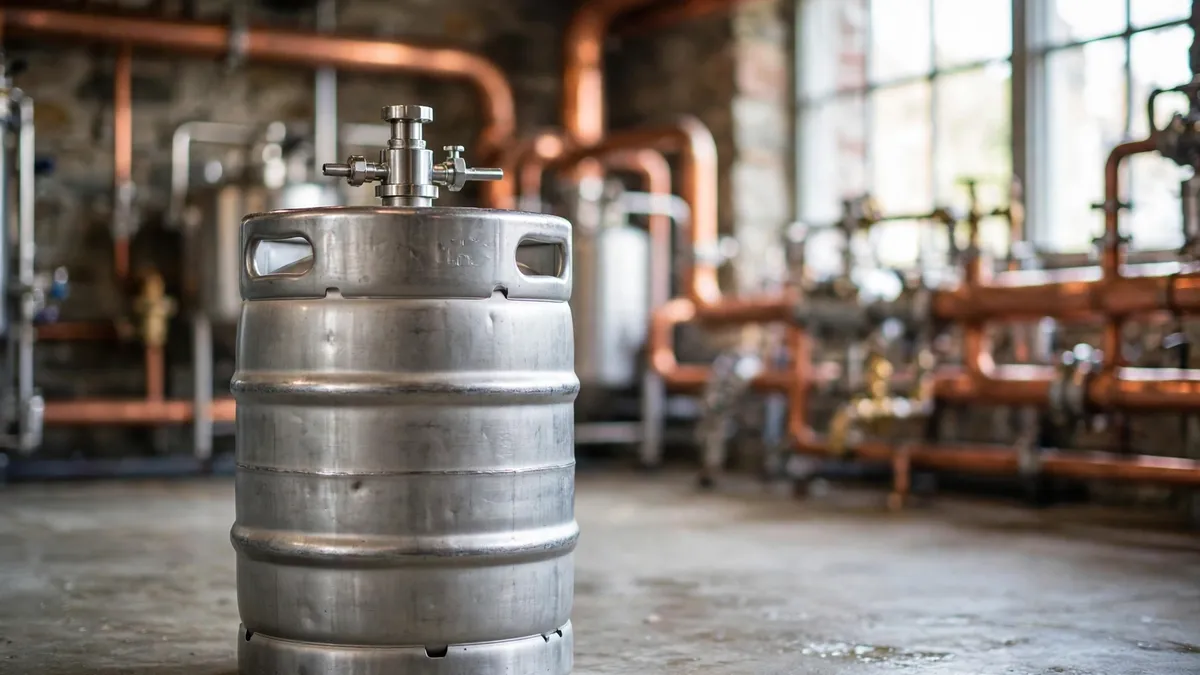

A Sanke keg is the standard stainless steel keg used by most commercial breweries to store, transport and serve beer. The central question is simple: what makes a Sanke keg different from other kegs, and what do you need to tap one? A Sanke keg has a single valve on top, opened by a coupler, with a spear inside that reaches to the bottom, so pressurised gas pushes the beer up and out to the tap.
The name comes from Sankey, short for sanitary key, and the design has become the default for draught beer in North America and much of Europe. If you have ever ordered a pint in a bar, it almost certainly came from a Sanke keg. This guide explains how the keg works, the sizes available, the coupler types, how to tap one safely, and how Sanke kegs compare with the alternatives home brewers use.
Key takeaways
- A Sanke keg is a stainless steel keg with a single valve on top, also known as a Sankey keg.
- The coupler, or sanitary key, opens the valve and connects the keg to the gas and beer lines.
- Most kegs in North America use a D-type coupler; European kegs often use an S-type.
- Common sizes are the half-barrel at 15.5 gallons, the quarter-barrel at 7.75 gallons and the sixth-barrel at 5.17 gallons.
- A keg must stay upright with the valve on top for the beer to dispense properly.
- Always check the coupler matches the keg valve before tapping, and never force a fit.
What a Sanke keg is
A Sanke keg is a stainless steel vessel built to hold beer under pressure. It has one opening on the top, fitted with a self-closing valve, and inside that opening sits a spear, a long metal tube that runs down to the bottom of the keg. When the keg is tapped, the coupler opens the valve, gas flows in through one side, and beer is pushed up the spear and out through the beer line to the tap.
The design replaced older systems that needed two connections and a separate bunghole for filling and cleaning, sealed with a wooden bung. Those older taps, with names such as Golden Gate, Hoff-Stevens and Peerless, worked well enough in the 1950s and 1960s, but the wooden bung was a sanitation problem. The Sanke system, with its single sealed valve and internal spear, is cleaner, simpler and easier to handle, which is why most major breweries now use internally speared kegs.
How the coupler works
The coupler is the fitting that connects the keg to the draught system, and it is also known as the sanitary key, which is where the Sanke name comes from. To tap a keg, you place the coupler over the valve, twist or press it into place so it locks, and then pull the handle or lever. The lever pushes a probe down into the valve, opening it so gas can flow in and beer can flow out.
Gas, usually carbon dioxide, enters through a side port on the coupler and pressurises the headspace above the beer. That pressure does two jobs: it keeps the beer carbonated, and it provides the force that pushes the beer up the spear, through the beer line and out of the tap. The coupler has valves that control the flow of beer out and gas in, and when you disengage it, the keg valve closes itself again, sealing the keg.
Keg sizes
Keg sizes are not standardised worldwide, and the same volume can come in a differently shaped keg with a different tap system. In the United States, brewers most commonly sell beer in half-barrels of 15.5 gallons, quarter-barrels of 7.75 gallons, and sixth-barrels of 5.17 gallons. The half-barrel is the size most people mean when they say keg, and it is the most common size in restaurants, bars and home use.
In Europe, the most common keg size is 50 litres, and the British standard keg is 11 imperial gallons, which is almost exactly 50 litres by coincidence. In Germany, where the standard serving is half a litre, a 50-litre keg holds about 100 beers. Whatever the size, the Sanke valve and spear work the same way, and the coupler type depends on the valve fitted to the keg, not on the volume it holds.
Coupler types: D, S, A, G, U and M
There are six main coupler types, and using the wrong one is the most common mistake in draught beer. The D-type, known as the American Sankey, is the standard in North America and fits most American and Canadian beers, including the big national brands. The S-type, the European Sankey, is used for many European imports, including well-known lagers from the Netherlands, Belgium and the Czech Republic.
The other four cover narrower ground. The A-type, or German slider, slides sideways onto the valve and is common in Germany and Belgium. The G-type, or Grundy, uses a triangular bayonet lock and is used mainly for British beers. The U-type, also called the Irish or UEC coupler, is used for Guinness and several other Irish brands. The M-type is a German coupler used by a small number of breweries. Always confirm the valve with the brewery or distributor before ordering a coupler, since the brand alone is not a reliable guide.

Sanke kegs compared
Sanke kegs are the commercial standard, but they are not the only keg in use. The table below compares the main types.
| Keg type | Best for | Keep in mind |
|---|---|---|
| Sanke, D-type | North American commercial beer | Needs the matching D coupler |
| Sanke, S-type | European imports | Looks like a D-type but the probe differs |
| Cornelius, or Corny | Home brewing | Tall and narrow, uses no coupler |
| Sixth-barrel Sanke | Small kegerators at home | Same volume as a Corny keg |
| KeyKeg | Disposable, single-use serving | Bag inside the keg, gas never touches the beer |
| Cask | Traditional unpressurised ale | Two openings and no spear, unlike a keg |
Tapping a Sanke keg safely
Tapping a keg is straightforward if you take it step by step. First, chill the keg thoroughly, since warm beer foams. Second, check that your coupler matches the keg valve: a D-type and an S-type look alike, but their probes differ in depth and diameter, and forcing one onto the other can deform the seal and cause a constant gas leak. Third, make sure the gas is connected and the pressure is set correctly for the beer.
To tap, place the coupler over the valve, lock it in place, and pull the handle to engage the probe. Open the tap briefly to check the flow, and pour a small amount to clear the line. If the beer pours foamy, the usual causes are a warm keg, too much pressure, or a long beer line that needs cooling. When you finish, push the handle back to disengage the coupler, and the valve will close itself. Never try to open a keg valve without a coupler, and never point the valve at your face: the keg is under pressure.
Storing and handling kegs
A keg must stay upright, with the opening on top, for the beer to dispense. If a keg is tipped on its side, the spear no longer reaches the beer, and the gas will push foam or nothing at all. Keep kegs cold and out of direct sunlight, and let a keg that has been moved or shaken rest for a few hours before tapping, so the beer settles and the foam subsides.
Empty kegs are usually returnable, and most breweries and distributors charge a deposit that is refunded when the keg comes back. Do not try to open an empty keg yourself: the valve is under pressure even when the beer is gone, and the spear assembly is fitted with tools at the brewery. Return the keg to the supplier, who will clean, inspect and refill it. A well-maintained stainless steel keg can be used for decades.
Your Sanke keg checklist
Run through this list before you tap a keg.
- Chill the keg thoroughly before tapping, since warm beer foams.
- Confirm the coupler type matches the keg valve, D or S.
- Check the gas supply is connected and the pressure is set.
- Keep the keg upright with the valve on top at all times.
- Let a moved or shaken keg rest for a few hours before tapping.
- Lock the coupler fully before pulling the handle.
- Pour a small amount first to clear the line.
- Never force a coupler that does not fit the valve.
- Disengage the coupler when you finish, so the valve seals itself.
- Return the empty keg to the supplier for the deposit and reuse.
Frequently asked questions
What does Sanke mean?
Sanke, also spelled Sankey, is short for sanitary key, which is the coupler that opens the keg valve. A Sanke keg is a stainless steel keg with a single valve on top and a spear inside, used by most commercial breweries to store, transport and serve beer under pressure.
What is the difference between a D-type and an S-type coupler?
Both use a bayonet lock and look alike at first glance, but the S-type probe is narrower and longer than the D-type probe. The D-type is the standard in North America, while the S-type is used for many European imports. Forcing one onto the other can deform the spear seal and cause a gas leak, so check the valve before tapping.
How many beers are in a half-barrel keg?
A half-barrel holds 15.5 US gallons, which is about 58.7 litres. At a standard 12-ounce serving that is roughly 165 beers, and at a 16-ounce pint it is about 124. The exact number depends on the serving size and how much foam is lost in pouring.
Can I use a Sanke keg at home?
Yes, if you have a kegerator or a draught setup with the right coupler and gas supply. Sixth-barrel Sanke kegs, at 5.17 gallons, are the most practical size for home use, since they fit small fridges and hold the same volume as a Cornelius keg. Check the coupler type with your supplier first.
Why is my keg pouring foam?
The most common causes are a warm keg, too much gas pressure, or a beer line that is warm or too long. Chill the keg fully, check the pressure setting for the beer style, and let a shaken keg rest for a few hours. If the problem persists, check the coupler seal and the line for kinks or damage.
Do Sanke kegs need cleaning?
Yes, but that is normally the brewery’s job. Returned kegs are cleaned, inspected and refilled by the supplier, and the sealed Sanke valve keeps the inside clean between uses. At home, clean the coupler and the beer lines regularly, since those are the parts that touch the beer after it leaves the keg.
The bottom line
A Sanke keg is a simple idea done well: one valve, one spear and one coupler, holding beer under pressure from the brewery to the glass. Match the coupler to the valve, keep the keg cold and upright, and the system does the rest. For more on food and drink at home, see our beer subscription guide, our easy Belgian recipes at home, and our guide to the best inexpensive wines.
Alcohol should be enjoyed responsibly and only by people of legal drinking age in your country. If you or someone you know needs help with drinking, speak to a doctor or a local support service.