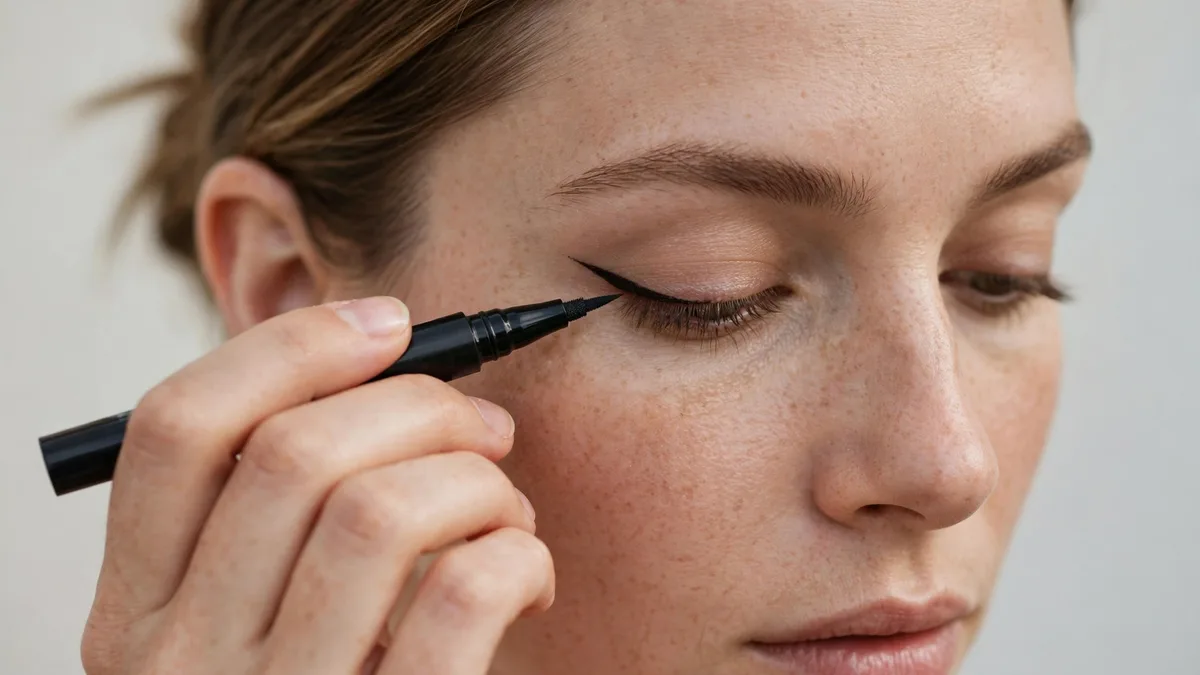

Liquid eyeliner is a fluid eye makeup that is applied with a fine tip, and the question most people ask about it is a simple one: is it worth the learning curve? The short answer is yes, if you want a sharp, defined line that a pencil cannot match, because liquid eyeliner lays down dense colour in a single stroke and stays put once it dries. A felt-tip pen gives a beginner the most control, while a pot with a brush suits anyone who enjoys a more artistic finish.
What puts many people off is the fear of a wobbly line, yet that fear is mostly about technique rather than talent. A steady hand, a good mirror and a formula that suits your eye shape will carry you further than any amount of practice with the wrong product. This guide covers the formats, the application steps, the mistakes worth avoiding and how to remove liquid eyeliner gently at the end of the day.
Key takeaways
- Liquid eyeliner gives a sharper, denser line than pencil or powder, and it sets once it dries.
- A felt-tip pen is the easiest format for beginners; a pot and brush gives more freedom for detailed looks.
- Rest your elbow, look down into a mirror, and draw the line in short strokes rather than one long sweep.
- Draw the wing by extending the lower lash line upwards, then join it back to the lash line.
- Let the liner dry fully before opening your eyes wide, or it can transfer onto the lid.
- Remove liquid eyeliner with a gentle eye makeup remover, never by scrubbing or pulling at the skin.
What liquid eyeliner is
Liquid eyeliner is a water-based or film-forming liquid that is brushed or drawn along the lash line. Unlike a pencil, which deposits a softer, waxy line, a liquid formula dries to a smooth film that holds its edge for hours. That is why it is the standard choice for a winged look, a graphic line or any style where the edge itself is the point. The Wikipedia page on eye liner traces the product from ancient kohl to the modern felt-tip pen.
Most liquid eyeliners fall into two camps: pens and pots. A pen has a felt or brush tip fed by a reservoir inside the barrel, much like a marker, and it is ready to use with no extra tools. A pot holds the liquid in a small jar, and you pick it up with a separate fine brush, which gives you control over how much product you load and how thick the line becomes. Both formats can be excellent, and the right choice depends more on your hand than on the price.
Pen, pot or cake: which formula suits you
| Format | Best for | Control | Removal |
|---|---|---|---|
| Felt-tip pen | Beginners and quick everyday lines | High: the tip does the shaping | Usually easy with micellar water |
| Brush-tip pen | Winged lines and varied thickness | High: flexible tip follows the lid | Usually easy with micellar water |
| Pot and brush | Detailed and artistic looks | Very high: you choose the brush | Depends on formula, often needs oil |
| Cake liner | Soft lines and smudged effects | Moderate: needs water to activate | Easy: it is water-based |
| Waterproof pen | Long days, humidity and tears | High: same as a standard pen | Needs an oil-based remover |
If you are buying your first liquid eyeliner, a felt-tip pen is the sensible starting point. It needs no brush, no loading and no clean-up, and the firm tip forgives a slightly unsteady hand. A brush-tip pen is the next step when you want a wing that flicks and tapers, since the flexible tip can press down for a thick line and lift for a fine point. Pots are best left until you enjoy the process, because they reward patience and punish rushing.

How to apply liquid eyeliner
Start with clean, dry eyelids. Any moisturiser left on the lid will make the liner slide, so let skincare sink in for a few minutes first. If your lids tend to get oily during the day, a light dusting of translucent powder or a primer made for eyes will help the line stay where you put it.
Sit down, rest your elbow on a table, and hold a mirror slightly below eye level so that you are looking down into it. This keeps the lid flat and gives you a clear view of the lash line. Keep the eye you are working on relaxed and half open rather than stretched wide, because pulling the skin tight changes the shape of the line once you let go.
Draw the line in short, connected strokes rather than one long sweep. Start at the inner corner with a thin line, then build outwards, pressing slightly harder as you reach the outer third, where the line should be thickest. If the line goes wobbly, let it dry, then tidy the edge with a cotton bud dipped in micellar water.
Let the liner dry before you blink hard or open your eyes fully. Most formulas set within half a minute, and touching the lid too soon is the main cause of transfer marks on the crease. If you wear mascara, apply it after the liner, since the liner sits on the skin and the mascara sits on the lashes.
Getting the wing right
The wing is the part that worries people most, yet it follows a simple rule: extend the lower lash line, not the upper one. Imagine a line running from the outer corner of your eye towards the end of your eyebrow, and draw a short flick along that angle. Then draw a second line from the tip of the flick back down to the middle of your upper lash line, and fill in the triangle you have made. Keeping the flick short at first makes the whole thing easier to control.
Symmetry is the other challenge, and the honest truth is that nobody’s eyes are perfectly symmetrical. Aim for a good match rather than a mirror image, and compare the two eyes from a normal distance rather than with your nose against the mirror. If one wing ends up longer, shorten the longer one rather than lengthening the shorter one, since a small wing is easier to wear than an oversized one. Many of the looks in our roundup of viral TikTok beauty products depend on exactly this kind of patience, and they look simple on camera only because the creator has practised the same flick many times.
Eye shape changes what works best. On hooded eyes, the wing can disappear when the eye is open, so draw the flick with the eye open and keep it slightly higher than you think it needs to be. On round eyes, extending the flick a little further outwards gives a pleasing elongated effect, while on downturned eyes, a flick that points upwards lifts the whole look.
Common mistakes and how to fix them
The most common mistake is starting with the wing before the lash line is drawn. Without the base line, the flick has nothing to join to, and the result floats above the lashes. Always draw the lash line first, then add the wing as an extension of it, and the look will sit together naturally.
The second mistake is using too much product. A pen tip loaded with liquid will flood the lid and bleed into fine lines, so wipe the tip lightly on the back of your hand before you start if it looks wet. A pot user should load the brush, then wipe one side of it on the rim of the jar.
Finally, many people throw a pen away when the tip starts to feel dry, when the problem is often storage. Pens should be stored horizontally so the tip stays saturated, and the cap should click shut every time, since a loose cap dries the tip out within days.
A checklist for buying your first liquid eyeliner
- Choose a felt-tip pen first: it is the most forgiving format for a beginner.
- Pick black for definition or brown for a softer daytime look.
- Check the tip in the shop: it should feel firm, not floppy or frayed.
- Store the pen horizontally at home so the tip stays saturated.
- Buy a gentle eye makeup remover at the same time, especially for waterproof formulas.
- Patch test a new formula on the back of your hand before using it near your eyes.
- Replace a pen when the tip goes scratchy or the line starts to skip.
- Keep your receipt: a pen that dries out in a week is worth exchanging.
Shopping for makeup is easier when you know what suits you, and hair matters just as much as the eyes. Our roundup of trending hairstyles for women pairs well with a sharp liner look, while rosemary oil for hair growth is worth a read if you are building a fuller beauty routine around the same mirror.
Frequently asked questions
Is liquid eyeliner hard to apply?
It takes a little practice, but it is not hard once you have the setup right. Rest your elbow, look down into a mirror, and draw in short strokes rather than one long line. Most people find it clicks within a week of daily use.
Should beginners use a pen or a pot?
A pen, without question. A felt-tip pen needs no brush, no loading and no clean-up, and the firm tip does much of the shaping for you. A pot and brush gives more control, but it is better suited to someone who already enjoys the process and wants to experiment with detailed looks.
How do I stop liquid eyeliner smudging?
Start with a clean, dry lid, and let the liner dry fully before you blink hard or open your eyes wide. If your lids get oily, a light dusting of translucent powder or an eye primer helps. Waterproof formulas also resist smudging, although they need an oil-based remover at the end of the day.
How long does liquid eyeliner last once opened?
Most liquid eyeliners are best used within three to six months of opening, since the tip can dry out and the formula is used so close to the eye. If the line starts to skip or the colour looks grey rather than black, replace it.
Can I wear liquid eyeliner with sensitive eyes?
Many people with sensitive eyes wear it without trouble, but choose a fragrance-free formula and patch test it on the back of your hand first. Avoid applying liner to the waterline if your eyes water easily, and remove it gently every night rather than sleeping in it.
What is the easiest winged eyeliner for hooded eyes?
Draw the wing with your eye open, looking straight into the mirror, and keep the flick slightly higher than feels natural. A thinner line usually works better on hooded eyes, and a small wing that you can see when the eye is open beats a large one that disappears into the crease.
The bottom line
Liquid eyeliner is the sharpest tool in a makeup bag, and it rewards a calm approach more than a steady hand. Choose a felt-tip pen, rest your elbow, draw in short strokes, and let the line dry before you judge it. The wing will not be perfect on the first day, and it does not need to be: a small, neat line worn with confidence looks better than a dramatic flick that took half an hour.
If your eyes are sensitive, or you have had a reaction to eye makeup before, patch test any new liquid eyeliner first and stop using it if you notice redness, itching or swelling. This article is general information, not medical advice, and an eye specialist can help if irritation keeps coming back.