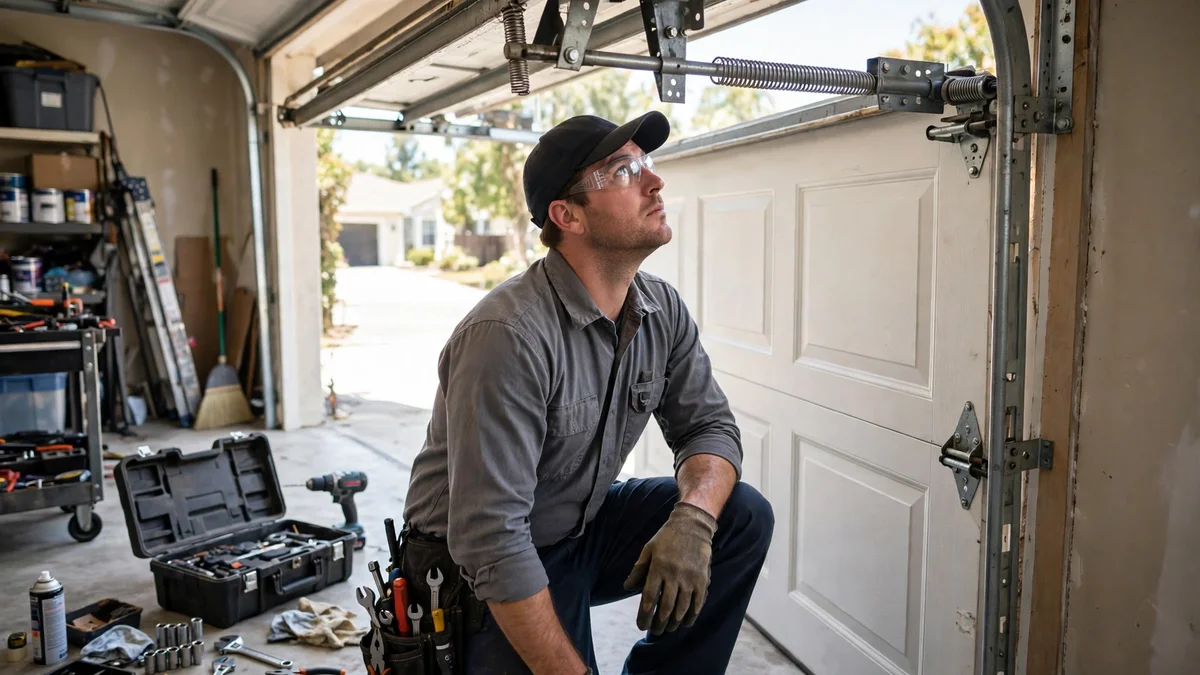

Emergency garage door repair near me is the search people make when a garage door will not open, will not close, or has come off its tracks, often with a car trapped inside or the house left insecure. The question in that moment is a practical one: what can I safely check myself, and how do I find a trustworthy repair service quickly? The short answer is that a few simple checks are safe for anyone, such as the opener, the remote and the power supply, while anything involving the springs, cables or tracks belongs to a trained technician, because those parts carry enormous tension.
A garage door is the largest moving part of most homes, and it is also one of the heaviest. The springs that balance it are wound tight enough to lift that weight with one hand. When those parts fail, the door can drop without warning, which is why this is one repair where enthusiasm and a toolbox are not enough.
Key takeaways
- Emergency garage door repair covers doors that will not open or close, doors off their tracks, broken springs and failed openers.
- Safe checks for anyone include the opener, the remote batteries, the power supply and the safety sensors.
- Never touch the springs, cables or lifting mechanism; they are under high tension and can cause serious injury.
- If the door is stuck open, secure the garage another way and do not leave the house unattended.
- Search locally, check reviews and response times, and ask for the callout charge before booking.
- Regular lubrication and a yearly inspection prevent many of the failures that lead to emergency callouts.
What counts as a garage door emergency
A door that will not close is an emergency, because the house is left open and insecure. A door that will not open is an emergency when a car is trapped inside, or when the garage is the only way into the house. A door that has come partly off its tracks, a cable that has snapped, or a spring that has broken with a loud bang are all emergencies, because the door is no longer held safely and may drop.
Other faults are urgent but less dramatic. A noisy opener, a remote that works only sometimes, a door that moves slowly, or weather seals that have come loose can usually wait a day or two, provided the door still opens and closes safely. The distinction matters, because emergency callouts cost more, and the premium is best spent on faults that genuinely cannot wait. The Wikipedia page on garage doors describes the main types, from sectional and roller doors to the springs and openers that operate them, and that anatomy is what a technician works through during a diagnosis.
If the door is stuck open and you have to leave the house, do what you can to secure the garage: lock any internal door between the garage and the house, move valuables out of sight, and ask a neighbour to keep an eye on the property.
Safe checks before you call
Start with the opener. Check that it has power, that the plug is in, and that the breaker for the garage circuit has not tripped. If the opener has a battery backup, check whether it is showing a fault light. Many callouts end with a tripped breaker or a plug knocked loose, and both take seconds to rule out.
Next, check the remote and the wall control. Replace the remote batteries, try the wall button, and check whether the opener responds to either. If the wall button works but the remote does not, the problem is the remote or its signal, not the door. If neither works, the problem is more likely the opener or the power supply.
Then look at the safety sensors near the floor on either side of the door. These small sensors stop the door closing on anything in its path, and they are easily knocked out of alignment or covered in dust. Wipe the lenses gently and check that both sensors show a steady light. A blinking or dark sensor is a common reason for a door that starts to close and then reverses. Our guide to emergency garage door repair covers the same first steps, because most technicians begin every visit by checking the simple causes before they touch the mechanism.
Finally, look at the door itself from a safe distance. Check whether it sits evenly in its tracks, whether any rollers look damaged, and whether the cables on either side look intact. Do not touch the springs, the cables or the brackets that hold them, and do not try to lift a door that feels heavy or uneven. If anything looks broken, bent or out of place, leave it alone and call a professional.
Garage door faults compared
| Symptom | Likely cause | How urgent it is |
|---|---|---|
| Door will not close | Sensor fault, opener fault, obstruction | Emergency, house left insecure |
| Door will not open | Broken spring, opener fault, power loss | Emergency if a car is trapped |
| Loud bang, then door heavy | Broken torsion or extension spring | Emergency, do not use the door |
| Door off its tracks | Damaged roller, bent track, impact | Emergency, door may drop |
| Door reverses when closing | Sensor alignment or obstruction | Often a simple fix, check sensors first |
| Noisy or slow operation | Worn rollers, dry hinges, opener wear | Book soon, not an emergency |

How to find a repair service near you
Search locally and check that the business actually serves your area, rather than a national call centre that passes the job on. A local company usually knows the common door types in your neighbourhood, carries the right parts, and can give a realistic arrival time. Look for recent reviews that mention emergency work specifically, since a company that is good at planned installations is not always fast at callouts.
When you call, describe the symptoms clearly: the type of door, what it is doing or not doing, any noise you heard, and whether the door is stuck open or closed. Ask for the callout charge, the hourly rate, and whether parts are included or charged separately. A reputable service will give you a time window and a price structure before dispatching anyone, and will tell you honestly if the job can wait until normal hours.
Ask what the technician will do on arrival. A good visit follows a clear order: secure the door, diagnose the fault, explain the repair and the cost, then carry out the work and test the door through several full cycles. If a part is not on the van, the technician should make the door safe, explain what is needed, and agree a return date. The same comparison habit helps with other home services: our guide to window tinting near me shows how checking local reviews, response times and written prices works for any trade you find through a near-me search.
Be cautious of anyone who quotes a price without asking about the door, who insists the whole door must be replaced before inspecting it, or who will not give a business name and address.
What the repair usually involves
Spring replacement is the most common emergency repair, and it is also the one that must never be attempted at home. Torsion springs sit above the door and extension springs run along the tracks, and both are wound under enough tension to balance the full weight of the door. Replacing them needs specialist tools and training, and a spring that slips during the work can cause serious injury.
Cable and roller repairs are also common. Cables fray over time and can snap without warning, leaving the door hanging unevenly. Rollers wear, crack or come out of their tracks, which makes the door noisy, stiff or stuck. Both repairs involve supporting the weight of the door safely while the parts are changed, which is why they belong to a professional even when they look simple.
Opener repairs range from replacing a worn gear or a failed circuit board to fitting a new opener altogether. If the opener is old and parts are no longer available, replacement is often the better choice, and a new opener brings quieter operation and modern safety features. The same care with the fabric of the house applies elsewhere: our guide to how to reseal windows notes that a door or window that is properly sealed and balanced is what keeps draughts, water and noise out, and a garage door deserves the same attention.
A checklist for a garage door emergency
- Check the opener power, the breaker and the remote batteries.
- Try the wall control as well as the remote.
- Wipe the safety sensors and check both show a steady light.
- Look at the door from a safe distance for damage or unevenness.
- Never touch the springs, cables or lifting mechanism.
- Secure the house another way if the door is stuck open.
- Search locally, read recent emergency reviews, and ask for prices before booking.
- Ask the technician to test the door through several full cycles before leaving.
Frequently asked questions
What is emergency garage door repair?
Emergency garage door repair is urgent service for a door that will not open or close, has come off its tracks, or has a broken spring or cable. It is usually available outside normal working hours and prioritises faults that leave a home insecure or a car trapped.
Can I fix a broken garage door spring myself?
No. Garage door springs are under high tension and can cause serious injury if they slip or break during handling. Spring replacement needs specialist tools and training, and it should always be done by a qualified technician.
Why does my garage door reverse when closing?
The most common cause is the safety sensors near the floor. If they are dirty, misaligned or blocked, the door reverses as a safety measure. Wipe the lenses and check that both sensors show a steady light; if the problem persists, call a technician.
How much does emergency garage door repair cost?
It depends on the fault, the time of day and the parts needed. Emergency visits usually carry a higher callout charge than a normal appointment. Ask for the callout charge, the hourly rate and the parts cost before the work starts.
How do I find a reliable repair service near me?
Search for local companies, check recent reviews that mention emergency work, and confirm the business serves your area. Call and ask for the price structure and a realistic arrival time before booking, and be wary of anyone who will not give a business name and address.
How can I prevent garage door emergencies?
Have the door inspected once a year, lubricate the rollers and hinges, keep the tracks clear, and replace worn parts before they fail. A door that has become noisy, slow or uneven is warning you, and acting on that warning is far cheaper than an emergency callout.
The bottom line
Emergency garage door repair near me is a search you make when the door will not move and the house is left open or a car is trapped. Check the power, the remote and the sensors, never touch the springs or cables, and call a local technician with the symptoms written down. Agree the price before work starts, insist on a full test before the technician leaves, and book a yearly inspection afterwards, because the cheapest emergency repair is the one that never happens.
Safety note: this article is general information only. Garage door springs and cables are under high tension and can cause serious injury. Never attempt to repair, adjust or replace springs, cables or the lifting mechanism yourself; always use a trained technician. If a door is stuck open, secure the property another way and do not try to force the door.