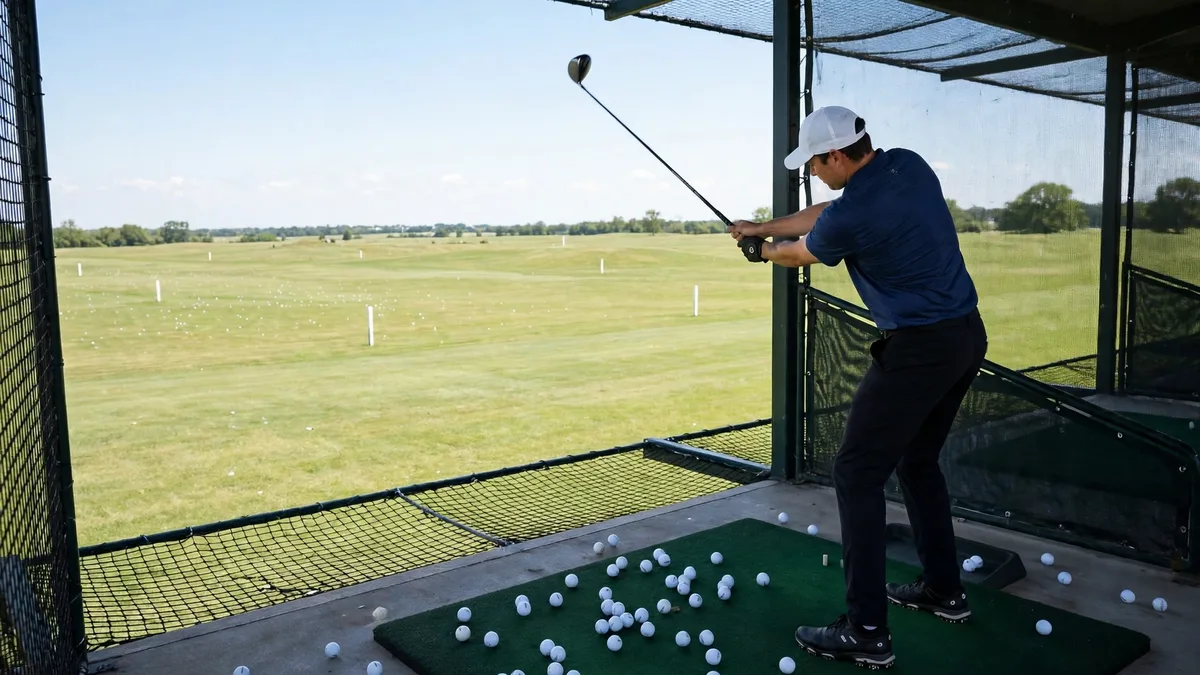

Golf range driving is the practice of hitting balls at a driving range, a dedicated facility where golfers work on their swing without playing a full round. A driving range gives you a bay to stand in, a bucket of balls and a wide open field with distance markers, so you can repeat the same shot again and again until it starts to feel natural. This guide explains how a range works, what to bring, the etiquette that keeps everyone safe and how to practise with purpose rather than just hitting balls.
A range is the best place to learn golf and the best place to keep improving at it. On a course, every shot counts and a bad one costs you strokes; on a range, a bad shot costs you nothing but a ball, and you can try again straight away. Beginners can learn the basics without holding anyone up, and experienced players can work on a single part of their swing or warm up before a round.
Key takeaways
- Golf range driving means practising your swing at a driving range, hitting balls from a bay into an open field.
- Ranges provide the bay, the mat, the balls and the distance markers; you bring clubs, a glove and comfortable shoes.
- Most ranges sell balls by the bucket, and many let you hire clubs if you do not own a set.
- Never walk onto the field, cross in front of another bay or swing a club where someone could be hit.
- Warm up with short shots, then work through your clubs with a target in mind for each ball.
- A focused half-hour of practice, with a clear aim for every shot, beats an hour of hitting balls without thinking.
What a driving range is
A driving range is a large open field, usually with a line of covered bays along one edge where golfers stand to hit. Each bay has a mat to hit from, a rubber tee for use with a driver or wood, and space for a bag of clubs. Balls are supplied by the range, either from a dispenser you fill a basket from or from a ball machine, and the field ahead is marked with distance signs and targets, so you can see how far each shot travels. Some ranges have grass teeing areas as well as mats, and many have floodlights for evening practice.
Most ranges offer more than just the driving bays. There is often a chipping green for short shots, a putting green for work on the putter, and sometimes a practice bunker for sand shots. Larger venues add a shop, a café, coaching and club fitting, and some have technology that tracks each shot and shows its distance and direction on a screen. The basic idea is the same everywhere, though: a safe place to hit a lot of golf balls, with something to aim at.

What to bring to the range
You do not need much for a first visit. Bring your clubs if you have them, a golf glove if you use one, and comfortable shoes with a good grip. Trainers are fine at most ranges, although golf shoes give better footing, especially on a wet mat. Bring a bottle of water, and dress for the weather: ranges are outdoors, and a covered bay keeps the rain off your head but not the wind off your hands. A towel is useful for wiping grips and clubs.
If you do not own clubs, ask at reception. Many ranges hire out sets, sometimes for a small fee, and some include a few clubs with a bucket of balls. A beginner does not need a full set: a 7-iron, a wedge and a putter will cover most of what a first session needs, and a driver can be added once the shorter clubs feel comfortable.
How a session at the range works
A typical visit follows a simple pattern. You pay at reception or at a kiosk, collect a basket or bucket of balls, and find a free bay. Some ranges assign bays, and some let you choose. Set your bag behind you, place a few balls on the mat, and start with a few gentle practice swings without a ball, to loosen up and check your footing. Then hit a few short shots with a wedge or a short iron before moving to longer clubs.
When your bucket is empty, the session is over, unless you buy another. Most ranges offer different bucket sizes, so a beginner can start small and an experienced player can buy a larger one for a longer session. If you are sharing a bay with a friend, take turns hitting, one person at a time, and stand well behind the hitter while you wait.
Range etiquette and safety
Safety comes first at a driving range, because a golf ball struck at full speed can cause a serious injury. Never walk onto the field to collect a ball, even if it has only gone a short distance, and never cross in front of another bay while someone is hitting. Stay behind the hitting line at all times, and if a ball comes towards you, turn away and cover your head. If you hit a shot that goes wide towards another bay, call out to warn people nearby.
The rest of range etiquette is about consideration. Keep noise down while the golfer beside you is swinging, and do not stand close behind them. Wait your turn if the range is busy, and keep your session to a reasonable length when others are waiting for a bay. Do not take more balls than you have paid for, and do not hit from the grass if the range asks you to use the mats. Treat the range as a shared space, and it stays pleasant for everyone. The Wikipedia page on driving ranges describes the usual layout of bays, mats and targets.
| Practice area | What it trains | How to use it |
|---|---|---|
| Driving range | Full swing, distance and direction | Hit from the bay towards a chosen target marker |
| Chipping green | Short shots around the green | Practise landing the ball on a chosen spot |
| Putting green | Putting pace and line | Work on short putts first, then longer ones |
| Practice bunker | Sand shots and explosion shots | Strike the sand behind the ball, not the ball itself |
| Warm-up nets | Swing rhythm without watching the ball fly | Use for loosening up before a round |
Practice tips that actually help
The most common mistake at a range is hitting ball after ball with no aim. A better session has a plan. Start with ten minutes of short shots, using a wedge and aiming at a near target, to warm up your hands and your rhythm. Then pick one club and one target, and hit ten balls with the same club, watching where each one finishes. Only then move to the next club, working from short irons through to longer clubs, and finishing with a few drives.
Pay attention to what the ball does rather than how the swing feels. If your shots consistently go to the right, aim slightly left and see if the pattern changes. If you are topping the ball, slow the swing down and focus on making clean contact. Take a short pause between shots, step back, and set up again, rather than rushing from one ball to the next. Coaching helps too: even a single lesson can give you one clear thing to practise, which is worth more than a hundred unguided buckets.
A checklist for your first visit to a driving range
Use this checklist before your first session, so you arrive ready and enjoy it rather than worrying about what you have missed.
- Wear comfortable clothes and shoes with a good grip, and dress for the weather.
- Bring clubs if you have them, or ask at reception about hiring a set.
- Buy the smallest bucket first, so you can judge how long a session suits you.
- Start with short shots and a wedge, then work through your clubs from short to long.
- Pick a target for every shot, and watch where each ball finishes.
- Stay behind the hitting line, never walk onto the field, and call out if a shot goes wide.
- Take a short pause between shots, and step back to set up again.
- Return your basket when you finish, and leave the bay tidy for the next golfer.
Frequently asked questions
What is a golf driving range?
A driving range is a practice facility where golfers hit balls from a bay into a large open field. Each bay has a mat to hit from, and the field has distance markers and targets so you can judge how far each shot travels. Most ranges also have chipping and putting greens. It is a place to learn, warm up and practise, without playing a full round of golf.
How much does a driving range cost?
Prices vary by venue and by bucket size, and they are usually higher at peak times such as weekend mornings. Most ranges charge per bucket of balls, with smaller buckets for a short session and larger ones for longer practice. Some offer memberships or off-peak deals. Check the range’s website or ask at reception before you visit, so you know the options.
Do I need my own clubs to use a driving range?
No. Many ranges hire out clubs, and some include a few clubs with a bucket of balls. A beginner can manage with a 7-iron, a wedge and a putter, and can add a driver later. If you plan to practise regularly, buying a second-hand set is worth considering, but there is no need to spend on clubs before your first visit.
Can beginners use a driving range?
Yes, ranges are the best place for a beginner to start. You can learn the basics at your own pace, without holding up other players on a course, and a bad shot costs you nothing but a ball. A single lesson with a coach is a good idea early on, so you learn a sound grip and set-up before habits form, but plenty of people start by simply hitting balls and watching what happens.
How long does a bucket of balls last?
That depends on the size of the bucket and how quickly you hit. A small bucket of around 50 balls lasts most beginners about half an hour, while a larger bucket can take an hour or more if you pause between shots. It is better to hit fewer balls with care than to rush through a large bucket, so start small.
What should I wear to a driving range?
Wear comfortable clothes you can move in, and shoes with a good grip. Trainers are acceptable at most ranges, although golf shoes give better footing on a wet mat. Dress for the weather, since ranges are outdoors, and bring a waterproof layer if rain is forecast. There is no strict dress code at most ranges, but avoid anything that restricts your swing.
The bottom line
Golf range driving is the simplest way into golf and the best way to stay sharp at it: a bay, a bucket of balls and a field full of targets, with no scorecard and no pressure. Arrive with a plan, warm up with short shots, aim at something with every ball, and respect the safety rules that keep the range safe for everyone. Do that, and an hour at the range becomes one of the most useful hours in a golfer’s week. For more on getting outdoors, read our guide to Saguaro National Park, our collection of the best picnic recipes, and our article on the artificial zoo.