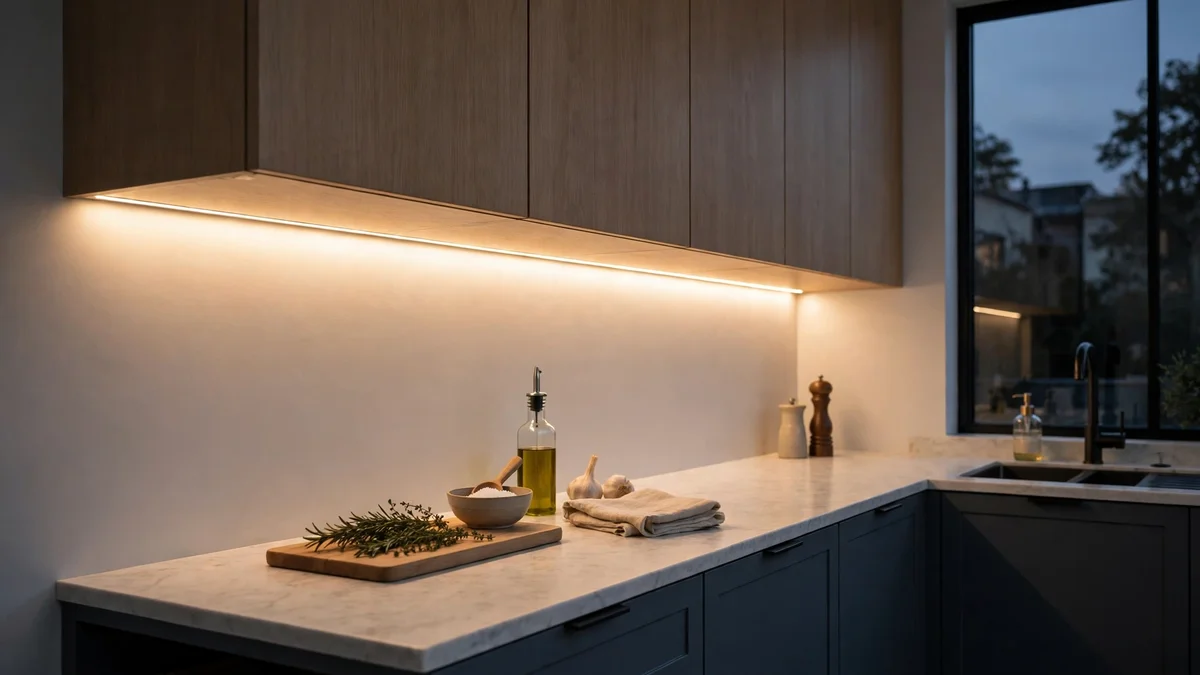

LED strip lights are the simplest way to add warm, even light to a room without a new fitting or an electrician. A strip is a flexible ribbon of small light-emitting diodes on a circuit board, sold by the reel, and you stick it where the light is needed, such as under a kitchen cabinet or behind a television. The short answer to choosing well is to match the strip to the job, buy a power supply with room to spare, and test everything before you fix it in place.
Key takeaways
- LED strip lights are flexible ribbons of diodes on a circuit board, sold by the reel.
- Choose brightness in lumens per metre, not watts, and colour temperature in Kelvin.
- Most home strips run on 12V or 24V and need a separate power supply, called a driver.
- Buy a driver rated at least 20 per cent above the strip’s total wattage.
- Use channels with diffusers to hide the individual dots of light.
- Test the full length before sticking it down.
What LED strip lights are
An LED strip light is a long, narrow, flexible circuit board with surface-mounted light-emitting diodes spaced along it, usually with a self-adhesive backing. Most strips are sold in reels of five metres and can be cut to length, but only at the marked cut points. Cutting anywhere else will break the circuit and leave part of the strip dead.
Strips run on low-voltage direct current, normally 12 volts or 24 volts, so they need a power supply, often called a driver, that converts mains electricity to the right voltage. The driver is a separate box that needs to sit somewhere ventilated and out of sight, such as inside a cabinet, and it should stay accessible, because it is the part most likely to need replacing.
The main types of LED strip lights
Single-colour white strips are the workhorses. They come in a fixed colour temperature, from warm white to daylight, and they are the best choice for task lighting, such as under kitchen cabinets or inside a wardrobe, where you want steady, useful light. They are also the simplest to wire and dim.
RGB strips can produce a range of colours by mixing red, green, and blue diodes. They suit mood lighting behind a television or along a ceiling cove, and they are controlled by a remote or an app. Their white light is a blend of the three colours, which can look less natural than a dedicated white strip, so they are not the best choice for task lighting.
RGBW strips add a separate white diode to the red, green, and blue ones, which gives a cleaner white when you want it and colour when you do not. They cost more than plain RGB strips, but they are the most flexible option where a room needs both white light and occasional colour.
The numbers that matter when you choose
The table below explains the numbers worth comparing before you buy.
| Specification | What it means | What to look for at home |
|---|---|---|
| Voltage | The low voltage the strip runs on | 12V for short runs; 24V for long runs |
| Lumens per metre | How bright the strip is | 300 to 500 for accent light; 700 or more for task lighting |
| Colour temperature (Kelvin) | How warm or cool the white looks | 2700 to 3000K warm; 3500 to 4000K neutral; 5000 to 6500K daylight |
| LEDs per metre | How closely the diodes are spaced | 60 is standard; 120 gives a smoother line |
| IP rating | How well the strip resists dust and water | IP20 for dry rooms; IP65 for kitchens and bathrooms |
| CRI | How faithfully colours look under the light | 80 or above is decent; 90 or above is better for kitchens |
| Watts per metre | How much power the strip uses | Multiply by length to size the power supply |
Brightness is the number most people get wrong. Watts tell you how much power a strip uses, not how bright it is, so compare lumens per metre instead. For a soft glow behind a television or along a shelf, 300 to 500 lumens per metre is plenty. For a worktop you actually cook on, look for 700 lumens per metre or more, and a diffuser will cut the brightness a little, so allow for that.
Colour temperature is measured in Kelvin, and it changes the feel of a room more than any other choice. Warm white, around 2700 to 3000K, feels cosy and suits bedrooms and living rooms. Neutral white, around 3500 to 4000K, is a good all-rounder for kitchens. Daylight, at 5000K and above, feels crisp and clinical, and suits a workshop better than a living room.
Voltage matters most on long runs. A 12V strip is fine for short lengths, but on a run longer than about five metres the far end can look dimmer than the near end, because the voltage drops along the strip. A 24V strip suffers less from this, so it is the better choice for long runs. If you need a long run on 12V, feed power from both ends or split it into two shorter runs.
Choosing the right strip for each room
In the kitchen, strips belong under the wall cabinets, shining down onto the worktop. Choose a warm or neutral white strip with at least 700 lumens per metre and an IP65 rating. Fit it in an aluminium channel with a diffuser, set back from the front edge so the light falls on the worktop, not into your eyes.
In the living room, strips are best used as accent lighting: behind the television, along the top of a bookcase, or inside a ceiling cove. A warm white strip at 2700K, or an RGBW strip for the option of colour, works well. Keep the brightness modest, around 300 to 500 lumens per metre, because accent lighting should add atmosphere.
How to install LED strip lights
Start by measuring the run and working out the power. Multiply the strip’s watts per metre by its length to get the total watts, then choose a driver rated at least 20 per cent above that figure. A driver that is too small will run hot, fail early, and may make the strip flicker.
Clean the surface before you stick anything down. Dust, grease, and old paint will all stop the adhesive from holding, and a strip that falls down after a week is a common complaint. Wipe the surface with a cloth and a little isopropyl alcohol or a mild cleaner, let it dry fully, and only then peel the backing. Our guide to how to make natural face wash shows how straightforward a homemade recipe can be. On rough or painted surfaces, use small mounting clips or an aluminium channel instead.
Test the full length before you fix it in place. Connect the strip to the driver, switch it on, and check that every section lights evenly, that the colour is what you expected, and that the dimmer or controller works. This is the step people skip, and it saves the most trouble: a faulty section is easy to swap before it is stuck to a wall.
Finally, hide the cables. A neat installation is mostly about what you cannot see: the driver tucked away, the cable run along a corner, and the strip out of direct view. Cable clips or trunking will do the job. Our guide to emergency AC repair makes a similar point about preparation: knowing where everything is before you start saves a difficult job later.
Common mistakes to avoid
The most common mistake is buying the wrong power supply. A driver that is too small will overheat, flicker, or fail, and a driver that is the wrong voltage will not work at all. Always match the voltage exactly, and leave at least 20 per cent of headroom on the wattage.
The second mistake is sticking the strip to a dirty or unsuitable surface. Adhesive backing is strong on a clean, smooth surface and useless on dust, grease, or flaking paint. If the strip will not stick, do not add more tape; clean the surface properly or use clips or a channel instead.

A checklist before you buy
- Measure the run and work out the total watts.
- Choose a driver rated at least 20 per cent above the total watts, at the right voltage.
- Pick the colour temperature: 2700 to 3000K warm, 3500 to 4000K neutral.
- Check the brightness in lumens per metre, not watts.
- Check the IP rating: IP20 for dry rooms, IP65 for kitchens and bathrooms.
- Decide whether you need a dimmer, a remote, or app control.
- Buy an aluminium channel and a diffuser if the strip will be visible.
- Buy a short test length first if unsure about the colour.
- Check that the strip can be cut at the length you need.
- Plan where the driver will sit, ventilated and accessible.
Frequently asked questions
Do LED strip lights need a separate power supply?
Yes. Most LED strips run on 12V or 24V, so they need a driver that converts mains electricity to the right voltage. The driver is usually sold separately, and it must match the strip’s voltage and exceed its total wattage.
Can you cut LED strip lights to length?
Yes, but only at the marked cut points, which are usually printed on the strip every few centimetres. Cutting anywhere else will break the circuit. If the length you need falls between two cut points, leave a small gap.
How long do LED strip lights last?
A good-quality strip should last many years in normal home use, and manufacturers often quote tens of thousands of hours. Heat is the main enemy, so a strip in an aluminium channel, with a driver that is not overloaded, will last longer than one on a warm surface.
Are LED strip lights expensive to run?
No. LED strips use little power compared with older forms of lighting, and a typical run of a few metres uses only a handful of watts. The exact cost depends on the strip’s wattage and how long it is on, but for most homes it is very low. Our guide to heating repair covers the other side of home energy use, where the bills are usually much larger.
Can LED strip lights be used in a bathroom?
Yes, provided you choose an IP65 strip, which is protected against splashes, and keep the driver out of the wettest zones. Check the manufacturer’s guidance, and if you are unsure about the wiring, ask a qualified electrician.
Why does one end of my LED strip look dimmer than the other?
This is usually voltage drop along a long run. The far end receives less voltage than the near end, so it looks dimmer. The fix is a 24V strip for long runs, power fed from both ends, or two shorter lengths.
The bottom line
LED strip lights are a simple, flexible way to add light where you want it, but the result depends on a few decisions before you buy: brightness in lumens per metre, colour temperature, IP rating, and a power supply with at least 20 per cent of headroom. Test the strip before you fix it down, fit it in a channel with a diffuser, and keep the driver ventilated and reachable, and the strips will look neat, feel right, and last for years.