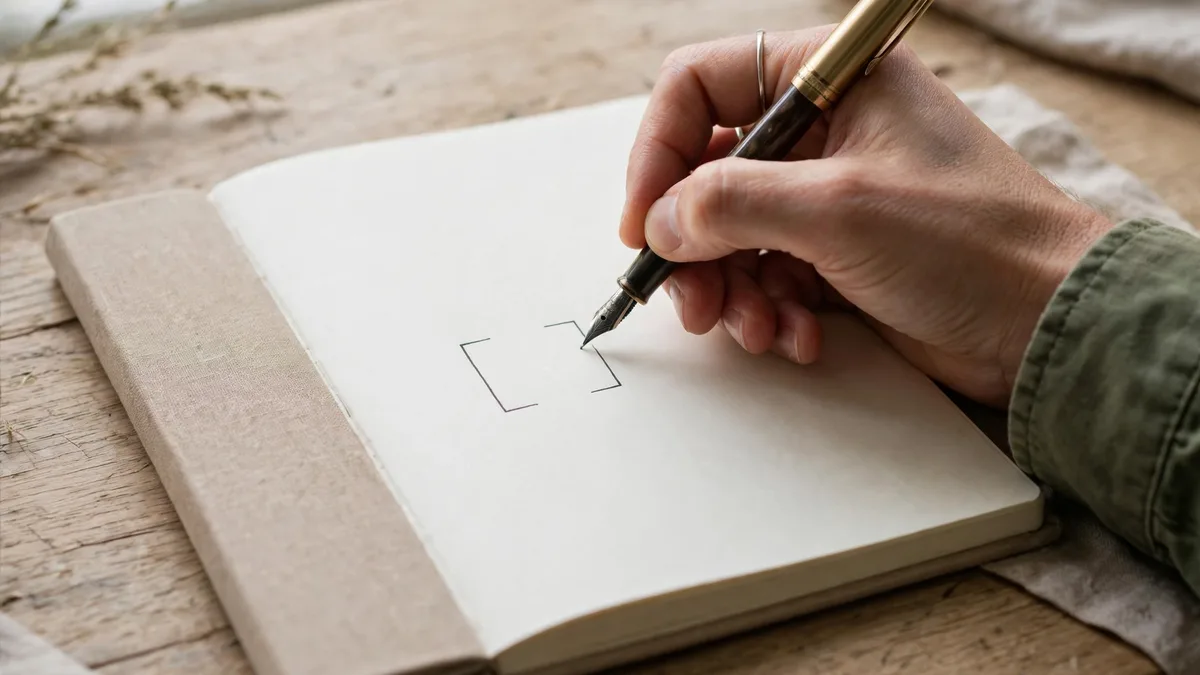

Brackets are the pairs of marks that enclose extra information, and the word covers four different shapes: round brackets ( ), square brackets [ ], curly brackets { } and angle brackets < >. The question most people ask is simple: which bracket should I use, and when? In everyday writing, round brackets do most of the work, square brackets are for edits and additions inside quotations, and curly and angle brackets belong mainly to maths and computing.
Brackets also live outside writing. The same word describes the metal supports that hold up a shelf, the fixings that carry a curtain rail, and, in dentistry, the small squares bonded to teeth during orthodontic treatment. This guide starts with the punctuation marks, because that is how most people meet brackets, then covers the other meanings so you can tell them apart.
Key takeaways
- Round brackets ( ) add extra information that could be removed without breaking the sentence.
- Square brackets [ ] show edits, clarifications and additions inside quoted text.
- Curly brackets { } group items in maths and mark blocks in computing.
- Angle brackets < > appear in web addresses, code and some technical writing.
- Brackets also mean shelf supports and the fittings used in orthodontic treatment.
- When in doubt, use round brackets and keep the aside short.
Brackets in writing
Round brackets, often called parentheses, are the brackets of everyday prose. They hold an aside: a clarification, a date, an abbreviation, or a remark that adds colour but is not essential to the sentence. The sentence should still read correctly if the bracketed words are removed, which is the simplest test of whether they belong there. If removing them breaks the grammar, the words should not be in brackets at all.
Overuse is the common fault. A paragraph with three sets of brackets feels hesitant, as if the writer kept interrupting themselves, and the reader has to work harder to follow the main thread. One pair per paragraph is usually enough. If the information matters, promote it to the main sentence; if it does not, cut it. Brackets are at their best for brief asides, such as a full name on first mention or the year of an event.
Round brackets
Round brackets have a few standard jobs. They give dates and places, as in “the exhibition (2024) drew large crowds”, and they introduce abbreviations, as in “the National Health Service (NHS)”. They also hold translations, conversions and brief explanations, and they are the usual choice for numbering items in a list within a sentence, such as (a), (b) and (c).
Punctuation around round brackets follows a simple rule. If the whole sentence sits inside the brackets, the full stop goes inside too. If only part of the sentence is bracketed, the full stop stays outside, after the closing bracket. A comma that belongs to the main sentence goes outside the brackets as well. Keeping this straight matters more than it seems, because misplaced punctuation is the most visible bracket error in everyday writing.
Square brackets
Square brackets are the editor’s mark. Their main job is to show a change made inside a quotation, so the reader knows the quoted words are not exactly as the speaker or writer produced them. A common use is to add a clarification, as in “She told him [the manager] the news”, where the bracketed words identify who “him” is. They also mark a word that has been changed to fit the grammar of the new sentence, and they show where words have been cut with an ellipsis.
Square brackets also appear in academic and technical writing to hold references, stage directions and editorial notes. In a play script, they describe actions and settings. In a dictionary entry, they may hold pronunciation. The thread running through all these uses is the same: square brackets signal that the words inside them come from someone other than the original author, or that they are an addition to the original text.
Curly and angle brackets
Curly brackets are rare in ordinary prose but common in maths and computing. In maths they group a set of values, as in {1, 2, 3}, or show that several expressions belong together. In programming they mark a block of code, gathering a group of instructions into a single unit. In everyday writing they sometimes appear in dictionaries and reference works to show word families or alternative forms.
Angle brackets have a narrower life still. They appear in web addresses and in markup languages, where they mark tags, and in some technical writing they hold placeholders, such as an email address in a template. In informal writing they sometimes mark an action or a stage direction, as in <laughs>, though this is a habit of chat messages and forums rather than formal prose. In British writing they are also used in some publishing styles to mark words that should be set in a different typeface.

Brackets compared
The four shapes look alike at a glance, but their jobs barely overlap. The table below sets out where each one belongs and where it does not.
| Bracket | Main use | Where you will see it |
|---|---|---|
| Round ( ) | Asides, dates and abbreviations | Everyday writing, essays and letters |
| Square [ ] | Edits and clarifications in quotations | Academic writing, journalism and scripts |
| Curly { } | Grouping sets and blocks | Maths, programming and reference works |
| Angle < > | Tags, placeholders and markup | Web pages, code and technical writing |
| Round ( ) in lists | Numbering items inside a sentence | Reports, instructions and exam papers |
| Square [ ] in drama | Stage directions and actions | Play scripts and screenplays |
Brackets in maths
In maths, brackets control the order in which things are worked out. An expression inside brackets is calculated before anything outside them, which is why “2 × (3 + 4)” gives 14 and not 10. Square brackets and curly brackets are used as a second and third level of grouping when a calculation already has round brackets inside it, so the reader can see which pairs match. The convention is to work from the innermost pair outwards.
This is also why mismatched brackets cause so much trouble in maths and in spreadsheets. Every opening bracket needs a closing partner, and a missing one changes the answer or breaks the formula entirely. Most people learn this in school and then forget it, until a spreadsheet returns an error and the hunt for the missing bracket begins.
Brackets beyond writing
Step away from the page and brackets are physical things. A shelf bracket is an L-shaped piece of metal or wood fixed to a wall, with one arm supporting the shelf and the other screwed to the wall. They come in many sizes, from small brackets for a spice rack to heavy-duty ones for a workbench, and the right choice depends on the weight the shelf must carry and the wall it is fixed to. Fitting them level matters more than strength alone, since a bracket that is slightly off will make the whole shelf slope.
In dentistry, brackets are the small squares bonded to the front of each tooth during orthodontic treatment with fixed braces. A wire runs through them, and the orthodontist adjusts the wire to move the teeth gradually into place. The word is the same because the job is the same: a bracket holds something in position. Treatment takes months, and the brackets are removed once the teeth have settled.
Your brackets checklist
Use this checklist whenever you are unsure about a bracket.
- Ask whether the words are essential: if they are, take them out of brackets.
- Read the sentence without the bracketed words to check it still works.
- Use round brackets for ordinary asides, dates and abbreviations.
- Use square brackets only for edits and additions inside quotations.
- Put a full stop inside only when the whole sentence is bracketed.
- Keep asides short: one pair of brackets per paragraph is usually enough.
- Match every opening bracket with a closing one, especially in maths.
- Do not mix bracket types in the same job without a reason.
- For shelves, check the weight rating before you buy the bracket.
- For braces, follow your orthodontist’s advice on cleaning around brackets.
Frequently asked questions
What is the difference between brackets and parentheses?
In British English, “brackets” usually means round brackets, and “parentheses” is the American term for the same marks. In American English, “brackets” usually means square brackets. The meaning depends on where the writer is from, so check the context if the term is unclear.
When should I use square brackets instead of round brackets?
Use square brackets when you are changing or adding to quoted material, or when you need brackets inside brackets. In most other writing, round brackets are the right choice, because square brackets signal an editorial change rather than an aside.
Can I put brackets inside brackets?
Yes, and the usual style is to use square brackets outside round brackets, or the other way round, so the pairs are easy to tell apart. If the nesting gets complicated, it is usually better to rewrite the sentence so the brackets are not needed.
Do brackets affect the punctuation of a sentence?
They do. A full stop goes inside the brackets only if the whole sentence is bracketed; otherwise it goes outside, after the closing bracket. Commas belonging to the main sentence also go outside the closing bracket.
What are brackets used for in maths?
They group parts of a calculation and set the order in which it is worked out, with the innermost brackets calculated first. Square and curly brackets provide second and third levels of grouping when round brackets are already in use.
What is a bracket in dentistry?
It is a small square bonded to a tooth during treatment with fixed braces. A wire runs through the brackets, and the orthodontist adjusts it over months to move the teeth into place. The brackets are removed at the end of treatment.
The bottom line
Brackets are a small piece of punctuation with an outsized effect on how clearly a sentence reads. Round brackets hold asides, square brackets mark editorial changes, and curly and angle brackets do their work in maths and computing. Away from the page, the same word holds up shelves and straightens teeth. Keep asides short, match every pair, and let the main sentence carry the meaning. If you enjoy the details of language, try our guide to the best gel pens for writing by hand, our round-up of the best baby books for reading aloud, and our look at the chef cookbook for recipes worth following closely.