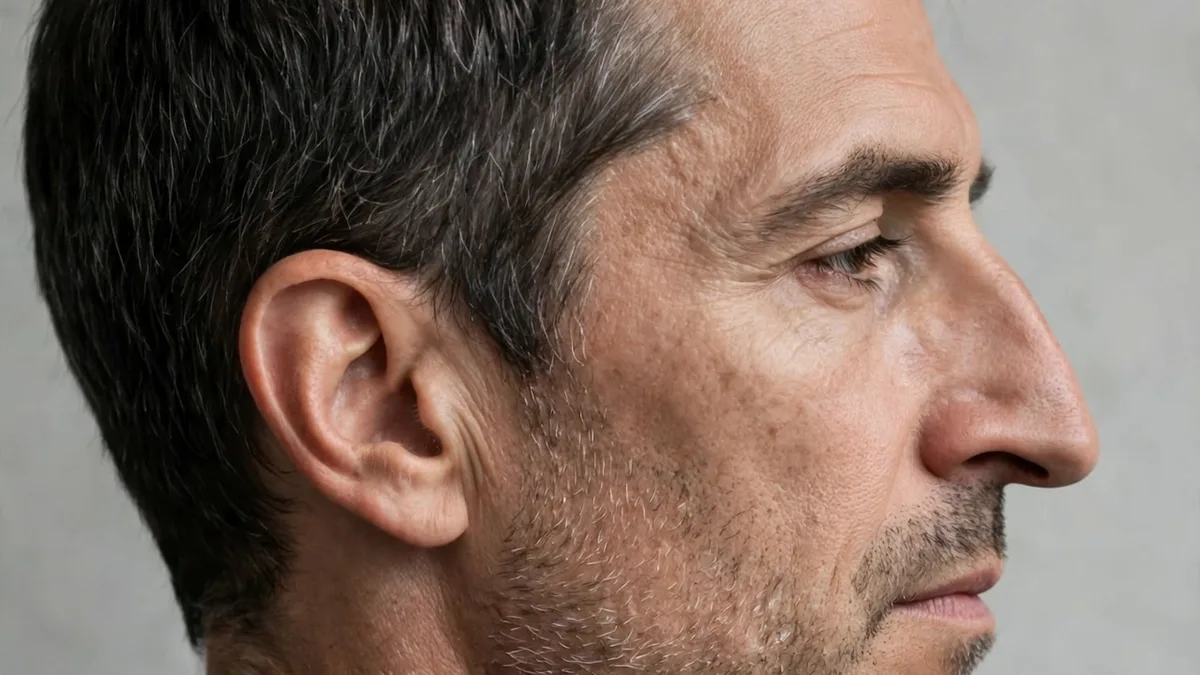

An aquiline nose is a nose with a prominent, curved bridge that dips down towards the tip, giving the profile a shape often compared to an eagle’s beak. The word comes from the Latin aquila, meaning eagle, and the feature has been noticed, painted, praised and teased for thousands of years. It is simply one of the many shapes a human nose can take, decided by bone, cartilage and family resemblance.
Key takeaways
- Aquiline means eagle-like, from the Latin aquila, meaning eagle.
- An aquiline nose has a prominent bridge that curves downward towards the tip.
- It is also commonly called a Roman nose, after the profile seen in classical Roman sculpture.
- Nose shape is largely inherited, shaped by bone and cartilage and by the populations a person’s ancestors came from.
- The aquiline profile has been admired in art and literature for centuries as a sign of dignity and strength.
- Glasses, breathing and self-image are the practical things an aquiline nose can affect, not health in general.
What an aquiline nose looks like
The defining feature of an aquiline nose is the shape of the bridge when seen in profile. Instead of running straight from the forehead to the tip, or curving gently upwards, the bridge rises prominently and then slopes down, often with a slight hump where the bone meets the cartilage, and the tip points a little downwards. From the front, the same nose may look unremarkable: the aquiline quality is a matter of profile, and it is usually most obvious in a photograph taken from the side.
Not every curved nose is aquiline. Some noses have a bump on an otherwise straight bridge, some have a drooping tip without a prominent bridge, and some curve smoothly without any hump at all. The aquiline nose combines the prominent bridge and the downward direction into a single hooked or beak-like line. The degree varies a great deal: some aquiline noses are gently curved and barely noticeable, while others have a strong, unmistakable hook. Both are the same feature, expressed more or less strongly, and both are within the normal range of human variation. The aquiline nose entry on Wikipedia describes the shape and its history in more detail.
Where the word comes from
Aquiline comes from the Latin aquila, meaning eagle, through the adjective aquilinus, meaning eagle-like. The Romans used the word for anything hooked like an eagle’s beak, and it passed into English in the sixteenth century as a learned term for a curved nose. The more familiar synonym, Roman nose, comes from the same idea by a different route: the profiles carved on Roman busts and struck on Roman coins very often show this prominent, downward-curving nose, and later generations took it as the mark of a Roman face.
The association with Rome gave the feature a particular prestige in European culture. In the eighteenth and nineteenth centuries, when classical art was the model for good taste, an aquiline nose was considered handsome and distinguished, the sort of nose a hero or a statesman ought to have. Novelists of the period gave their noblest characters aquiline noses and their comic characters snub or upturned ones, a shorthand that readers understood at once. The habit has faded, but the vocabulary has not, and “aquiline” is still the polite word for a hooked nose.
How nose shape is decided
Nose shape is largely inherited. The nose is built from bone in its upper third and cartilage in its lower two thirds, covered by skin, and the size and shape of each part are set by genes. Children often resemble one parent’s nose closely, and the shape usually becomes more defined during adolescence as the face grows. Because so many genes are involved, brothers and sisters can have quite different noses, and the feature can skip a generation or appear in a milder form.
Ancestry also plays a part, since nose shapes vary between populations in ways that reflect climate as much as chance. Narrower noses with high bridges are more common among people whose ancestors lived in cold, dry climates, where a long nasal passage warms and moistens the air before it reaches the lungs, while broader noses are more common in warm, humid climates. These are broad tendencies, not rules, and any population contains the full range of shapes. Injury can change a nose too: a broken nose that heals with a bump or a bend can look aquiline even when the underlying shape was straight.
The aquiline nose in art and history
The aquiline profile has been celebrated in art for as long as artists have carved faces. Roman portrait busts show emperors and generals with strong, hooked noses, and Renaissance painters gave the same profile to prophets, kings and saints. In the nineteenth century, the phrenologists and physiognomists, who claimed to read character from the face, wrote at length about the aquiline nose, calling it the mark of energy, ambition and command. Their science was nonsense, but their descriptions show how highly the shape was regarded: the aquiline nose was the nose of the leader, the thinker and the hero.
Literature followed the same pattern. From classical heroes to Victorian gentlemen in novels, the aquiline nose signalled dignity, and it appears beyond Europe too: Mughal miniatures, Persian painting and Ottoman portraiture all show prominent curved noses as a mark of nobility.
Living with an aquiline nose
For most people, an aquiline nose is simply a feature, neither a problem nor an advantage, and it needs no more attention than any other nose. Two practical points come up more often than others. The first is glasses: a prominent bridge can make frames sit higher or slide forward, and an optician can adjust the pads or suggest a different bridge fit. The second is the profile in photographs, where a nose that looks fine in the mirror can seem larger side-on.
An aquiline shape on its own does not cause breathing difficulty: breathing problems come from inside the nose, such as a deviated septum or swollen turbinates, and these can occur with any nose shape. Anyone who struggles to breathe through the nose, snores heavily or suffers repeated sinus infections should discuss it with a clinician, whatever the shape of the nose. General health guidance follows the same pattern as eye care: a guide to what is glaucoma shows how routine checks catch problems early, and the nose deserves the same matter-of-fact attention.
| Nose shape | Bridge in profile | Tip direction | Common name |
|---|---|---|---|
| Aquiline | Prominent and curved | Points slightly down | Roman nose, hook nose |
| Straight | Runs straight from brow to tip | Points straight ahead | Greek nose |
| Upturned | Short, with a concave curve | Points upwards | Snub nose, celestial nose |
| Wide | Broad, with wide nostrils | Varies | Nubian nose |

Rhinoplasty and the aquiline nose
Some people with an aquiline nose choose to change it, and rhinoplasty, surgery on the nose, is the usual route. The operation can reduce a hump, straighten a bridge or lift a tip, and it is one of the most commonly performed cosmetic operations. It is also a serious undertaking, involving anaesthesia, weeks of swelling and bruising, and a result that takes months to settle, and like all surgery it carries risks. Anyone considering it should talk to a qualified surgeon, see honest before-and-after results, and think carefully about whether the change is for themselves or for someone else’s opinion.
Fashions in noses change: the strong Roman profile admired in the nineteenth century gave way to a preference for smaller, straighter noses, and that preference is itself changing as ideas about beauty broaden. That is a poor reason to rush into surgery and a good reason to live with a nose for a while before deciding to change it. A person’s face is also read as a whole: the sphyg cuff guide is a reminder that a single measurement or a single feature rarely tells the whole story of a person’s health or appearance.
Your aquiline nose checklist
- Remember the meaning: aquiline comes from the Latin aquila, eagle, and describes a beak-like curve.
- Judge the shape in profile, not from the front, where an aquiline nose can look unremarkable.
- Know that the shape is mostly inherited, shaped by bone, cartilage and ancestry.
- Expect glasses to need adjusting: ask an optician about pads and bridge fit.
- Do not blame the shape for breathing trouble: that comes from inside the nose, not its outline.
- Take time before considering surgery, and talk to a qualified surgeon if you do.
- Remember that fashions change: the Roman profile admired for centuries is admired again.
- Enjoy the history: your nose shares its shape with emperors, prophets and heroes of art.
What does aquiline nose mean?
An aquiline nose is a nose with a prominent, curved bridge that slopes down towards the tip, resembling an eagle’s beak. The word comes from the Latin aquila, meaning eagle. It is also called a Roman nose, after the profile seen in classical Roman sculpture.
Is an aquiline nose genetic?
Largely, yes. Nose shape is set by genes that control the bone and cartilage of the nose, and children often resemble a parent’s nose. Ancestry plays a part too, since nose shapes vary between populations, and an injury such as a break can also change the shape of a nose.
Is an aquiline nose attractive?
Beauty is a matter of taste and fashion, and the aquiline nose has been admired for centuries in art and literature as a sign of dignity and strength. In some periods it was the ideal, in others a straighter nose was preferred, and today a wide range of nose shapes is celebrated. There is no single standard.
Can an aquiline nose cause breathing problems?
The shape of the nose on the outside does not by itself cause breathing difficulty. Breathing problems come from the structures inside the nose, such as a deviated septum or swollen turbinates, which can occur with any nose shape. Anyone with persistent breathing difficulty should discuss it with a clinician.
What is the difference between an aquiline nose and a Roman nose?
There is no difference: the two terms describe the same shape. “Aquiline” is the Latin-derived term, meaning eagle-like, while “Roman nose” is the popular name, taken from the profiles on Roman busts and coins. Both refer to a prominent bridge curving down to a slightly downturned tip.
Can an aquiline nose be changed without surgery?
Make-up contouring can soften a hump in photographs, and glasses can change how the bridge is read, but the shape itself can only be changed by surgery. Fillers are sometimes used to smooth a profile, but they are a medical procedure with their own risks, and the effect is temporary. The tenor saxophone guide is a reminder that presence and posture shape a portrait far more than any single feature.
The bottom line
An aquiline nose is a curved, prominent profile with a long history: named for the eagle, carved into Roman emperors, praised by poets and painted by masters. It is inherited, normal and varied, and it affects little beyond the fit of your glasses and the line of your profile. Wear it as the Romans did, with confidence.