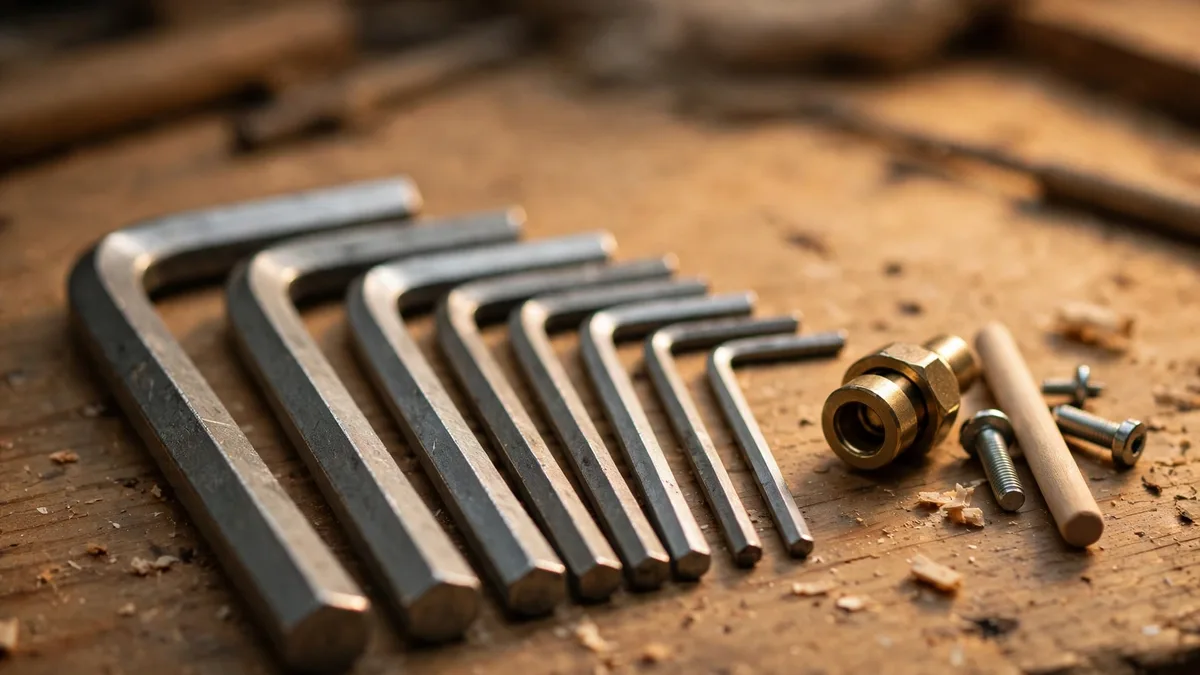

An Allen key is a small L-shaped tool with a hexagonal tip that fits into a socket-head screw or bolt and turns it. If you have ever built flat-pack furniture, adjusted a bicycle or tightened a loose door handle, you have almost certainly held one, even if you did not know its name. It is one of the simplest tools in the drawer.
Key takeaways
- An Allen key, also called a hex key, is an L-shaped bar with a hexagonal cross-section that drives socket-head screws.
- It is named after the Allen Manufacturing Company of Hartford, Connecticut, which popularised the design in the early twentieth century.
- Allen keys come in metric and imperial sizes, and using the wrong size is the most common cause of damage.
- Ball-end keys can work at an angle, while T-handle keys give more leverage for stubborn fasteners.
- The long arm gives reach and speed; the short arm gives grip and torque.
- A key that slips or wobbles in the socket is the wrong size, and forcing it will round off the corners.
What an Allen key is
An Allen key is a simple hand tool made from a single bar of steel bent into an L shape, with a hexagonal profile along its whole length. The short end and the long end both carry the same hexagonal tip, so either end can be inserted into the matching hexagonal socket in the head of a screw or bolt. Turning the key turns the fastener. It has no moving parts, which is why it is so cheap and durable.
The tool is also known as a hex key, a hex wrench and, in the United States, an Allen wrench. All of these names describe the same thing. The “Allen” name comes from the Allen Manufacturing Company of Hartford, Connecticut, which popularised the hexagonal socket screw and its matching key in the early twentieth century. The name stuck, and “Allen key” remains the usual British term. The hex key entry on Wikipedia sets out the history of the design and its many variations.
Why the hexagonal shape works
The hexagon is the heart of the design. Six flat faces give the key six points of contact inside the socket, which spreads the turning force evenly and lets a small tool transmit a surprising amount of torque. A round bar would slip, and a square bar would concentrate the force on four corners and wear quickly. The hexagon is a compromise that grips firmly without needing a large head, which lets socket-head screws sit flush or recessed.
That recessed head is the reason designers love the system. A socket-head screw can be sunk into a metal plate, a bicycle stem or a piece of furniture so that almost nothing protrudes, giving a clean finish and removing snag points. The trade-off is that the socket is hidden, so you cannot see at a glance which size key it needs, and dirt can collect inside it.
Metric and imperial sizes
Allen keys are sold in two measuring systems, metric and imperial, and the two do not mix. Metric keys are measured across the flats in millimetres, commonly 1.5 mm to 10 mm in household sets. Imperial keys are measured in fractions of an inch, such as 1/8 inch or 5/32 inch. A metric key will not fit an imperial socket properly, and an imperial key will not fit a metric socket, even when the sizes look close. If you are working out which size you need from a measurement, the guide to transform mm to inches explains how to convert between the two systems.
The most common household sizes are 3 mm, 4 mm, 5 mm and 6 mm, which cover most flat-pack furniture, bicycle parts and household fittings. Small sizes such as 1.5 mm and 2 mm appear in electronics, spectacles and model-making, while 8 mm and 10 mm turn up on larger furniture, gym equipment and machinery. The 5/32 inch key is close to 4 mm but not identical, and it may seem to fit a worn 4 mm socket before slipping under load. When in doubt, try the key that fits snugly with no wobble at all, and if you are comparing imperial sizes, remember that fractional sizes do not convert to round metric numbers.
The main types of Allen key
The classic L-shaped key is the most common type and the one most people picture. Its long arm is used for fast spinning and for reaching into deep or awkward places, while the short arm gives a better grip and more turning force for the final tightening or the first loosening of a stiff screw. Sets are usually sold in a holder or a folding case, arranged from smallest to largest, and a good set will cover the sizes you meet most often.
The ball-end key is a clever variation in which one tip is shaped into a ball. The ball lets the key work at an angle of up to about 25 degrees from the axis of the screw, which is useful when a straight approach is blocked by another part of the machine or the furniture. A ball end transmits less torque, so it suits spinning a screw rather than final tightening. T-handle keys, by contrast, are built for force: the handle sits across the top of the shaft like the letter T, giving two-handed grip and much greater leverage for stubborn fasteners. Folding sets pack several keys into a handle like a penknife, handy for a saddlebag or drawer, though the short keys give less leverage.
What Allen keys are used for
Flat-pack furniture is the place most people meet the Allen key first. Manufacturers favour socket-head screws because they are cheap, sit flush and can be driven with a single small tool that can be included in the box. Bicycles are the second home of the hex key: stems, seat posts, brakes, derailleurs and pedals are very often held by socket-head bolts, and a multi-tool with hex keys is standard kit for any cyclist. It also appears in office chairs, gym equipment, door handles and machinery.
Small electronics also rely on tiny hex screws, and many gadgets that charge over a USB-C type A cable are assembled with screws that need a 1.5 mm or 2 mm key. The table below summarises where each type earns its keep.
| Type | Best for | Main advantage | Main drawback |
|---|---|---|---|
| L-shaped key | General household and furniture work | Cheap, strong, two grip options | Easy to lose; small sizes bend |
| Ball-end key | Screws you cannot approach straight on | Works at an angle up to about 25 degrees | Less torque than a flat end |
| T-handle key | Stiff or large fasteners | Two-handed leverage and comfort | Bulky; not good in tight spaces |
| Folding set | Cycling and portable toolkits | Compact; keys stay together | Short keys give less leverage |

How to use one properly
Start by finding the right size. Push the key into the socket and check that it sits fully home with no sideways play. If it wobbles, it is too small; if it will not enter, it is too big or the socket is blocked with dirt or paint. Clear the socket with a pin or a puff of air before you start, and press the key in firmly so it engages along the full depth of the socket. If the key is imperial rather than metric, the guide to 5-eighths of an inch shows how fractional sizes relate to everyday measurements. A key that is only half in will slip and damage the corners.
For a screw that is already loose, use the long arm as a handle and spin the screw with the short arm in the socket. It is fast and needs little effort. For the final tightening, or for loosening a screw that has seized, swap around: put the long arm into the socket and grip the short arm. The shorter lever is easier to hold firmly, and you can apply steady pressure without the key flexing. Turn clockwise to tighten and anticlockwise to loosen, and stop as soon as the joint feels snug: over-tightening can strip threads or crack furniture board.
Your Allen key checklist
- Match the key to the socket exactly: no wobble, no forcing, and the key seated to its full depth.
- Clean out the socket before you start so dirt or paint does not stop the key engaging.
- Use the long arm for speed and reach, and the short arm for grip and final torque.
- Keep metric and imperial sets separate so you never mix a 4 mm key with a 5/32 inch socket.
- Choose a ball-end key for awkward angles, but finish tightening with a flat end.
- Turn clockwise to tighten and anticlockwise to loosen, and stop as soon as the joint is snug.
- Replace a key that is bent, worn or rounded, since it will damage the next socket it meets.
- Store the set in its holder or case, ordered by size, so the right key is easy to find.
What is an Allen key used for?
An Allen key is used to turn socket-head screws and bolts, which are common in flat-pack furniture, bicycles, office chairs, gym equipment, door handles and machinery. The hexagonal tip fits a matching socket, letting a small tool apply strong turning force while the screw sits flush.
What is the difference between an Allen key and a hex key?
There is no difference: the two names describe the same tool. “Allen key” comes from the Allen Manufacturing Company, which popularised the design, while “hex key” describes the hexagonal cross-section. “Allen wrench” is the usual American name for the same tool.
Which size Allen key do I need?
Most household furniture uses 3 mm, 4 mm, 5 mm or 6 mm keys, while bicycles and small electronics often need 1.5 mm or 2 mm. The right key fits snugly with no wobble; if it slips, try the next size and check metric against imperial.
Can I use a ball-end Allen key for everything?
Not quite. A ball-end key is excellent for reaching screws at an angle and for spinning screws in and out quickly, but it transmits less torque than a flat end and can slip under heavy load. Use it for access and speed, then finish the tightening with the flat end of a standard key.
Why does my Allen key keep slipping?
Slipping usually means the key is the wrong size, the socket is worn, or the key is not pushed fully home. Clean the socket, check the size, and press the key fully home. If the corners are already rounded, the screw may need an extractor.
Are Allen keys the same as Torx keys?
No. An Allen key has a hexagonal tip, while a Torx driver has a six-pointed star tip, and the two systems are not interchangeable. Torx is common in cars and electronics, Allen keys in furniture and bicycles. Check the socket shape before choosing the tool.
The bottom line
An Allen key is a small, cheap and almost indestructible tool that earns its place in every household. Learn the difference between metric and imperial sizes, keep the key fully seated in the socket, and use the long arm for speed and the short arm for force. Do that, and the humble hex key will handle almost every flat-pack, bicycle and household job you meet.