
Plasma rich injections, usually called PRP, are a treatment made from the patient’s own blood, and they have become one of the most talked-about options for sore joints, damaged tendons and thinning hair. The idea is simple: a small amount of blood is drawn, spun in a machine to concentrate the platelets, and the resulting plasma is injected back into the injured area. The short answer to whether they work is less simple — the evidence is mixed and still evolving, and the right choice depends on the condition, the patient and the clinician.
Key takeaways
- PRP stands for platelet-rich plasma, made by concentrating platelets from the patient’s own blood.
- It is used for knee osteoarthritis, tendon injuries, hair loss and some skin treatments.
- The blood is drawn, spun in a centrifuge, and the platelet-rich layer is injected at the treatment site.
- The evidence is mixed and evolving: some people improve, others notice little change.
- Costs vary widely and are often not covered by insurance, so ask for the full price before agreeing.
- PRP is not a first step for every injury; rest, physiotherapy and standard care usually come first.
What plasma rich injections are
Platelet-rich plasma is a preparation made from a sample of the patient’s own blood. Blood is mostly made of red cells, white cells, platelets and plasma, the pale liquid those cells float in. Platelets are best known for helping blood clot, but they also carry growth factors — proteins that play a part in tissue repair. The theory behind PRP is that concentrating platelets at the site of an injury delivers more of those growth factors where healing is needed.
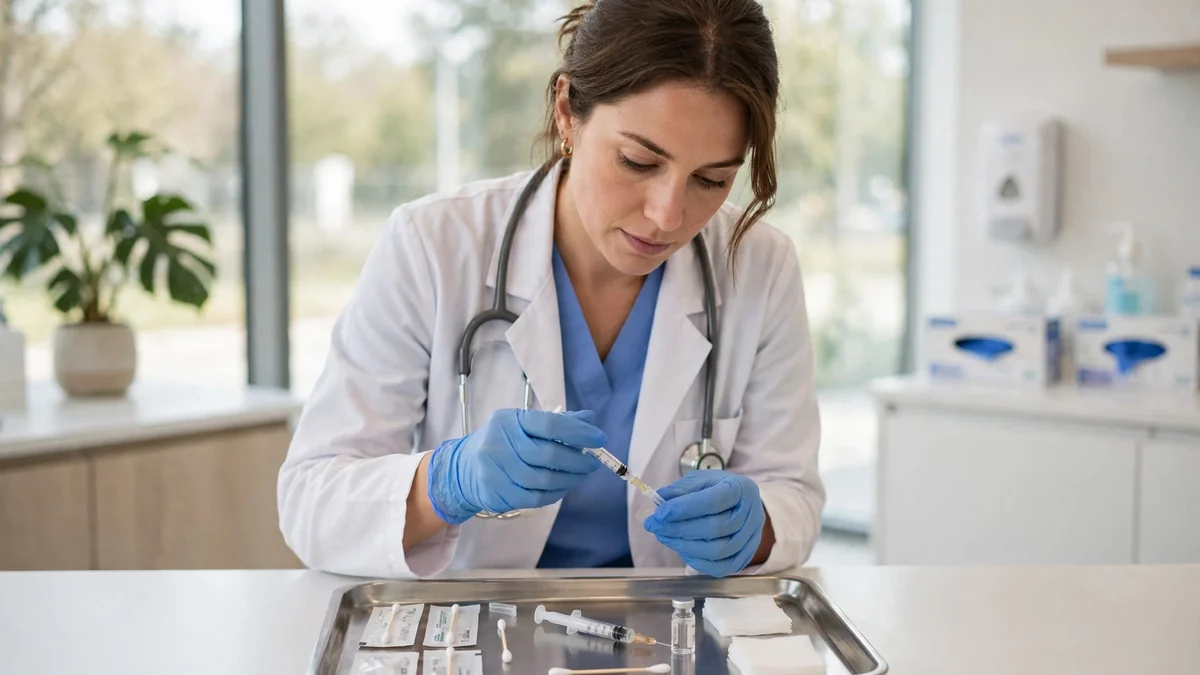
The procedure itself is straightforward. A clinician draws a small amount of blood, usually from the arm, and places it in a centrifuge, a machine that spins the sample fast enough to separate its layers. The platelet-rich layer is drawn off into a syringe and injected into the injured joint, tendon or area of skin. The whole appointment often takes under an hour, and most people go home the same day. Because the material comes from the patient’s own body, the risk of an allergic reaction to the injected substance itself is low, although the injection can still cause soreness, swelling or bruising, and any injection carries a small risk of infection.
It is not a single standardised product: different clinics use different machines and preparation methods, which is one reason study results vary.
What PRP is used for
The best-known use of plasma rich injections is for knee osteoarthritis, the wear-and-tear arthritis that causes pain and stiffness in the knee. Several studies have found that some people with mild to moderate knee osteoarthritis report less pain and better movement after PRP, although the benefit varies and does not last forever. The platelet-rich plasma entry on Wikipedia gives a clear overview of the treatment and the state of the research for readers who want more background.
Tendon injuries are the second common use. Conditions such as tennis elbow, golfer’s elbow, Achilles tendinopathy and patellar tendinopathy — the jumper’s knee seen in sportspeople — involve tendons that have become painful and slow to heal. PRP is sometimes offered when rest and physiotherapy have not settled the problem, on the reasoning that growth factors may help the tendon repair. The evidence here is mixed: some trials show a benefit, others show little difference from a placebo injection, and the quality of the studies varies.
PRP is also used outside joints and tendons. In hair loss, it is injected into the scalp in the hope of supporting hair follicles, and it is offered by some clinics for thinning hair in men and women. In skin care, it is sometimes combined with microneedling, a treatment that creates tiny punctures in the skin, and marketed as a facial. For each of these uses, the evidence is thinner than for knees and tendons.
What the evidence says
The honest picture is that the evidence for PRP is promising in places and uncertain overall. For knee osteoarthritis, several reviews of the available trials have found modest improvements in pain and function compared with placebo or with hyaluronic acid injections, particularly in the months after treatment. But the trials are often small and use different methods, which makes firm conclusions difficult.
For tendon injuries, the picture is less clear. A number of well-run trials have found no meaningful difference between PRP and a saline injection, while others have reported a benefit, particularly for tennis elbow. The variation may reflect differences in how the PRP was prepared, where exactly it was injected, and how severe the injury was. For hair loss and skin treatments, the studies are generally smaller and shorter, and the results are harder to generalise.
Regulators and professional bodies have taken a cautious line. In several countries, PRP is offered as a treatment whose benefit is not yet proven, and guidance often describes the evidence as limited or low quality. That does not mean it cannot help, but go in with realistic expectations, and be wary of any clinic that promises a certain result.
What treatment involves
A typical course is not a single injection. Many clinicians offer a series of one to three injections, spaced weeks apart, although the number varies with the condition and the clinic. Before the first injection, the clinician should take a history, examine the area, and often arrange imaging such as an ultrasound or MRI to confirm the diagnosis.
On the day, the blood draw feels like any blood test, and the injection itself can be uncomfortable, particularly into a tendon. The area is often sore for a few days afterwards, and the clinician may advise rest, ice and avoiding anti-inflammatory painkillers for a short period, since those drugs may interfere with the healing response the treatment is trying to encourage.
Afterwards, progress is usually judged over weeks rather than days. Some people notice an improvement within a month, while for others it takes two or three months, and some notice no change. A follow-up appointment is a normal part of the course, and it is the point at which the clinician can judge whether another injection is worth trying or whether a different approach is needed. A guide to muscle spasm may help readers tell ordinary post-injection soreness from a problem that needs a call to the clinic.
Plasma rich injections compared with other options
PRP is one of several options for joint and tendon pain, and it helps to see how it sits beside the alternatives. The table below compares it with the treatments most often offered for the same problems.
| Treatment | How it works | What it is used for | Evidence |
|---|---|---|---|
| PRP injections | Concentrated platelets from your own blood | Knee arthritis, tendons, hair loss | Mixed and evolving |
| Corticosteroid injections | Anti-inflammatory medicine injected into the joint | Arthritis flare-ups, bursitis | Good short-term relief |
| Physiotherapy | Exercise and hands-on treatment | Tendons, backs, knees, shoulders | Strong for many conditions |
| Hyaluronic acid injections | Gel-like fluid injected into the joint | Knee osteoarthritis | Modest benefit for some |
| Surgery | Repair or replacement of the damaged tissue | Severe arthritis, torn tendons | Definitive where needed |

Costs, cover and questions to ask
The cost of plasma rich injections varies widely. It depends on the country, the clinic, the condition being treated and the number of injections in the course, and it is often not covered by health insurance, since many insurers class PRP as experimental. Ask for the full price of the whole course, not just one injection, and ask what is included: the consultation, the imaging, the blood draw, the preparation and the follow-up should all be clear before you agree.
Before booking, it is worth asking the clinician a few direct questions. What is the evidence for PRP in your specific condition, and what result should you expect? How many injections are planned, and how will success be judged? What preparation method does the clinic use, and how much experience does it have with this treatment? What are the risks, and what should you do if the area becomes hot, swollen or increasingly painful afterwards? And what would the clinician do if the PRP does not help?
It is also worth asking what else should happen alongside the injection. PRP is rarely a standalone fix. For a tendon, it usually sits beside a programme of loading exercises; for a knee, beside weight management and strengthening work. A clinic that offers the injection without a plan for rehabilitation may be selling a procedure rather than a treatment. Readers weighing other options may want to compare it with NMES vs TENS electrical stimulation, and a guide to TMJ symptoms explains why jaw pain needs a careful diagnosis first.
Your plasma rich injections checklist
- Confirm the diagnosis first: PRP cannot help an undiagnosed problem.
- Ask what the evidence is for PRP in your specific condition.
- Find out how many injections are planned and what the full course costs.
- Check whether your insurance covers it, and get the price in writing.
- Ask about the clinic’s preparation method and experience.
- Plan for soreness for a few days after each injection.
- Ask what rehabilitation or exercise should happen alongside the treatment.
- Agree how success will be judged, and when to try something else.
What are plasma rich injections?
Plasma rich injections, or PRP, are made from the patient’s own blood. A small sample is drawn, spun in a centrifuge to concentrate the platelets, and the platelet-rich plasma is injected into an injured joint, tendon or area of skin.
What conditions is PRP used for?
It is most often used for knee osteoarthritis and tendon injuries such as tennis elbow and Achilles tendinopathy. It is also offered for hair loss, some skin treatments and certain dental and wound-healing uses, where the evidence is thinner.
Does PRP hurt?
The blood draw feels like any blood test, and the injection itself can be uncomfortable, particularly into a tendon. The area is often sore for a few days afterwards. Most people return to normal activity within days.
How many PRP injections are needed?
Many clinicians offer a course of one to three injections, spaced weeks apart, although the number varies with the condition and the clinic. Progress is usually judged over weeks rather than days.
Is PRP covered by insurance?
Often not. Many insurers class PRP as experimental, so the cost usually falls on the patient. Ask for the full price of the whole course in writing before agreeing to treatment.
Is PRP safe?
Because the material comes from the patient’s own blood, the risk of an allergic reaction to the injected substance is low. The injection can still cause soreness, swelling or bruising, and any injection carries a small risk of infection. Discuss your own risks with your clinician.
The bottom line
Plasma rich injections are a reasonable option to discuss for some joint and tendon problems, and for some people they bring real relief. They are not a cure-all, the evidence is mixed and still evolving, and the cost is often yours to bear. Go in with a clear diagnosis, a clinician who answers questions plainly, and realistic expectations — and judge the treatment by how you feel over the following months, not by the promise on the clinic’s website.
This article is general information about a medical treatment, not medical advice. PRP is not suitable for everyone, and it is not a substitute for a diagnosis. Discuss your condition, your options and the risks with your own clinician before deciding on any treatment, and seek prompt medical care if an injection site becomes hot, increasingly painful or swollen.