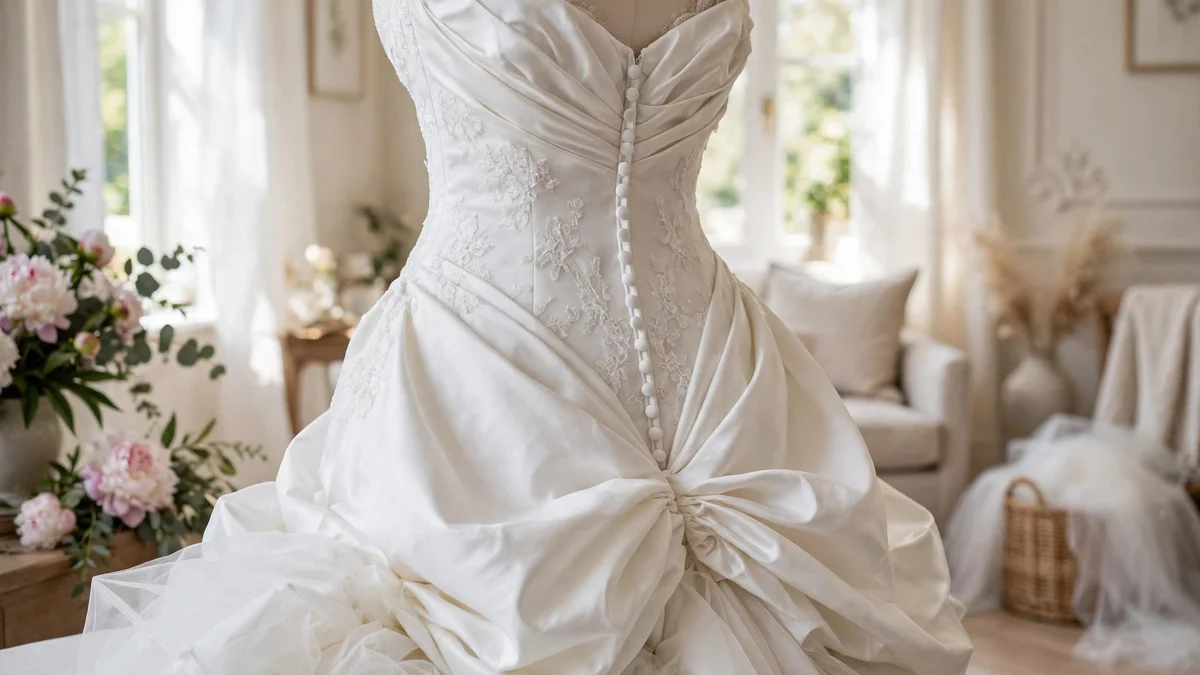

A bustle wedding dress is a gown whose train can be lifted and fastened up after the ceremony, and the question most brides ask is simple: do I need one, and which style should I choose? The short answer is that any dress with a train benefits from a bustle, because it frees your hands, protects the fabric, and lets you move and dance at the reception. This guide explains how a bustle works, the main styles, and what to expect at your fittings.
The word bustle has a long history in fashion. In the late nineteenth century it meant a padded framework worn under a skirt to shape its silhouette, and the Wikipedia page on the bustle describes that earlier garment in detail. The modern dressmaking meaning is different but related: instead of shaping the skirt from underneath, a bustle gathers the train up and fastens it to the back of the dress, so the skirt becomes shorter and easier to wear.
Key takeaways
- A bustle lifts the train off the floor after the ceremony, so you can move, sit and dance freely.
- Any dress with a train needs a bustle, unless you plan to carry the train all evening.
- The American bustle lifts the train over the skirt; the French bustle gathers it underneath.
- A bustle is fitted at your final dress fittings, usually a few weeks before the wedding.
- Ask a helper to attend a fitting and learn how the bustle fastens.
- Test the bustle by sitting, walking and dancing in the dress before the day.
What a bustle does
A wedding dress train looks beautiful in photographs and during the ceremony, but it is impractical for a long evening. A train trails on the floor, where guests can step on it, where it can catch on chairs and doorways, and where it collects dirt from the ground. A bustle solves that problem without changing the dress. Small loops, ties or buttons are sewn into the train and the back of the skirt, and after the ceremony the train is folded up and fastened in place, lifting the hem clear of the floor.
The effect is easy to picture: the long, flowing back of the dress becomes a shorter, fuller skirt, often with soft folds that look like part of the design. A well-made bustle looks deliberate rather than improvised, and many guests will not even notice that the dress has changed. The bride, meanwhile, can walk, sit down to dinner and dance without holding her skirt.
The main bustle styles
The American bustle, also called the overbustle, is the most common style. The train is lifted up and fastened over the outside of the skirt with buttons and loops, so the folds sit on top of the dress. It is simple to put up, easy for a helper to learn, and it suits most fabrics.
The French bustle, also called the European bustle or underbustle, works the other way. The train is gathered underneath the skirt and fastened with ties or ribbons, so the folds sit beneath the dress and the outside of the skirt keeps a smooth line. It looks elegant and is popular with slim, fitted dresses, but it can be harder for a helper to fasten, since the ties are hidden under the skirt. If you choose a French bustle, make sure the person who will help you on the day practises it at a fitting.
The ballroom bustle is a variation of the American style with several fastening points spread across the back of the skirt. When it is put up, the train disappears almost completely and the dress looks as if it never had one. It suits very full skirts and long trains, and it gives the most freedom of movement, which is why it is popular with brides who plan to dance all evening. It does take a little longer to fasten than a single-point bustle.
Other styles exist for particular dresses. A Victorian bustle uses several ties to create a layered effect that suits a vintage-style gown, and a bow bustle fastens the train into a decorative bow at the back. A seamstress will usually suggest the style that suits your dress best, taking into account the fabric, the weight of the train and the shape of the skirt.
Bustle styles compared
| Bustle style | How it works | Best for | Watch out for |
|---|---|---|---|
| American (overbustle) | Train lifted over the skirt and buttoned in place | Most dresses and fabrics | Folds show on the outside of the skirt |
| French (underbustle) | Train gathered underneath and tied | Slim, fitted dresses | Ties are hidden and harder to fasten |
| Ballroom | Several fastening points across the back | Full skirts and long trains | Takes longer to put up |
| Victorian | Several ties create layered folds | Vintage-style gowns | Needs a confident helper |
| Bow | Train fastened into a decorative bow | Simple, plain dresses | The bow becomes a visible feature |
| No bustle | Train carried or held all evening | Very short trains | Train drags, gets stepped on and dirty |

Fittings and the big day
A bustle is not part of the dress when you buy it; it is added by a seamstress during alterations. It is usually fitted at one of your later fittings, once the hem and the bodice are settled, because the bustle has to work with the final length of the dress. Bring the shoes you will wear on the day to every fitting, since the height of your heel changes where the train falls and therefore where the bustle points must go.
Bring a helper to the fitting where the bustle is finished. The seamstress will show them how to lift the train, where each loop and button is, and in what order to fasten them. Ask the seamstress to mark the fastening points with coloured thread or small tags, so your helper can find them quickly in a dim room. Then let your helper practise putting the bustle up while you are wearing the dress, more than once, until it feels easy.
On the day itself, the bustle is usually put up after the ceremony and the formal photographs, just before the reception begins. Allow a few quiet minutes for it, and do not rush it: a bustle fastened in a hurry can come undone halfway through the evening. A small sewing kit with a needle, thread and safety pins is a sensible addition to the bridal emergency kit, just in case a loop comes loose.
It is worth testing the bustle properly before the wedding. At your final fitting, sit down in the dress with the bustle up, walk across the room, and try a few dance steps. Check that you can move freely and that the fastenings hold. If anything pulls or feels tight, tell the seamstress: a bustle can be adjusted, and it is far easier to fix it at a fitting than on the day.
Looking after the dress after the bustle is up
Once the bustle is up, the dress needs a little care. Check the fastenings again after the first dance, since movement can loosen a button or a tie. Avoid catching the loops on chairs or jewellery, and ask your helper to keep an eye on the back of the dress during the evening.
After the wedding, the bustle points can be removed by a seamstress or left in place, depending on whether you plan to keep, sell or store the dress. If you are storing the dress, have it cleaned by a specialist before you put it away, and keep it in a breathable garment bag rather than a plastic one. Our guide to sketchbooks is about keeping a visual record, and a sketchbook is a lovely place to keep fabric swatches and photographs of the dress, so the details are not forgotten.
Choosing a bustle is also a good moment to think about the rest of the day. A wedding is a long event, and small practical decisions like this one are what make it enjoyable rather than stressful. Our article on marriage counseling looks beyond the day itself, at the relationship the wedding celebrates. And if you are meeting guests from out of town, our guide on where to meet people has ideas for relaxed gatherings around the main event.
A checklist for your bustle
- Ask your seamstress at the first fitting whether your dress needs a bustle.
- Choose the style that suits your dress, not the one that is most fashionable.
- Bring your wedding shoes to every fitting.
- Bring a helper to the fitting where the bustle is finished, and let them practise.
- Ask for the fastening points to be marked so they are easy to find.
- Test the bustle by sitting, walking and dancing at your final fitting.
- Decide when the bustle goes up on the day, and allow a few quiet minutes for it.
- Pack a small sewing kit with a needle, thread and safety pins.
Frequently asked questions
What is a bustle on a wedding dress?
A bustle is a set of loops, ties or buttons sewn into the back of a wedding dress that lets the train be lifted and fastened up after the ceremony. It shortens the skirt so the bride can move, sit and dance without the train trailing on the floor.
Does every wedding dress need a bustle?
No. A dress with no train, or with a very short train that barely touches the floor, can be worn all evening without one. Any dress with a chapel-length or cathedral-length train, or a train that pools on the floor, will need a bustle if the bride wants to move freely at the reception.
Which bustle style is best?
There is no single best style; it depends on the dress. The American bustle suits most dresses and is the easiest to fasten. The French bustle suits slim, fitted dresses and looks smooth from the outside. A ballroom bustle is best for very full skirts and long trains.
When is a bustle fitted?
A bustle is added during alterations, usually at one of the later fittings once the hem and bodice are settled. Bring the shoes you will wear on the day, since heel height affects where the train falls and where the fastening points must go.
Who puts the bustle up on the day?
Usually a bridesmaid, a family member or a friend. That person should attend a fitting, watch the seamstress put the bustle up, and practise it while the bride is wearing the dress. Ask the seamstress to mark the fastening points so they are easy to find.
Can a bustle be added to any wedding dress?
Almost any dress with a train can have a bustle added, though the style that works best depends on the fabric, the weight of the train and the shape of the skirt. Very light or delicate fabrics may need a gentler style with fewer fastening points. Your seamstress can advise on what will work for your dress.
The bottom line
A bustle wedding dress is a practical answer to a simple problem: a train is beautiful for the ceremony and awkward for the party. A bustle lifts the train off the floor, protects the fabric, and lets the bride enjoy the reception. Choose the style that suits your dress, have it fitted properly, bring a helper to a fitting so they can learn how it fastens, and test it by sitting, walking and dancing before the day. Done well, a bustle is invisible to the guests and liberating for the bride, which is exactly what it should be.