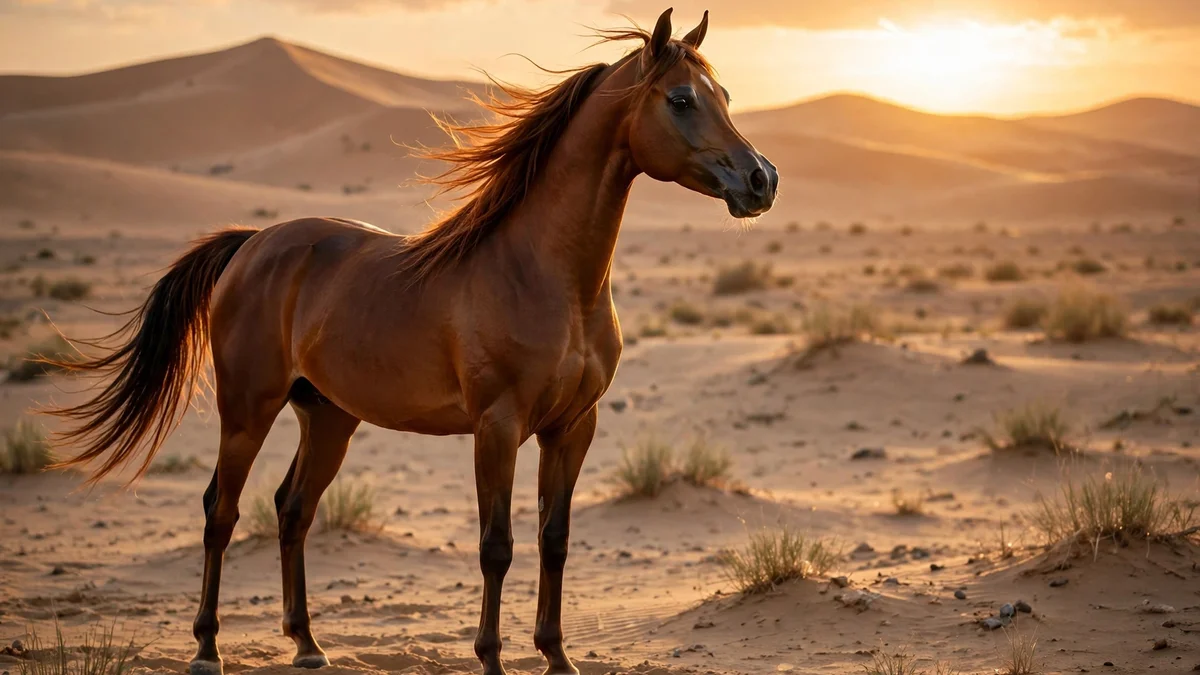

The Arabian horse is one of the oldest horse breeds in the world, and the question most people ask is a simple one: what makes it so distinctive, and why has it influenced so many other breeds? The short answer is that centuries of desert breeding produced a horse with a dished face, an arched neck, a high-carried tail and remarkable endurance, along with an intelligence and temperament that owners still prize. This guide explains the history of the Arabian horse, the traits that define it, and what it takes to care for one.
Few breeds inspire the loyalty that the Arabian does. Owners describe a horse that bonds closely with people, learns quickly and stays sound into old age. At the same time, the Arabian is a living piece of history: its bloodlines run through the Thoroughbred and many other modern breeds.
Key takeaways
- The Arabian is one of the oldest horse breeds, developed on the Arabian Peninsula.
- Its hallmarks are a dished face, arched neck, level croup and high-carried tail.
- Most Arabians stand between 14.1 and 15.1 hands high.
- Endurance is its greatest strength, shaped by desert life.
- The breed influenced the Thoroughbred and many other modern breeds.
- Arabians are intelligent, sensitive and bond closely with their owners.
Where the Arabian horse comes from
The Arabian horse developed on the Arabian Peninsula, in the desert lands of the Middle East, where Bedouin tribes bred horses for survival as much as for riding. In that harsh landscape, a horse had to travel long distances on little food and water, endure extreme heat, and stay sound over rocky ground. Only the toughest animals were kept for breeding, and over many generations this produced a horse that was hardy and efficient for its size.
Bedouin breeders kept careful track of bloodlines, passing knowledge of each mare’s family down through spoken records. Horses lived close to their owners, often sharing the tent and the family’s food, which helped shape the breed’s famously people-orientated temperament. Mares were especially prized, since a good mare could found a whole line of horses, and the best families were guarded carefully. This close relationship between people and horses is one reason the Arabian still seeks human company more than many other breeds.
From the desert, Arabian horses spread across the world through trade, war and diplomacy. Rulers and generals prized them, and gifts of Arabian horses sealed alliances between courts. In Europe, the breed arrived in greater numbers from the seventeenth century onwards, and English breeders used Arabian stallions to develop the Thoroughbred racehorse. The Wikipedia page on the Arabian horse gives a detailed account of this spread, from the desert tribes to the stud farms of Europe and America.
What an Arabian horse looks like
The Arabian is easy to recognise once you know what to look for. Its head is its most famous feature: a finely shaped skull with a concave, or dished, profile, large eyes set wide apart, and small, curved ears. The neck is long and arched, rising from a well-shaped shoulder, and the back is short and strong. The croup is comparatively level, and the tail is carried high, which gives the horse a distinctive silhouette in motion.
Most Arabians stand between 14.1 and 15.1 hands high, which makes them smaller than many modern riding horses, though they carry weight well for their size. A hand is four inches, the traditional unit for measuring horses, so 14.1 hands means fourteen hands and one inch. Their weight usually falls between 800 and 1,000 pounds, and they are fine-boned rather than heavy, with dense bone that is stronger than it looks.
Colour is another part of the picture. Grey is the most common colour in the breed, followed by bay and chestnut, with black less common. Many grey Arabians are born dark and lighten with age, so a horse that looks almost white may have started life bay or chestnut. White markings on the face and legs are common. The mane and tail are full and often wavy, and the whole impression is one of refinement rather than bulk.
Temperament and intelligence
The Arabian horse is known for intelligence, sensitivity and a strong bond with people. Owners often say that an Arabian notices everything: a change in routine, a new object in the yard, or a rider’s mood. That sensitivity is a strength when the horse is handled calmly and consistently, because it learns quickly and tries hard to please. It can become a problem when handling is rough or inconsistent, since the horse remembers bad experiences and may become anxious.
This temperament makes the Arabian a rewarding horse for experienced riders and a challenging one for complete beginners. It responds best to patient, quiet handling and to work that keeps its mind busy. Boredom is the enemy: an Arabian left standing in a stable with nothing to do is more likely to develop bad habits than a duller breed.
The breed’s reputation for courage is also well earned. Arabians were bred to carry riders into battle and across deserts, and they still show a willingness to keep going when other horses tire. That courage, combined with stamina, is what makes them so successful in endurance riding, where horse and rider cover long distances together.
The Arabian horse at work and play
| Activity | Why Arabians suit it | What to know |
|---|---|---|
| Endurance riding | Stamina, efficient movement, tough hooves | Needs careful fitness training and vet checks |
| Showing | Refined head, arched neck, high tail carriage | Judged on conformation and movement |
| Dressage | Intelligence, willingness, natural balance | Sensitive to the rider, needs a light hand |
| Trail riding | Sure-footed, alert, bonds with the rider | Can be sharp, so needs a confident rider |
| Driving | Flashy movement and presence | Needs steady training to accept harness |
| Family riding | Gentle with people it trusts | Best with experienced supervision |

How the Arabian shaped other breeds
Almost every modern light horse breed carries some Arabian blood. The Thoroughbred, the world’s most famous racehorse, was developed in England in the seventeenth and eighteenth centuries from Arabian, Barb and Turk stallions crossed with native mares. Two of the three foundation sires of the Thoroughbred, the Darley Arabian and the Godolphin Arabian, were Arabians by name and type.
The influence did not stop with racing. Warmblood breeds across Europe were refined with Arabian blood to add elegance, stamina and a better temperament. The Morgan, the American Saddlebred and the Welsh Cob all carry Arabian influence, as do many pony breeds. Even breeds developed for very different purposes, such as the Quarter Horse, have Arabian ancestors in their pedigrees. This is why the Arabian is often called a foundation breed: it improved whatever it was crossed with.
Stud farms played a large part in this story. In the late nineteenth century, the Crabbet Park Stud in England, founded by Wilfrid and Lady Anne Blunt, became one of the most famous Arabian breeding centres in the world, and its horses shaped breeding programmes across Europe, America and Australia. Later, breeders in Poland, Russia, Egypt and the United States developed their own distinct lines, each with its own character.
Caring for an Arabian horse
Day-to-day care for an Arabian is much like care for any horse: regular feeding, clean water, turnout, grooming and hoof care. Arabians are often easy keepers, meaning they hold condition on less feed than a larger horse, which reflects their desert origins. That is an advantage, but it also means they can gain weight quickly on rich grass, so grazing and feed need watching. A good routine, with forage as the main part of the diet, suits them well.
Exercise matters as much as feeding. Arabians were bred to move, and a horse that works regularly stays fitter, calmer and sounder than one that stands idle. Ridden work, long walks in hand, or time in a large field all help. Grooming is also important, since the fine coat shows dirt easily, and regular handling builds the bond that the breed thrives on. Hooves should be checked and trimmed regularly by a farrier, and teeth and vaccinations kept up to date with a vet.
Anyone thinking of keeping horses should also consider the wider costs of time, space and commitment, and should learn from experienced owners before buying. Visiting a reputable yard, taking lessons, and spending time around horses are the best preparation. If you enjoy learning about animals, our guide to can dogs have avocado covers feeding questions for a very different animal, while the artificial zoo guide looks at how animals are presented to the public. For a scenic ride, the 17 Mile Road in Monterey is one of the most beautiful coastal routes for a drive.
A checklist for Arabian horse owners
- Learn the breed standard: dished face, arched neck, level croup, high tail carriage.
- Feed mainly forage, and watch grazing so an easy keeper does not gain too much weight.
- Provide daily turnout and regular exercise to keep the horse fit and calm.
- Handle quietly and consistently, since Arabians remember both good and bad handling.
- Keep hooves trimmed, teeth checked and vaccinations up to date.
- Groom regularly, and use the time to build trust and check for injuries.
- Choose work that suits the horse, such as endurance, trails or dressage.
- Learn from experienced owners and a good instructor before buying your first Arabian.
Frequently asked questions
How old is the Arabian horse breed?
The Arabian is one of the oldest horse breeds in the world, with roots on the Arabian Peninsula going back many centuries. Bedouin tribes bred these horses long before written pedigrees existed, selecting for endurance, soundness and temperament.
Are Arabian horses good for beginners?
Arabians can be good for beginners when the individual horse is calm and well trained, and when the rider has good instruction. However, the breed is intelligent and sensitive, so it responds best to a confident, consistent rider. A complete beginner is usually better off learning on a quiet schoolmaster of any breed.
Why do Arabian horses have a dished face?
The dished, or concave, profile is one of the breed’s defining features, produced by centuries of selective breeding in the desert. The shape is linked to the fine bone structure of the head, large eyes and wide nostrils, which helped the horse breathe and see well in harsh conditions. It is now one of the first things judges and breeders look for.
What is the Arabian horse best at?
Endurance riding is the Arabian’s greatest strength, thanks to its stamina, efficient movement and ability to recover quickly. The breed also excels in showing, dressage and trail riding, where its intelligence and willingness count for a great deal. Its versatility is one reason it has remained popular for so long.
How much exercise does an Arabian horse need?
Arabians need regular exercise, ideally daily ridden work or active turnout in a large field. They were bred to travel long distances, so a horse left standing idle can become bored and develop bad habits. The exact amount depends on age, fitness and workload, but a routine of work, turnout and rest suits the breed best.
What colours can Arabian horses be?
Grey is the most common colour, followed by bay and chestnut, with black less common. Many grey Arabians are born dark and lighten as they age. White markings on the face and legs are common, and the skin beneath the coat is often dark. The breed registry recognises these colours, and each has its own admirers.
The bottom line
The Arabian horse is a breed shaped by the desert: small, tough, intelligent and beautiful, with a dished face, an arched neck and a high-carried tail that make it unmistakable. Its endurance made it the foundation of the Thoroughbred and many other breeds, while its temperament has won it devoted owners around the world.