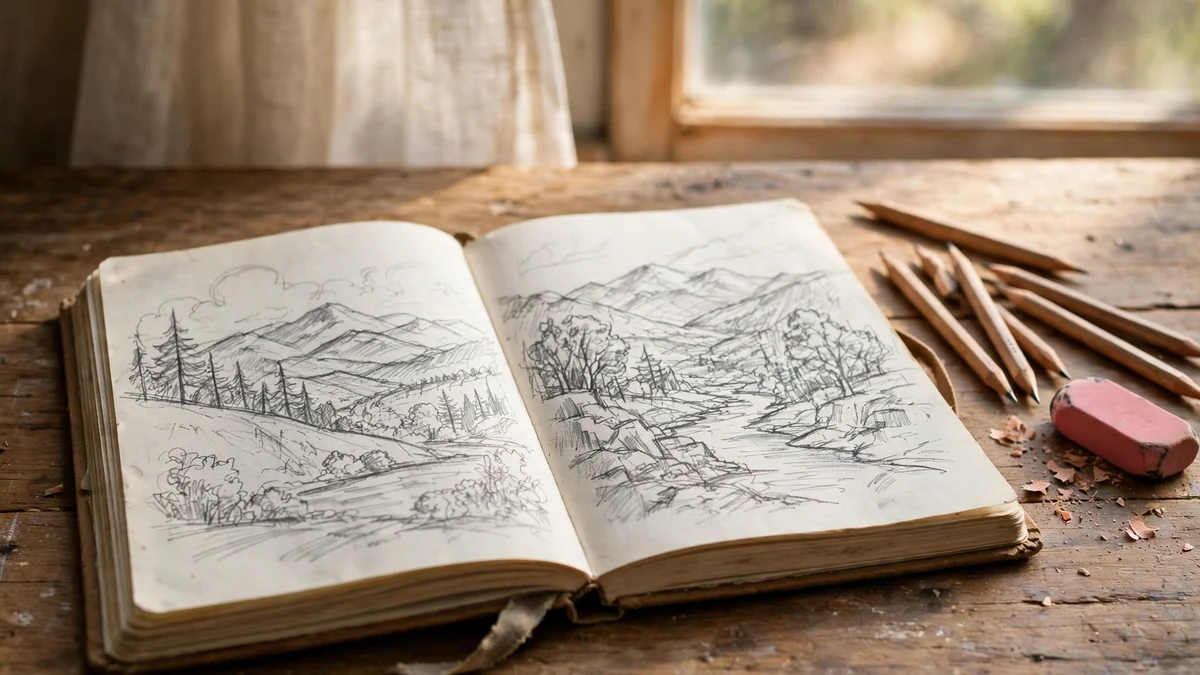

A sketchbook is a bound book of blank or lightly textured paper made for drawing, and choosing the right one comes down to three things: paper weight, size and binding. Heavy paper takes wet media without buckling, a size you will actually carry gets used, and a binding that lies flat makes drawing across two pages a pleasure rather than a fight. If you have ever bought a beautiful sketchbook and then been afraid to spoil it, you are not alone, and the answer is to choose a working book, not a precious one.
Artists have carried a sketchbook for centuries, and it remains the simplest way to record what you see. This guide explains how to choose a sketchbook for pencil, pen, watercolour or mixed media, how to look after it, and how to build a habit of drawing in it every day. The best sketchbook is not the most expensive one on the shelf; it is the one that is in your bag when you have ten spare minutes and something worth drawing.
Key takeaways
- A sketchbook is a bound book of paper made for drawing, and paper weight decides what media it can take.
- Paper of 140 grams per square metre or more handles light watercolour without buckling.
- Choose a size you will actually carry, because a sketchbook left at home is never used.
- A binding that lies flat makes drawing across two pages far easier.
- Start each sketchbook with a quick, imperfect drawing to break the fear of the first page.
- Date your drawings so you can watch your progress over months and years.
What makes a good sketchbook?
A good sketchbook starts with its paper. For pencil and pen, a smooth or lightly textured paper of around 100 to 140 grams per square metre is plenty, and it will take shading, hatching and fine ink lines without feathering. For watercolour and wet ink, you need heavier paper, ideally 200 grams or more, with a cold-pressed surface that holds water without buckling. Mixed-media paper sits in between, and it is a good choice if you switch between dry and wet materials. The weight is usually printed on the cover, so check it before you buy.
Size matters more than most beginners expect. A pocket sketchbook fits in a coat and gets used on trains and in queues, while an A4 book gives your arm room to move and suits larger studies. An A5 book is the middle ground, and it is the size most people settle on for daily drawing. Whatever size you choose, make sure the binding lies flat: a spiral binding opens completely, a sewn binding lies reasonably flat once broken in, and a glued binding often fights you at the spine. A sketchbook that opens flat is a sketchbook you will enjoy using.
How to choose a sketchbook for your medium
Pencil artists have the easiest choice, because almost any sketchbook takes graphite well. Look for a slightly textured paper that grips the pencil and allows soft shading, and avoid very glossy paper, which leaves graphite sitting on the surface. A hardbound book protects your drawings in a bag, while a softcover book is lighter to carry. Either works, so choose by how you carry it rather than by how it looks on the shelf.
Pen and ink artists need paper that does not bleed. A smooth paper of 120 grams or more keeps fine lines crisp, and a sketchbook sold for markers or illustration will usually have been tested for bleed-through. Test any new sketchbook with your heaviest pen on the first page: if the ink shows through badly, use that book for pencil instead and keep the pen work for a heavier paper. Watercolour artists need the heaviest paper of all, and a sketchbook with 300-gram cold-pressed paper will take washes without cockling. If you only use watercolour occasionally, a mixed-media sketchbook of 200 grams will cope with light washes and still take pencil.
Digital artists face a different version of the same question. A tablet and stylus can replace a paper sketchbook for many people, but the habit is the same: draw often, keep the work in one place, and look back at it. If you sketch on a laptop screen for reference or for digital drawing, keep the screen in good order, because a marked or damaged display makes fine work harder; our guide to MacBook Pro screen burn marks explains what to watch for. Whether your sketchbook is paper or pixels, the discipline of a daily page is what builds skill.
How to use a sketchbook every day
The hardest part of keeping a sketchbook is not drawing; it is starting. The blank first page stops more people than any lack of talent, so spoil it on purpose. Fill the first page with scribbles, colour tests and a bad drawing of your own hand, and the fear disappears. From then on, the rule is simple: one page a day, however small. A five-minute sketch of a coffee cup counts, and so does a thumbnail of a view from a window. The habit matters more than the result.
Carry the sketchbook with you, and keep a pencil tucked in its elastic band or pocket. Waiting rooms, train journeys and lunch breaks are all drawing time, and a sketchbook that lives in your bag will be used far more than one that lives on a shelf. Date each page as you finish it, and write a line or two about where you were and what you noticed. Those notes turn a sketchbook into a diary, and they are often the most interesting thing about it years later. Sketching outdoors is part of the pleasure, whether you are drawing a landscape or the finds from a hobby such as metal detecting, and a sketchbook is light enough to take anywhere a walk takes you.
Do not tear pages out. A bad drawing is still a record of what you were trying, and a sketchbook full of failures is more useful than a sketchbook full of only the good pages. If a drawing goes badly, turn the page and start again rather than removing the evidence. Over months, the pages add up into a record of progress that no single drawing could show. That record is the real value of a sketchbook.
Sketchbook paper at a glance
| Paper weight | Best for | Surface | Watch out for |
|---|---|---|---|
| 90 to 110 gsm | Pencil and light pen work | Smooth or light texture | Too thin for wet media |
| 120 to 140 gsm | Pen, ink and light wash | Smooth | Ink may show through thin sheets |
| 150 to 200 gsm | Mixed media and markers | Light texture | Heavy washes may cockle |
| 200 to 300 gsm | Watercolour and wet ink | Cold-pressed | Heavier and more expensive |
| Toned paper | White pencil and chalk | Mid-tone grey or tan | Needs white media for highlights |

Looking after your sketchbook
A sketchbook lasts longer if it is kept dry, flat and away from direct sunlight. A hardbound book protects the pages in a bag, but a softcover book in a zip pocket or a padded pouch does just as well. Keep a sheet of plain paper between a fresh pencil drawing and the facing page if the graphite smudges, and avoid stacking heavy books on top of a spiral-bound sketchbook, which can bend the wire. If you draw with charcoal or soft pastel, a light spray of fixative helps, though many artists simply accept a little smudging as part of the medium.
Store finished sketchbooks upright on a shelf, like books, with the spine out and a label on the end showing the dates inside. A row of filled sketchbooks is a satisfying sight, and it makes it easy to find a particular year or trip. Number them as you finish them, and keep a simple list of what is in each one. A sketchbook habit that lasts for years produces a small library, and that library is worth keeping in order. Even a practice session at the golf driving range can fill a page or two, since the figures, the swing and the landscape are all good drawing subjects.
A checklist for starting a new sketchbook
- Choose paper weight for your main medium, heavier for watercolour and lighter for pencil.
- Pick a size you will actually carry every day, not the size you wish you carried.
- Check that the binding lies flat before you buy.
- Spoil the first page on purpose with scribbles and colour tests.
- Keep a pencil with the book at all times, so you are never without a tool.
- Date every page and add a line about where you drew it.
- Draw one page a day, even if it is only a five-minute sketch.
- Never tear a page out; a bad drawing is still part of the record.
Frequently asked questions
What paper weight should a sketchbook have?
For pencil and pen, paper of 100 to 140 grams per square metre is enough. For mixed media, choose 150 to 200 grams, and for watercolour, choose 200 to 300 grams so the paper does not buckle. The weight is printed on the cover, so check it before you buy.
What size sketchbook is best for beginners?
A5 is the best size for most beginners, because it is large enough to draw comfortably and small enough to carry every day. A pocket sketchbook suits quick studies on the move, while A4 suits larger work at a desk. Choose the size you will actually carry, because a sketchbook left at home is never used.
Can you use watercolour in a normal sketchbook?
Light washes work in a sketchbook of 150 grams or more, but heavy washes will buckle thin paper. For regular watercolour, use a sketchbook with 200- to 300-gram cold-pressed paper, or a dedicated watercolour sketchbook. If the paper cockles, let it dry flat under a heavy book.
How do I get over the fear of the first page?
Spoil the first page on purpose. Fill it with scribbles, colour tests, a shopping list and a bad drawing of your hand, and the pressure disappears. A sketchbook is a working book, not a gallery, and the first page is allowed to be messy. Once it is spoiled, the rest of the book feels easy.
Should I tear bad drawings out of my sketchbook?
No, leave them in. A bad drawing is a record of what you were trying, and a sketchbook full of failures is more useful than one with only the good pages kept. Over months, the pages add up into a record of progress that no single drawing could show, and you will be glad you kept them.
How long does a sketchbook last?
A sketchbook used daily lasts a few weeks to a few months, depending on its size and how much you draw. Acid-free paper keeps for decades if the book is stored dry and out of direct sunlight. Store finished sketchbooks upright on a shelf, spine out, with the dates written on the end.
The bottom line
A sketchbook is a simple tool, and choosing one is mostly a matter of matching the paper to your medium and the size to your life. Pick a book you will carry, spoil the first page, and draw a little every day. The drawings will improve on their own, and the filled books on your shelf will be the proof.