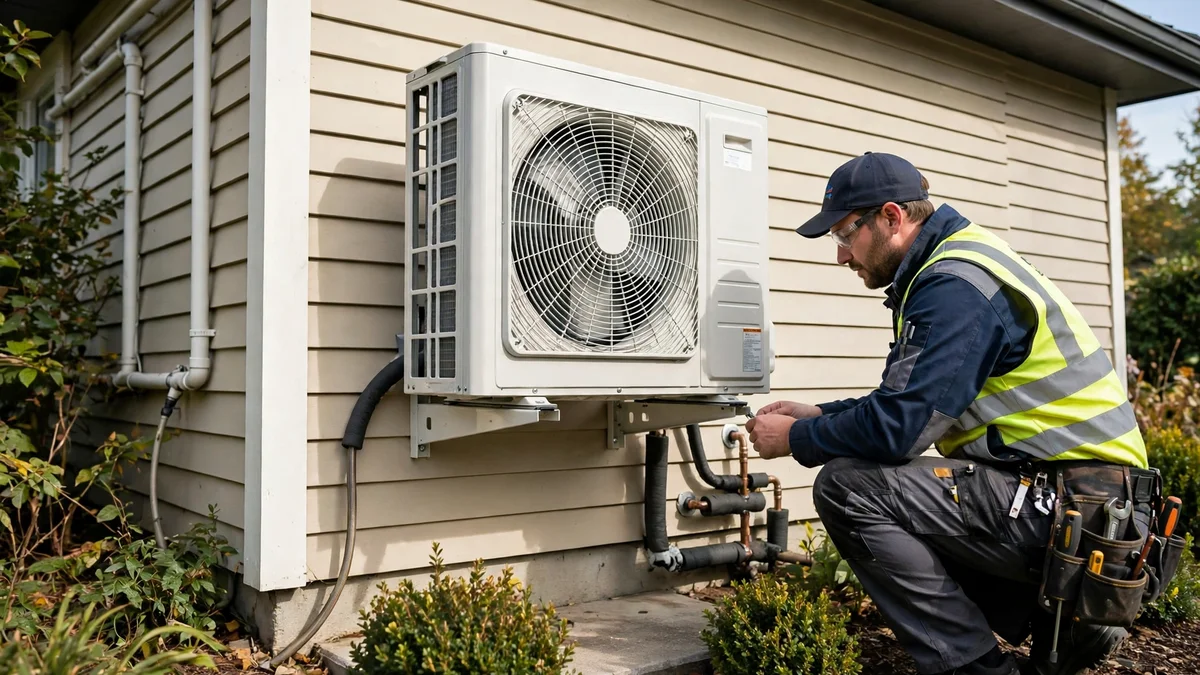

Heat pump repair usually starts with simple checks, not a new system. When a heat pump stops heating, stops cooling, or starts making unfamiliar noises, the cause is often a thermostat setting, a clogged filter, a tripped breaker or blocked airflow. This guide explains the common faults, how to diagnose them safely, when to call a professional, and what affects the cost of a repair.
A heat pump moves heat rather than making it, taking warmth from the outside air and moving it indoors in winter, then reversing the process in summer. That makes it efficient, but it also means the system depends on clean airflow, correct refrigerant levels and a working reversing valve. When any of those are wrong, the symptoms show up quickly: weak airflow, lukewarm air, or ice on the outdoor unit.
Key takeaways
- Most heat pump faults show up as weak heating or cooling, ice build-up, odd noises or short cycling.
- Check the thermostat, the filters, the power supply and the airflow around the outdoor unit first.
- Dirty filters and blocked airflow are the most common causes and the easiest to fix.
- Refrigerant, electrical and compressor work belongs to a qualified professional.
- Regular servicing and clean filters prevent many of the faults that lead to call-outs.
- Repair cost depends on the fault, the parts needed, the age of the system and access.
How a heat pump works
A heat pump is a refrigeration system that can run in both directions. In heating mode, the outdoor unit absorbs heat from the outside air, even when that air feels cold, and a refrigerant carries it indoors, where the indoor unit releases it into the room. In cooling mode, a reversing valve changes the direction of flow, and heat is carried out of the house instead. A fan moves air over the coils at each end, and a compressor drives the refrigerant around the circuit.
Because the system moves heat instead of burning fuel to create it, it can deliver several units of heat for each unit of electricity it uses. That efficiency depends on the whole circuit working well. If airflow is restricted, the coils cannot exchange heat properly. If refrigerant is low, the system cannot carry enough heat. If the reversing valve sticks, the system cannot change modes.
Common heat pump faults
Weak or lukewarm air is the most common complaint. The system runs, the fan blows, but the air never feels warm enough in winter or cool enough in summer. Dirty filters are often the cause: a clogged filter chokes the airflow over the indoor coil, so less heat reaches the room. Low refrigerant has a similar effect, though it also tends to ice up the coils. A thermostat set to the wrong mode can produce the same symptom without anything being broken.
Ice on the outdoor unit is normal in small amounts during cold weather, because heat pumps run a defrost cycle that melts it away. It becomes a fault when the ice is thick, covers the fan, or never clears. A failed defrost cycle, a faulty sensor, low refrigerant or blocked airflow can all leave the unit frozen, and running it in that state strains the compressor.
Short cycling is when the system switches on and off far more often than it should, sometimes every few minutes. An oversized system, a clogged filter, a faulty thermostat or low refrigerant can all cause it, and it wears out components quickly. Unusual noises point in different directions: rattling may mean a loose panel or debris in the fan, grinding may mean a failing fan motor or compressor bearings, and hissing may mean a refrigerant leak.

How to diagnose a heat pump problem safely
Start with the controls. Check that the thermostat is set to the right mode, heating or cooling, and that the set temperature is sensible for the season. Check that the thermostat has power: dead batteries in a wireless thermostat are a common and easily missed cause. Then check the filters. If they are grey with dust, clean or replace them following the maker’s instructions, and see whether the system recovers over the next hour.
Next, check the power and the airflow. Make sure the isolator switch is on and that the circuit breaker has not tripped, and reset it once if it has. Look at the outdoor unit: clear leaves, snow and garden growth from around it, and check that nothing is leaning against it. Listen to the system as it runs, and note whether the fan is turning and whether the air from the vents changes temperature.
Know where to stop. Do not open the outdoor unit, do not touch wiring or capacitors, and do not try to top up refrigerant. Refrigerant is a controlled substance in many countries, and handling it without training and certification is both dangerous and, in many places, unlawful. If the fault is not fixed by the thermostat, the filters, the power and the airflow, the next step is a professional.
Faults at a glance
The table below matches the most common symptoms with their likely causes and whether the fix is a home job or a professional one.
| Symptom | Likely cause | Home check | Professional? |
|---|---|---|---|
| Weak heating or cooling | Dirty filter, low refrigerant | Clean or change the filter | Yes, if refrigerant is low |
| Ice that never clears | Failed defrost, faulty sensor | Clear debris around the unit | Yes |
| Short cycling | Clogged filter, faulty thermostat | Clean filter, check settings | Often |
| Rattling noise | Loose panel, debris in fan | Clear debris, check panels | If it persists |
| Hissing or bubbling | Refrigerant leak | Switch off, ventilate | Yes, always |
| No power at all | Tripped breaker, blown fuse | Check breaker and isolator | If it trips again |
When to call a professional
Call a professional when the fault involves refrigerant, electrics or the compressor. A hissing sound, oily marks around pipe joints, or ice that returns after the filters are clean all point to a refrigerant problem, which only a qualified technician can repair and recharge. Electrical faults are the same: a breaker that trips repeatedly, a burning smell, or scorch marks near the unit are reasons to switch the system off and call for help rather than keep resetting it.
Age and history matter too. A system that has needed several repairs in a short time, or one that is well past its expected service life, may be telling you that a repair is poor value compared with replacement. A good technician will say so honestly. Always check that the engineer is qualified for the work: in the UK, for example, anyone handling refrigerant should hold the relevant F-Gas certification. Ask to see the credentials before the work starts.
What affects the cost of a heat pump repair
Repair costs vary widely, and no single figure covers every fault, so it is more useful to understand what drives the price. The nature of the fault is the biggest factor: cleaning filters and resetting controls costs little, while replacing a compressor, a reversing valve or a fan motor involves expensive parts and several hours of labour. Parts for older models can also be harder to find, and some may no longer be made.
Access and timing also affect the bill. An outdoor unit that is easy to reach takes less time to work on than one tucked behind a fence or mounted high on a wall. Emergency or out-of-hours call-outs usually carry a premium, while a repair booked as part of a planned visit is generally cheaper. The best way to keep costs down is to get a written quote before the work starts, ask whether the price includes parts and labour, and check what warranty the repair carries. A clear quote protects both sides and avoids surprises.
A checklist before you call for heat pump repair
Running through these checks first often fixes the problem without a call-out.
- Check the thermostat mode, the set temperature and the batteries.
- Clean or replace the filters and give the system an hour to recover.
- Check the isolator switch is on and the circuit breaker has not tripped.
- Clear leaves, snow and plants from around the outdoor unit.
- Note any error code shown on the controller or thermostat.
- Listen for the fan and the compressor, and note any new noise.
- Check whether the ice on the outdoor unit clears after a defrost cycle.
- Write down when the problem started and what has changed since.
- Keep the model name and the service history ready for the engineer.
Frequently asked questions
Why is my heat pump not heating properly?
The most common causes are dirty filters, a thermostat set to the wrong mode, blocked airflow around the outdoor unit, or low refrigerant. Check the thermostat, clean the filters and clear the area around the outdoor unit first. If the air is still lukewarm after an hour, or the coils are icing up, call a qualified technician, because low refrigerant needs professional attention.
Is ice on my heat pump a problem?
A thin layer of frost in cold weather is normal, and the defrost cycle should melt it. Thick ice that covers the fan, blocks airflow or never clears is a fault, and it may mean a failed defrost cycle, a faulty sensor or low refrigerant. Clear debris from the unit and call a professional if the ice returns.
How often should a heat pump be serviced?
Most makers advise a professional service once a year, and filters should be cleaned or replaced far more often, typically every few months depending on use and dust levels. Regular servicing keeps the system efficient, catches small faults before they become expensive, and is often a condition of the warranty.
Can I repair a heat pump myself?
You can safely do the simple checks: thermostat settings, filters, power and airflow around the outdoor unit. Everything beyond that, including refrigerant, wiring, capacitors and the compressor, belongs to a qualified professional. Refrigerant handling needs certification, and electrical work on a heat pump can be dangerous without training. For background on how these systems work, see Wikipedia’s overview of heat pumps.
What does heat pump repair usually involve?
It depends on the fault. A service visit usually starts with diagnosis: checking pressures, temperatures, electrical readings and error codes. Simple repairs may mean cleaning coils, replacing a capacitor or a sensor, or fixing a loose connection. Larger repairs involve replacing a fan motor, a reversing valve or a compressor.
When is it better to replace a heat pump than repair it?
Replacement is worth considering when the system is old, repairs are frequent, parts are no longer available, or a single repair would cost a large share of a new system’s price. A technician who has seen the system can advise honestly on its remaining life. If the system still heats and cools well after a modest repair, fixing it is usually the better choice.
The bottom line
Heat pump repair is mostly a matter of knowing what you can check and what you should leave alone. Thermostat settings, filters, power and airflow are yours to check, and they fix a surprising number of faults. Refrigerant, electrics and the compressor are not. Keep the filters clean, book a yearly service, and call a qualified engineer promptly when the system ices up, hisses, short cycles or trips the power. For more on keeping a home’s systems in good order, read our guide to car air conditioning repair, our article on radiator repair near you, and our guide to water heater installation near you.
Safety note: heat pumps run on mains electricity and use pressurised refrigerant. Never open the unit, touch wiring or attempt a refrigerant repair yourself; switch the system off and call a qualified engineer.