
What is the Indian legend regarding the discovery of tea? The best-known answer is the story of Bodhidharma, an Indian monk who, according to tradition, fell asleep during a long meditation and cut off his own eyelids in disgust at his weakness. The eyelids fell to the ground, took root, and grew into the first tea bushes, whose leaves could be brewed into a drink that kept people awake.
This is a legend, not verified history, and it is worth saying so plainly. No record proves the events happened as the story describes; the tale survives because of what it means. It links tea to watchfulness, discipline and the monastic life, and it gives a humble leaf a dramatic origin. Below, the story is told as tradition tells it, beside the history we can verify.
Key takeaways
- The Indian legend of tea’s discovery centres on Bodhidharma, an Indian monk and founder of Chan Buddhism.
- He cut off his eyelids after falling asleep during meditation, and tea bushes grew where they fell.
- The story is a legend, not verified history, and should be retold as tradition rather than fact.
- A variant of the tale names Gautama Buddha in place of Bodhidharma.
- A separate Chinese legend credits Emperor Shennong with discovering tea around 2737 BCE.
- Tea drinking is first credibly recorded in China in the third century AD.
The Bodhidharma story
The legend, as it is most often told, begins with Bodhidharma, a monk who travelled from India to China and became the founder of Chan Buddhism, the tradition later known in Japan as Zen. He was famous for the severity of his practice, and one account says he sat facing a wall in meditation for nine years. During that long vigil he fell asleep, and when he woke he was so angry with himself that he cut off his eyelids and threw them to the ground. Where the eyelids landed, tea bushes sprang up, and their leaves, when steeped in hot water, made a drink that kept monks awake during meditation.
The details of the story vary a little from one telling to another, which is exactly what you would expect from a tale passed down by word of mouth. In some versions the meditation lasts nine years, in others the emphasis falls on the monk’s vow never to sleep. The heart of the story never changes, though: a moment of failure is transformed into a gift, and the gift is a plant that helps others avoid the same failure. The legend belongs to a wider world of tea stories that crossed borders freely, carried by monks, merchants and travellers along the same routes as the tea itself.
How the legend travelled
Legends travel the way goods travel, along trade routes and in the company of the people who use them. Buddhist monks carried tea from China to Japan, and with the tea came stories about where it had come from and why it mattered. Eisai, a Japanese Zen priest, brought tea seeds to Kyoto in 1191 and wrote the first Japanese book on tea, describing it as a remedy for both mind and body. In that world of monastic discipline, a story that tied tea to wakefulness was far more than entertainment; it was a teaching, and it gave the drink a place in religious life. Tea is still a social drink today, and a quiet break outdoors suits it well, as our guide to picnic recipes shows.
The story also reached India itself, where it found a natural home. Bodhidharma was remembered as an Indian monk, and Indian tellings often stress his origins, making the discovery of tea an Indian story even though the surviving written version is Japanese. This is how legends work: they are adopted, adapted and claimed by each culture that retells them.
What the legend means
The meaning of the legend is easier to pin down than its facts, and it is the meaning that has kept the story alive. Tea is a mild stimulant, and in a monastery where monks sat in meditation for long hours, a drink that kept the mind clear was a practical blessing. The legend explains that blessing in the language of devotion: the plant exists because a holy man sacrificed part of himself to stay awake, and every cup is a small share in that sacrifice.
For readers who love tea, the legend also gives the drink a sense of ceremony. A cup of tea is an everyday pleasure, and the story lifts it into something older and stranger, a drink with a sacred origin and a purpose beyond refreshment. That is why the tale is still told in tea houses and in books on tea culture, even by writers who know it is not history. A good legend does not need to be true to be worth telling.
The other great tea legend
No account of tea legends would be complete without Shennong, the Chinese emperor of legend who is said to have discovered tea around 2737 BCE. According to the tale, Shennong was drinking a bowl of freshly boiled water when leaves from a nearby tree blew into it, changing the colour and flavour of the water. He tasted the brew and was pleased by its flavour and its restorative properties. A variant says he tested the medicinal properties of herbs on himself, chewing leaves, stems and roots to learn which were healing and which were poisonous, and found that tea worked as an antidote when he swallowed something harmful. Readers who want the wider picture can start with the History of tea on Wikipedia.
The Shennong story is older in its setting than the Bodhidharma tale, and it belongs to a different tradition, one that presents tea as a medicine discovered by a wise ruler rather than as a monastic aid discovered by a monk. The two legends sit side by side in the history of tea, and together they show how many cultures wanted to claim a part in the discovery of the drink. China remembers an emperor, India remembers a monk, and Japan remembers the priest who carried the seeds across the sea.
Tea in India: from legend to plantations
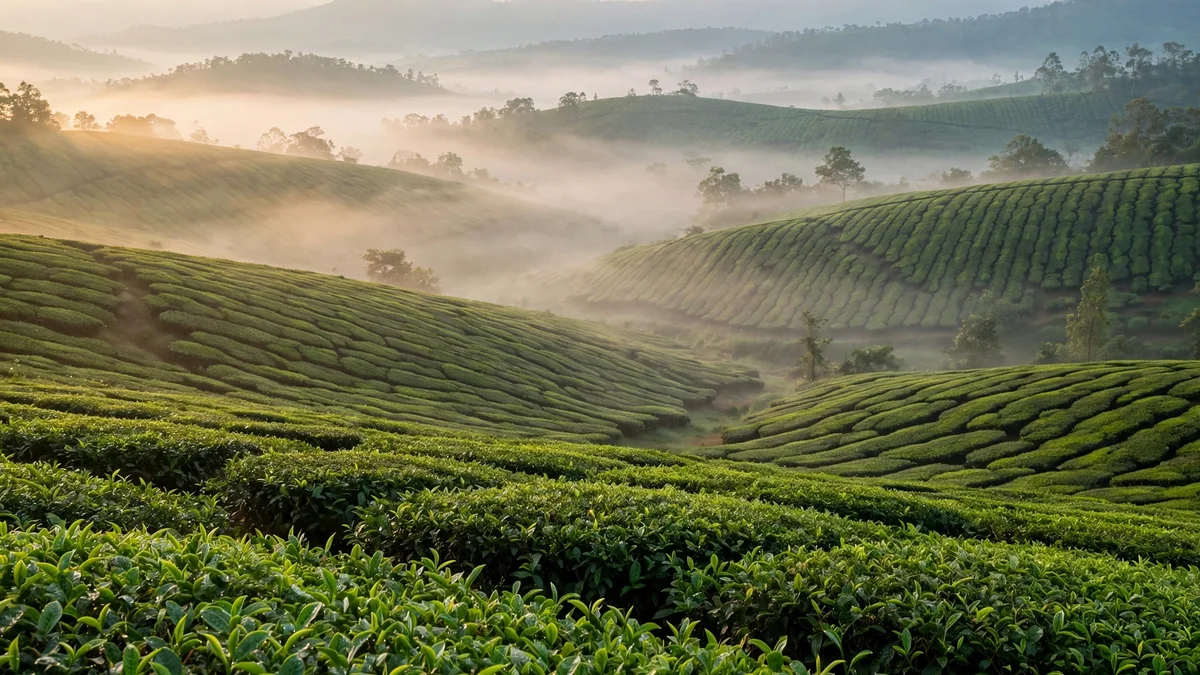
The real history of tea in India begins much later than the legend, and it is a story of trade, empire and agriculture rather than of monks and miracles. Tea drinking became popular in Britain during the seventeenth century, and to compete with the Chinese monopoly on tea, the British East India Company introduced commercial tea production to British India. The misty hills of Assam, where the tea plant grew wild, became the centre of a new industry, and the plantations that still cover those hills today are the visible result of that decision.
Indian tea culture grew into something distinct, and it is worth remembering that the drink most Indians know is not the plain green tea of the monasteries but masala chai, tea brewed with milk, sugar and spices. The legend of Bodhidharma and the history of Assam plantations belong to different chapters of the same book, and both help to explain why tea matters so much in India today. One gives the drink a sacred origin, the other gives it an economic one.
The legend at a glance
| Version | Main figure | What happens | Where it is told |
|---|---|---|---|
| Bodhidharma legend | Bodhidharma, an Indian monk | He cuts off his eyelids after falling asleep, and tea bushes grow where they fall | Japan, China and India |
| Buddha variant | Gautama Buddha | The same story, with the Buddha in place of Bodhidharma | Buddhist tradition |
| Shennong legend | Emperor Shennong of China | Tea leaves blow into his boiled water, and he discovers the brew | China |
| Documented history | Physician Hua Tuo | Tea drinking is recorded in a medical text in the third century AD | China |
| Tea in India | British East India Company | Commercial tea production begins in British India, centred on Assam | India |

A checklist for exploring the legend
- Remember that the Bodhidharma story is a legend, and retell it as tradition rather than as verified history.
- Name Bodhidharma as an Indian monk and founder of Chan Buddhism, and the nine years of meditation facing a wall.
- Keep the heart of the tale clear: the eyelids fall, tea bushes grow, and the leaves keep monks awake.
- Mention the Buddha variant, so listeners know the same story is told about more than one holy figure.
- Pair the legend with the Shennong story, the great Chinese legend of tea’s discovery.
- Set the legend beside the documented history, including Hua Tuo’s third-century record.
- Note how tea reached India commercially through the British East India Company and Assam.
- Enjoy the meaning of the story, watchfulness and renewal, without asking it to be history.
Frequently asked questions
What is the Indian legend regarding the discovery of tea?
The Indian legend regarding the discovery of tea is the story of Bodhidharma, an Indian monk who fell asleep during a long meditation, cut off his eyelids in disgust, and saw tea bushes grow where the eyelids fell. The leaves could be brewed into a drink that kept people awake. It is a legend rather than verified history, and it is best retold as tradition.
Who was Bodhidharma?
Bodhidharma was an Indian monk who travelled to China and became the founder of Chan Buddhism, the tradition later known in Japan as Zen. He is remembered for the severity of his meditation practice, including the account that he sat facing a wall for nine years. His Indian origins are why the legend is often called the Indian legend of tea, even though the best-known written version comes from Japan.
Is the Bodhidharma tea legend true?
No, the story is a legend, not a verified historical event. The same tale is told with Gautama Buddha in place of Bodhidharma, which shows the plot matters more than the historical detail. The documented history of tea begins in China, with the earliest credible record dating to the third century AD.
What is the Chinese legend of tea’s discovery?
The Chinese legend credits Emperor Shennong, who is said to have been drinking boiled water around 2737 BCE when leaves from a nearby tree blew into his bowl and changed its colour and flavour. He tasted the brew and was pleased by it. A variant says he used tea as an antidote after testing poisonous herbs on himself.
When was tea first drunk, according to the evidence?
The earliest credible written record of tea drinking dates to the third century AD, in a medical text by the Chinese physician Hua Tuo. Physical evidence is older: tea was found in the mausoleum of Emperor Jing of Han, dating to the second century BCE.
How did tea become important in India?
Tea became important in India when the British East India Company introduced commercial tea production to British India, to compete with the Chinese monopoly on tea. Assam, where the tea plant grew wild, became the centre of the industry. Today India is one of the great tea-growing countries, and its best-known drink is masala chai, tea brewed with milk, sugar and spices. For a related drink guide, see our notes on medium ground coffee, and for a food pairing, see pecorino romano.
The bottom line
What is the Indian legend regarding the discovery of tea? It is the story of Bodhidharma, the Indian monk whose eyelids became the first tea bushes, a tale of failure turned into a gift and a drink that keeps the mind awake. Treat it as the legend it is, enjoy the meaning it carries, and set it beside the real history: tea drinking recorded in China in the third century AD, and tea growing in India from the days of the British East India Company.