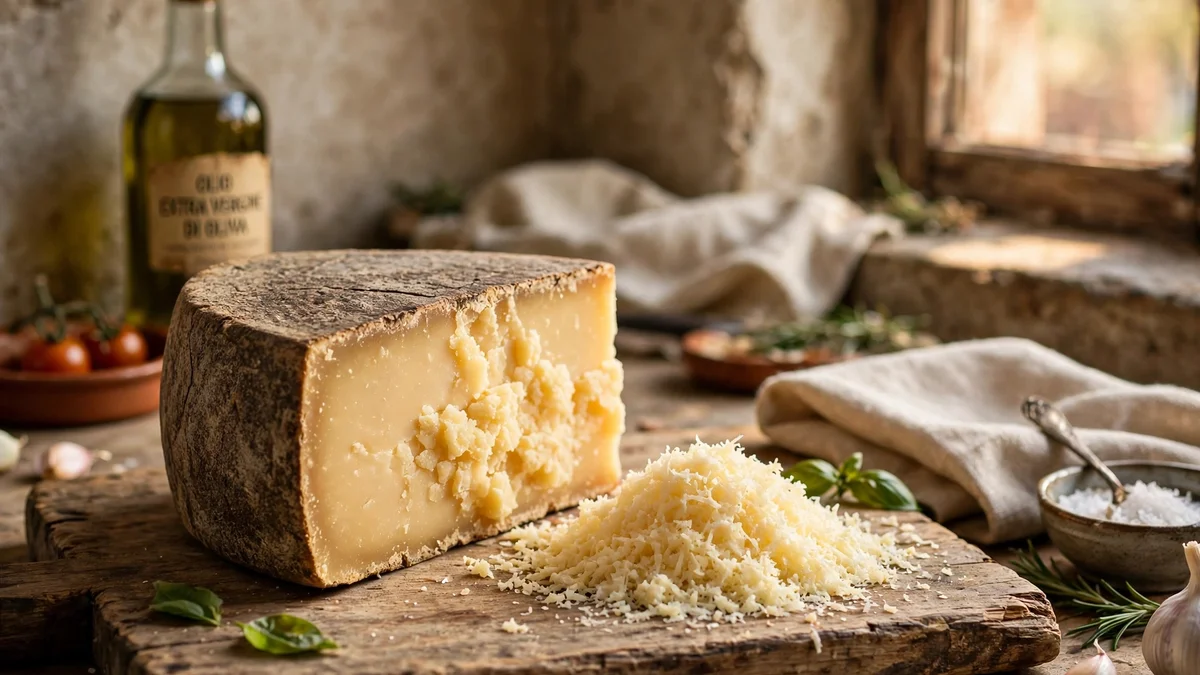

Pecorino Romano is a hard, salty Italian cheese made from sheep’s milk, and it is one of the oldest cheeses still made in Europe. Its name means sheep’s cheese of Rome, and it is best known as the sharp, savoury grating cheese behind Roman pasta dishes such as cacio e pepe. This guide explains what Pecorino Romano is, where it comes from, how it differs from Parmesan, and how to buy, store and cook with it.
Key takeaways
- Pecorino Romano is a hard cheese made only from sheep’s milk, with a salty, sharp and slightly peppery flavour.
- It carries protected designation of origin status, so it may only be made in Lazio, Sardinia and the province of Grosseto.
- Despite the Roman name, around 95 per cent of production now takes place in Sardinia.
- It must age for at least five months as a table cheese and eight months for grating.
- It is made with lamb rennet, so it is not suitable for vegetarians.
- Buy a wedge and grate it fresh, and never add it to a pan over direct heat, where it seizes into lumps.
What is Pecorino Romano?
Pecorino Romano is a hard, cooked cheese produced exclusively from sheep’s milk, and its name is a description rather than a brand. Pecorino means of sheep in Italian, while Romano points to Rome, the city around which the cheese was first made. The result is a firm, pale cheese with a compact, crumbly texture that breaks into shards rather than bending into slices, and a flavour that is salty first, sharp second, with a peppery finish that lingers.
The cheese is made by coagulating sheep’s milk with lamb rennet, cutting the curd small, cooking it gently, and pressing it into large cylindrical wheels that weigh between 20 and 35 kilos. The wheels are then dry-salted by hand over many weeks, which pushes the finished cheese to around 5 per cent salt and gives it its long keeping quality. The lamb rennet carries enzymes that break down milk fat and produce the cheese’s distinctive piquant bite.
Where Pecorino Romano comes from
Today Pecorino Romano has protected designation of origin status under European Union law, granted in 1996, which means every step of production must take place within Lazio, Sardinia or the province of Grosseto in Tuscany, using milk and rennet from local flocks. The name is protected, so a cheese made elsewhere cannot legally be sold as Pecorino Romano, however similar it may look. A consortium supervises production and protects the designation, and each wheel carries a mark on its rind: a stylised sheep’s head inside a diamond, repeated around the side of the wheel alongside the words Pecorino Romano.
The geography surprises many shoppers. Although the recipe is Roman, roughly 95 per cent of the cheese is now made in Sardinia, which supplies most of the sheep’s milk for a cheese that began life in the pastures of Lazio. The move was driven by practical reasons: Sardinia offered abundant pasture, space for large flocks and good conditions for ageing, and the island’s cheesemakers built their trade around the Roman recipe. Lazio still produces the cheese, and some shoppers prefer the Lazio style, but Sardinian wheels are the ones most people will find in shops.
Pecorino Romano and the other hard cheeses
Shoppers often confuse Pecorino Romano with Parmesan, and the confusion is understandable: both are hard, aged grating cheeses with pale, crystalline paste. The differences are clear once you know them. Parmigiano Reggiano is made from cow’s milk in Emilia-Romagna, aged for at least twelve months, and its flavour is nutty and mellow where Pecorino Romano is salty and sharp. Grana Padano is also a cow’s milk cheese, aged from nine months, and it is milder and less expensive than either. Pecorino Toscano is the closest relative, another sheep’s milk pecorino, but it is softer and milder, made to be eaten young as well as aged.
| Cheese | Milk | Minimum ageing | Flavour | Best use |
|---|---|---|---|---|
| Pecorino Romano | Sheep | 5 months, 8 for grating | Salty, sharp, peppery | Cacio e pepe, grating over pasta |
| Parmigiano Reggiano | Cow | 12 months | Nutty, mellow, savoury | Grating, risotto, eating in chunks |
| Grana Padano | Cow | 9 months | Mild, sweet, buttery | Everyday grating, cooking |
| Pecorino Toscano | Sheep | 20 days fresh, longer aged | Mild and sweet when young | Table cheese, salads, sandwiches |
| Pecorino Sardo | Sheep, Sardinia only | 20 days sweet, 60 days mature | Gentle, then firm and nutty | Table cheese, grating when mature |

How to cook with Pecorino Romano
Pecorino Romano is at its best in the four classic Roman pasta dishes: cacio e pepe, pasta alla gricia, amatriciana and carbonara. In each of them the cheese is the main seasoning, so its saltiness does much of the work and extra salt should be added with care. Cacio e pepe, which is simply pasta, black pepper and Pecorino Romano bound with starchy pasta water, is the purest test of the cheese: with only three ingredients, there is nowhere for a poor cheese to hide.
The cardinal rule of cooking with it is never to add it to a pan over direct heat. Sheep’s milk protein tightens fast, and the cheese will string and then seize into rubbery lumps. Instead, take the pan off the heat, or mix the finely grated cheese with a little warm pasta water in a bowl first, to make a smooth paste before tossing it through the pasta. Grate it as finely as you can, because fine shreds melt evenly while coarse ones clump. The same care applies to soups and sauces: stir it in off the heat, at the end, and let the residual warmth do the work.
Beyond pasta, Pecorino Romano earns its place as a table cheese. An older wheel is better grated, while the rind should not be thrown away: it keeps in the freezer and can be dropped into a pot of simmering minestrone, ribollita or bean soup, where it releases concentrated savoury flavour into the broth over about half an hour. Remove the rind before serving. For everyday meals, a little goes a long way, and a spoonful of finely grated Pecorino Romano lifts roasted vegetables, salads and egg dishes in the same way it lifts pasta. It also sits happily on a picnic spread, and our guide to the best picnic recipes includes dishes that take a shower of hard cheese well.
How to buy and store Pecorino Romano
Buy a wedge and grate it yourself, because pre-grated Pecorino Romano loses its aroma and behaves badly in sauces, partly because of the anti-caking agents added to keep it free-flowing. Look for the sheep’s head mark on the rind, check that the paste is white to faintly straw-coloured and compact, and choose a piece that breaks into shards rather than bending.
At home, wrap the wedge first in a lightly dampened cloth and then in waxed or greaseproof paper, and keep it in the vegetable drawer of the fridge. Cling film pressed against the surface makes the cheese sweat and softens the rind. Handled this way a wedge holds for two to three months, and across that time it keeps giving up water: it hardens, the salt concentrates, and it grates more finely than it did on the first day.
Pecorino Romano is naturally lactose-free after its long maturation, which suits shoppers who avoid lactose, but it is not suitable for vegetarians because of the lamb rennet, and its salt content is high, so a little goes a long way. For more on cooking with pulses and grains alongside strong cheeses, see our guide to dried lentils, and for a hearty breakfast that takes a grating of hard cheese, see our round-up of breakfast burritos near me.
A checklist for buying Pecorino Romano
- Check the label names sheep’s milk and the protected designation of origin.
- Look for the sheep’s head inside a diamond pressed into the rind.
- Choose a wedge that breaks into shards rather than bending.
- Buy a wedge, not pre-grated cheese, and grate it fresh as you need it.
- Ask the age: five months for the table, eight months or more for grating.
- Check the paste is white to faintly straw-coloured, compact, with few eyes.
- Store it wrapped in a damp cloth and waxed paper, not cling film.
- Save the rind for soups, and freeze spare wedges in small pieces.
Frequently asked questions
What is Pecorino Romano made from?
Pecorino Romano is made only from whole sheep’s milk, with salt, lamb rennet and lactic cultures. The milk is coagulated with rennet, the curd is cut small and cooked gently, and the wheels are pressed and dry-salted by hand over many weeks. Because the rennet comes from lambs, the cheese is not suitable for vegetarians, and because it is made only from sheep’s milk, it tastes quite different from cow’s milk hard cheeses.
Is Pecorino Romano the same as Parmesan?
No. Pecorino Romano is a sheep’s milk cheese from Lazio, Sardinia and Grosseto, aged at least five months, with a salty, sharp and peppery flavour. Parmigiano Reggiano is a cow’s milk cheese from Emilia-Romagna, aged at least twelve months, with a nuttier, mellower flavour. They can sometimes stand in for each other in cooking, but the result will taste different, and a dish built around Pecorino Romano, such as cacio e pepe, will lose its character with Parmesan.
Why is most Pecorino Romano made in Sardinia?
Although the cheese began in Lazio around Rome, production moved to Sardinia at the end of the nineteenth century, when cheesemakers followed the plentiful sheep’s milk and the good ageing conditions the island offered. Today around 95 per cent of Pecorino Romano is made in Sardinia, while the protected designation still covers Lazio and the province of Grosseto as well. The recipe stayed Roman, even as the sheep moved.
How long does Pecorino Romano age?
The specification requires at least five months of ageing for a table cheese and at least eight months for a grating cheese. Longer ageing makes the cheese harder, saltier and sharper, and it grates more finely. A five-month wheel is firm enough to break into pieces for the table, while an eight-month wheel is the better choice for grating over pasta.
Is Pecorino Romano vegetarian?
No. Pecorino Romano must be made with rennet from lambs raised in the same production area, so it is not suitable for vegetarians. Shoppers who avoid animal rennet should look for a vegetarian hard cheese instead, and check the label, because the word Romano on its own does not guarantee the same recipe or ingredients.
How should I store Pecorino Romano?
Wrap the wedge first in a lightly dampened cloth and then in waxed or greaseproof paper, and keep it in the vegetable drawer of the fridge, where it will hold for two to three months. Avoid cling film against the cut surface, which makes the cheese sweat. If the cut face dries out, scrape it back, and save the rind for soups. Grated cheese can be frozen for about six months, though freezing the wedge in small pieces keeps more flavour.
The bottom line
Pecorino Romano is a hard, salty sheep’s milk cheese with a Roman recipe, Sardinian heartland and protected name, and it earns its place in the kitchen by doing one thing brilliantly: seasoning pasta, soups and vegetables with a sharp, peppery depth that no other hard cheese quite matches. Buy a wedge, check for the sheep’s head mark on the rind, grate it fresh, keep it off direct heat, and let its salt do the work. Treated that way, a single wedge will flavour dozens of meals, and the rind will season the soup pot after the cheese itself is gone. For the full story of the cheese, its history and its protected status, see Pecorino Romano on Wikipedia.