
To transform mm to inches, divide the number of millimetres by 25.4, because one inch is exactly 25.4 millimetres. That single fact is all you need: 100 mm becomes 3.94 inches, 25 mm becomes 0.98 inches, and 10 mm becomes 0.39 inches. If you have ever stared at a ruler, a pattern or a parts list wondering whether a measurement was in millimetres or inches, this guide gives you the formula, worked examples, a quick-reference table and the mistakes that catch people out.
Key takeaways
- One inch is exactly 25.4 millimetres, by international agreement since 1959.
- To transform mm to inches, divide by 25.4; to go back, multiply inches by 25.4.
- Common conversions: 10 mm is 0.39 in, 25 mm is 0.98 in, 100 mm is 3.94 in.
- Round to two decimal places for everyday use, and keep more places for precise work.
- Watch out for mixing up millimetres and centimetres, the most common error.
- Check your ruler: many tape measures show both units side by side.
What transforming mm to inches means
Millimetres and inches are both units of length, but they belong to different systems. Millimetres are part of the metric system, used in most of the world for everything from engineering to dressmaking, while inches belong to the imperial system, still used in the United States and in some trades in Britain. Transforming mm to inches simply means expressing the same length in the other unit, so that a person, a machine or a pattern that works in inches can use a measurement that was given in millimetres.
The link between the two is exact, not approximate. Since 1959, the inch has been defined internationally as exactly 25.4 millimetres, so the conversion is a matter of arithmetic rather than measurement. The inch is described on Wikipedia as a unit of length in the imperial system, defined since 1959 as exactly 25.4 mm, which is why every conversion in this guide can be worked out precisely and checked. There is no rounding hidden in the definition itself; any rounding comes later, when you decide how many decimal places to show.
The formula for mm to inches
The formula is short. To transform millimetres to inches, divide the millimetres by 25.4. To go the other way, from inches to millimetres, multiply the inches by 25.4. In symbols, that is inches equals millimetres divided by 25.4, and millimetres equals inches times 25.4. A pocket calculator does this in a second, and most phones have a unit converter built in, but knowing the formula means you can check any answer rather than trusting a screen.
For rough mental arithmetic, remember that 25 mm is just under an inch, and 50 mm is just under two inches. That is enough to tell whether a measurement is sensible: if someone says a bolt is 150 mm long, you know at once that it is just under six inches. For anything that matters, such as cutting, drilling or ordering parts, work it out properly rather than guessing from the rough rule.
Worked examples
Start with a small measurement: 10 mm. Divide 10 by 25.4 and you get 0.3937, which rounds to 0.39 inches. That is about the width of a pencil. Next, 25 mm: 25 divided by 25.4 is 0.9843, which rounds to 0.98 inches, just under an inch. This is a useful one to remember, since 25 mm is a common size in screws, bolts and drill bits.
For a medium size, take 100 mm. Divide 100 by 25.4 and you get 3.9370, which rounds to 3.94 inches, just under four inches. And for a large one, 1,000 mm, which is a metre: 1,000 divided by 25.4 is 39.3701, which rounds to 39.37 inches. That is why a metre is often described as about 39 inches, though the precise figure is 39.37.
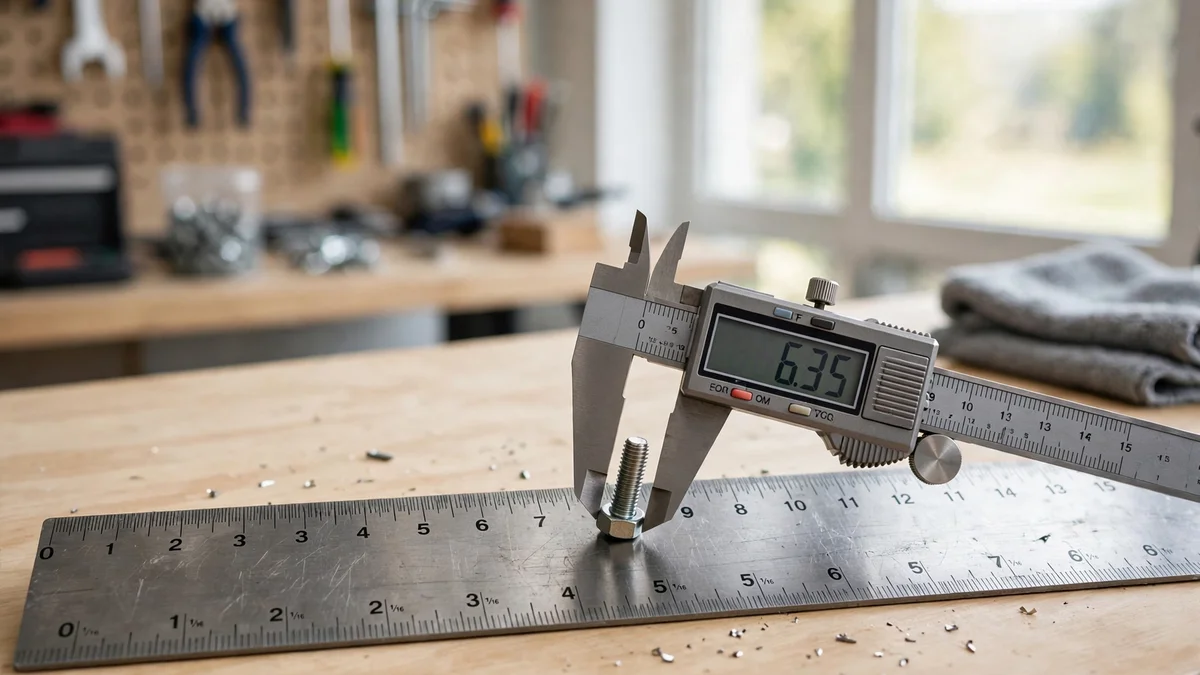
Going the other way works the same. One inch is 25.4 mm, two inches is 50.8 mm, and half an inch is 12.7 mm. Three quarters of an inch is 19.05 mm, and a quarter of an inch is 6.35 mm. These fractions matter because imperial measurements are often given in fractions, while metric ones are given in decimals, and the table below sets the two side by side.
Quick-reference table: mm to inches
The table below gives the most useful conversions, rounded to two decimal places. Keep it open while you work, or print it for the workshop.
| Millimetres | Inches | Nearest fraction | Millimetres | Inches |
|---|---|---|---|---|
| 1 mm | 0.04 in | 1/32 in | 100 mm | 3.94 in |
| 5 mm | 0.20 in | 3/16 in | 150 mm | 5.91 in |
| 10 mm | 0.39 in | 3/8 in | 200 mm | 7.87 in |
| 25 mm | 0.98 in | 1 in | 300 mm | 11.81 in |
| 50 mm | 1.97 in | 2 in | 500 mm | 19.69 in |
| 75 mm | 2.95 in | 3 in | 1,000 mm | 39.37 in |

Where you meet mm and inches
The two units meet most often in the workshop and the home. Screws, bolts, drill bits and spanners are sold in millimetres in most of the world, but older machinery, bicycles and plumbing fittings often use inches, so a repair can need both. A 10 mm spanner and a 3/8 inch spanner are close but not the same, and using the wrong one can round off a bolt head. The guide to 12 cm to inches covers the next step up in size, since centimetres and millimetres are often confused with each other.
Sewing and dressmaking mix the units too. Patterns from the United States often give seam allowances in fractions of an inch, while fabric shops elsewhere sell by the centimetre and the metre, so making a garment from an imported pattern means converting as you go. The guide to how to sew a button is a good place to practise careful measuring, since a buttonhole a few millimetres out will not hold its button. Screens are another meeting point: televisions, phones and laptops are sold by their diagonal size in inches almost everywhere, even in metric countries, while the bezels and stands around them are measured in millimetres. Clothing sizes mix the units as well, and the guide to the quarter zip shows how garment measurements are usually given, which is worth knowing before you convert a size.
Common mistakes when converting
The most common mistake is mixing up millimetres and centimetres. There are 10 millimetres in a centimetre, so a measurement of 25 centimetres is 250 mm, not 25 mm, and converting the wrong one gives an answer ten times too small. Always check the unit before you start: if a ruler shows centimetres, multiply by 10 to get millimetres first.
The second mistake is rounding too early. If you round 25.4 to 25 and then divide, a large measurement will drift: 1,000 divided by 25 is 40, not 39.37, an error of more than half an inch. Keep the full 25.4 in the calculation and round only at the end, to two decimal places for everyday use or three for precise work.
The third mistake is trusting a conversion in the wrong direction. Dividing by 25.4 turns millimetres into inches; multiplying by 25.4 does the opposite. If your answer looks wrong, check the direction first: a length in inches should always be a smaller number than the same length in millimetres, since an inch is much bigger than a millimetre. If your inches come out larger than your millimetres, you have multiplied when you should have divided.
Your mm to inches checklist
- Remember the key fact: 1 inch is exactly 25.4 mm.
- To transform mm to inches, divide by 25.4; to go back, multiply by 25.4.
- Check the unit first: 10 mm make 1 cm, so do not mix the two up.
- Keep the full 25.4 in the calculation and round only at the end.
- Round to two decimal places for everyday use, and three for precise work.
- Sanity-check the answer: inches should always be a smaller number than millimetres.
- Use the table above for common sizes: 10 mm is 0.39 in, 100 mm is 3.94 in, 1,000 mm is 39.37 in.
- When a measurement is given as a fraction, remember 1/4 in is 6.35 mm and 1/2 in is 12.7 mm.
How do I transform mm to inches?
Divide the number of millimetres by 25.4. For example, 100 mm divided by 25.4 is 3.94 inches, and 25 mm divided by 25.4 is 0.98 inches.
How many mm are in an inch?
There are exactly 25.4 mm in an inch. The inch has been defined as exactly 25.4 millimetres by international agreement since 1959.
What is 10 mm in inches?
Ten millimetres is 0.39 inches. Divide 10 by 25.4 to get 0.3937, which rounds to 0.39 inches at two decimal places.
What is 100 mm in inches?
One hundred millimetres is 3.94 inches. Divide 100 by 25.4 to get 3.9370, which rounds to 3.94 inches.
How do I convert inches to mm?
Multiply the inches by 25.4. One inch is 25.4 mm, two inches is 50.8 mm, and half an inch is 12.7 mm.
Why is my conversion ten times too big or too small?
You have probably mixed up millimetres and centimetres. There are 10 mm in 1 cm, so check the unit on your ruler or pattern before you start, and multiply centimetres by 10 to get millimetres first.
The bottom line
To transform mm to inches, divide by 25.4, because one inch is exactly 25.4 millimetres. That is the whole method: 10 mm is 0.39 inches, 25 mm is 0.98 inches, 100 mm is 3.94 inches and 1,000 mm is 39.37 inches. Check your units before you start, keep the full 25.4 in the calculation, round only at the end, and sanity-check the answer by remembering that inches are always the smaller number. With the formula and the table above, you can move between the two systems without guessing.