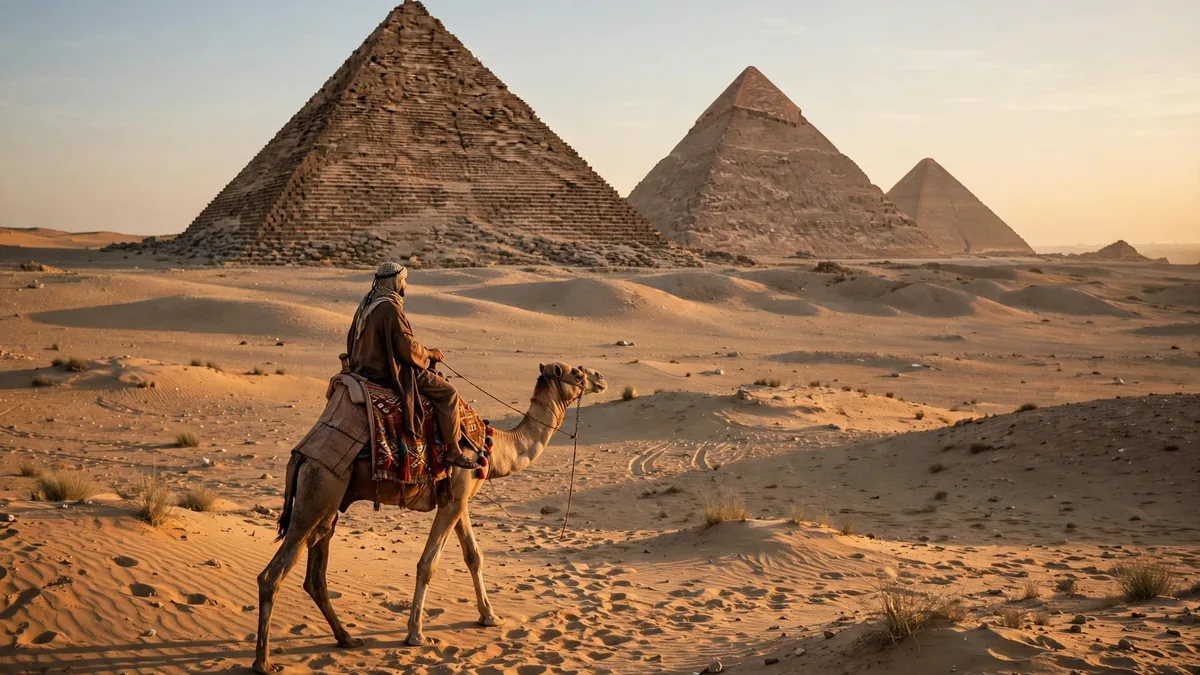

The Pyramids of Giza are the last surviving wonder of the ancient world, three great stone tombs rising from the desert edge outside Cairo, built more than 4,500 years ago for three kings of Egypt’s Fourth Dynasty. The largest of them, the Great Pyramid of Khufu, stood about 146.6 metres tall when it was finished, around 2560 BC, and it was the tallest building made by human hands for more than 3,800 years. This guide explains who built them, how they were made, and what to know before you visit.
Key takeaways
- The Pyramids of Giza were built for three Fourth Dynasty kings: Khufu, Khafre and Menkaure.
- The Great Pyramid of Khufu, c. 2560 BC, is the largest, originally about 146.6 metres tall.
- The pyramids were tombs, built as part of larger complexes with temples and causeways.
- Khafre’s pyramid still has part of its smooth limestone casing at the top.
- The Great Sphinx guards the plateau, with the body of a lion and a human head.
- The site is a UNESCO World Heritage Site, and the best views come from the desert to the west.
What the Pyramids of Giza are
The Pyramids of Giza stand on the Giza plateau, on the west bank of the Nile, just outside modern Cairo. There are three main pyramids, built in the 26th and 25th centuries BC for the kings Khufu, Khafre and Menkaure, along with smaller pyramids for queens, temples, causeways and the Great Sphinx. The whole plateau was a royal cemetery, and the pyramids were the centrepieces of much larger complexes, each with a valley temple, a causeway and a mortuary temple.
The Giza pyramid complex entry on Wikipedia gives a clear overview of the site and its layout, and it is worth reading before a visit, because the plateau is larger than most people expect. The pyramids are not grouped tightly together in the desert; they are spread across a raised limestone plateau, with the Sphinx at its eastern edge, looking out towards the Nile and the rising sun.
The pyramids were tombs, but they were also statements. A king’s pyramid announced his power and his wealth, and the bigger the pyramid, the stronger the statement. The Great Pyramid of Khufu is the largest pyramid ever built in Egypt, and it was the tallest building made by human hands for more than 3,800 years.
The Great Pyramid of Khufu
Khufu, known in Greek as Cheops, was the second king of the Fourth Dynasty, and his pyramid is the oldest and largest of the three. It was built around 2560 BC, and when it was finished it stood about 146.6 metres tall, on a base roughly 230 metres square. Today it is a little shorter, about 139 metres, because the smooth limestone casing that once covered it has been removed over the centuries, leaving the stepped core of rough blocks exposed.
Inside, the pyramid is a maze of passages and chambers. The best known are the King’s Chamber, built of red granite, and the Queen’s Chamber below it, reached by the Grand Gallery, a tall, corbelled passage that is one of the most impressive spaces in ancient architecture. The king’s burial chamber held a granite sarcophagus, which is still there, empty: the tomb was robbed long ago, and the king’s body has never been found.
The scale of the building is hard to grasp from numbers alone. The Great Pyramid is made of more than two million blocks of stone, most of them limestone quarried nearby, with granite brought from Aswan, hundreds of kilometres to the south. How the builders moved and lifted those blocks is still debated, and the most widely accepted explanation is a system of ramps, levers and manpower, organised by a skilled workforce of Egyptians rather than slaves, as was once believed.
Khafre and Menkaure
Khafre, Khufu’s son, built the second pyramid, and it is the one that still looks most like the pyramids of the imagination. Part of its smooth limestone casing survives at the top, a pale cap that catches the light, and because it stands on slightly higher ground than its father’s pyramid, it can look taller from a distance, even though it is actually a little smaller. Khafre’s pyramid is also the one most closely linked to the Sphinx, which stands at the end of its causeway and may bear the king’s face.
Menkaure’s pyramid is the smallest of the three, and it was built for Khufu’s grandson. It stands about 65 metres tall, less than half the height of the Great Pyramid, and it was originally cased in red granite at its lower levels. Three smaller pyramids stand beside it, built for queens, and the whole complex is more compact than its neighbours, which makes it a good place to see the shape of a pyramid complex without the crowds that gather around the larger two.
The Great Sphinx
The Great Sphinx stands at the eastern edge of the plateau, carved from a single ridge of limestone, with the body of a lion and the head of a human. It is about 73 metres long and 20 metres tall, and it is the largest monolith statue in the world. The Sphinx faces east, towards the rising sun.
Whose face the Sphinx wears is still debated, though it is usually thought to be Khafre. The statue has been buried in sand for much of its life, dug out again and again, and its nose was damaged long ago. What is certain is that it has watched over the plateau for more than 4,500 years, and that it is one of the most recognisable images in the world.
How the pyramids were built
The pyramids were built by a large, organised workforce, and the evidence from the workers’ town beside the plateau shows that they were skilled Egyptians, fed and housed by the state, not slaves. The work was seasonal: much of it happened during the annual flooding of the Nile, when farm work stopped and labour was available. The blocks were quarried, dragged on sledges and lifted into place, and the whole project was planned with a precision that still impresses surveyors today — the base of the Great Pyramid is level to within a few centimetres.
The stone came from several places. Most of the limestone was quarried on the plateau itself, while the fine white limestone for the casing came from Tura, across the Nile, and the granite for the inner chambers came from Aswan. Moving the granite alone was a major undertaking, and the boats that carried it down the Nile were part of a supply chain that stretched across the whole country.
The pyramids compared
The three main pyramids are often confused, so here is how they compare.
| Pyramid | Built for | Built around | Original height |
|---|---|---|---|
| Great Pyramid | Khufu | c. 2560 BC | About 146.6 metres |
| Second Pyramid | Khafre | c. 2558 BC | About 143.5 metres |
| Third Pyramid | Menkaure | c. 2510 BC | About 65 metres |

Visiting the Pyramids of Giza
The site is open to visitors, and the best time to go is early in the morning, when the light is soft and the crowds are thinner. The sun rises behind the pyramids from the east, so morning light falls on their eastern faces, and the desert to the west of the plateau gives the classic view of all three pyramids in a line. Bring water, a hat and sun protection, since there is little shade on the plateau, and wear comfortable shoes, because the ground is uneven sand and stone.
Inside the pyramids, the passages are narrow and steep, and the air is warm and close. Entry to the interior is limited, and not every pyramid is open on the same day, so check before you go. For many visitors, the outside of the pyramids, the Sphinx and the view from the desert are the highlights.
Guides, camel rides and horse rides are offered all over the plateau, and prices and quality vary. Agree a price before you set off, and be clear about how long the ride will last and where it will go. A licensed guide can add a great deal to the visit, especially around the Sphinx and the smaller pyramids, where the story is less obvious than the stones. The round-up of the best places to visit in Europe is a useful model for how to pair a single great sight with the places around it. If you are planning a wider trip, the guide to the best places to visit in Canada shows how to structure a journey around its biggest sights — the same planning works for Egypt.
Your Pyramids of Giza checklist
- Go early in the morning for soft light and thinner crowds.
- Bring water, a hat, sun protection and comfortable shoes.
- See the Sphinx from the front, at the eastern edge of the plateau.
- Walk out to the desert west of the pyramids for the classic view of all three.
- Look for the limestone cap still on top of Khafre’s pyramid.
- Check which pyramid interiors are open before you decide to go inside.
- Agree the price of any camel or horse ride before you set off.
- Allow a full morning or afternoon for the site, not just an hour.
Which pyramid is the largest?
The Great Pyramid of Khufu is the largest. It was built around 2560 BC and originally stood about 146.6 metres tall, making it the tallest of the three and the largest pyramid ever built in Egypt.
Why does Khafre’s pyramid look taller?
Khafre’s pyramid stands on slightly higher ground than the Great Pyramid, so from some viewpoints it appears taller. It is actually a little smaller, and part of its smooth limestone casing still survives at the top.
What is the Sphinx?
The Great Sphinx is a statue with the body of a lion and a human head, carved from a single ridge of limestone at the eastern edge of the plateau. It is about 73 metres long and 20 metres tall, and it guarded the approach to Khafre’s pyramid complex.
Can you go inside the pyramids?
Entry to the interior is limited, and not every pyramid is open on the same day. The passages inside are narrow and steep, and the air is warm and close, so it is not for everyone. Check which pyramid is open before you visit.
Who built the pyramids?
They were built by a large, organised workforce of skilled Egyptians, fed and housed by the state, with much of the work done during the annual flooding of the Nile, when farm work stopped. The evidence from the workers’ town beside the plateau shows they were not slaves.
Are the Pyramids of Giza a UNESCO site?
Yes. The pyramids and the Memphis necropolis, which includes the Giza plateau, were inscribed on the UNESCO World Heritage List in 1979, in recognition of their outstanding importance to human history.
The bottom line
The Pyramids of Giza are more than a postcard: they are the tombs of three kings, built with extraordinary skill and organisation more than 4,500 years ago, and they are the last of the ancient wonders still standing. The Great Pyramid of Khufu, at about 146.6 metres when it was finished, is the largest of the three, Khafre’s pyramid keeps its limestone cap, and the Sphinx still watches over the plateau from the east. Go early, bring water, walk out to the desert for the view of all three, and give the site the time it deserves — a full morning at least, and an afternoon if you can manage it. For travellers building a longer journey, the guide to the best places to visit in Norway shows how a single trip can be built around a handful of unmissable sights.