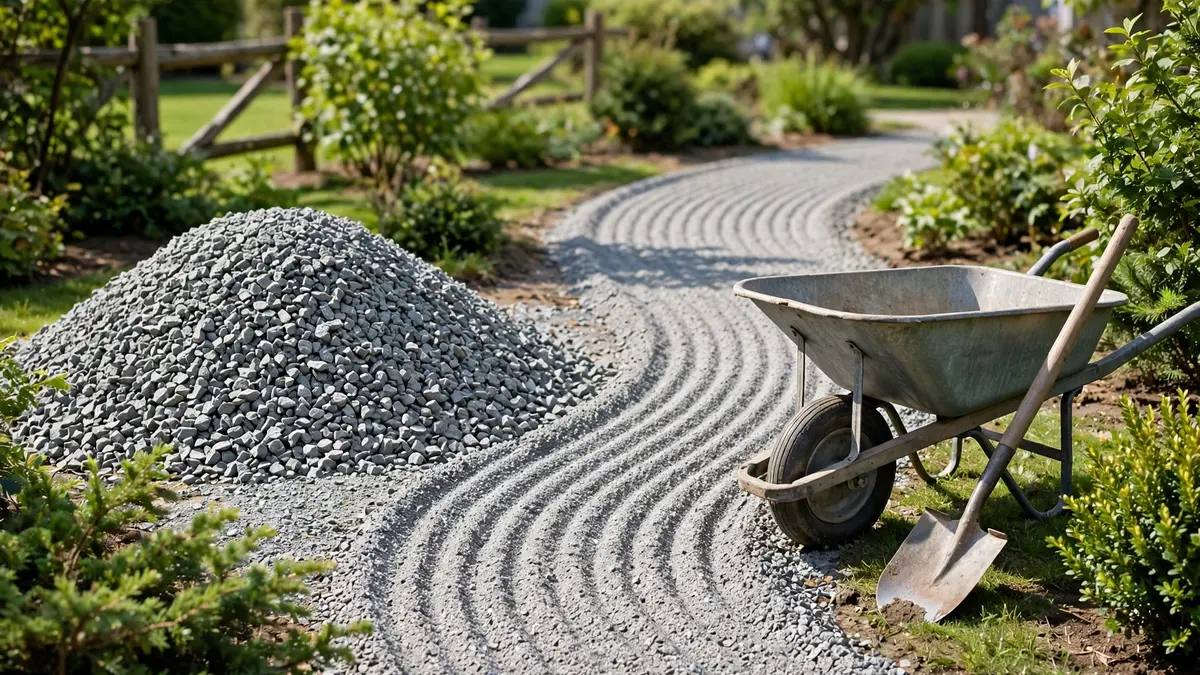

Searching for gravel near me is usually the start of a garden path, a driveway repair or a drainage job, and the first question is always the same: what kind should you buy, and where do you get it? The short answer is that most household jobs need a clean, angular stone in a size matched to the job, bought from a local builders merchant or aggregate supplier who can deliver it loose or in bulk bags. Choose the type first, work out how much you need, then compare local suppliers on delivery options and stone quality rather than on the headline figure alone.
Gravel is one of the simplest building materials you can buy, yet it comes in more varieties than most people expect. The stones differ in size, shape, colour and origin, and those differences decide whether a path stays firm underfoot, a driveway ruts in wet weather, or a flower bed drains properly. A little homework before you order saves the cost of shifting the wrong stone twice.
Key takeaways
- Know the type and size your job needs before you search for gravel near you.
- Angular crushed stone locks together and suits paths and driveways; rounded pea gravel suits beds.
- Measure length, width and depth before you ask any supplier for a quantity.
- Local builders merchants and aggregate suppliers deliver loose or in bulk bags.
- Check the stone in person or in a clear photograph before a large order is tipped.
- A membrane underneath, edging at the sides and the right depth keep gravel in place.
What gravel is and where it is used
Gravel is a loose collection of small rock fragments, generally larger than sand and smaller than cobbles. It forms naturally in riverbeds, beaches and glacial deposits, and it is also produced by crushing larger rock in a quarry. The Wikipedia page on gravel explains how it is classified by size and how widely it is used. For household buyers, the practical distinction is simpler: some gravel is rounded by water, and some is angular because it has been crushed.
Around the home, gravel has four common jobs. It surfaces paths and driveways, where it needs to stay put under feet and tyres. It dresses flower beds and borders, where it suppresses weeds and holds moisture in the soil. It fills drainage trenches, where water must pass through freely, and it decorates pots and rockeries, where appearance matters most. Each job favours a different size and shape, which is why buying the cheapest stone on offer is rarely the best plan.
Gravel is also a forgiving material to work with. It needs no mixing, no curing time and no specialist tools beyond a wheelbarrow, a rake and a shovel. The main work is in the preparation: clearing the ground, laying a membrane if weeds are a concern, and setting edging so the stones do not wander onto the lawn. If the beds beside your path will also hold compost, our guide to composting dos and donts explains how to keep the two areas working side by side.
The main types of gravel compared
The type you choose should follow the job, not the colour chart. Pea gravel is small and rounded, usually around 10 millimetres across, and it feels comfortable under bare feet, which makes it popular for seating areas and paths around a pond. Its roundness is also its weakness: the stones roll against each other, so a steep drive surfaced in pea gravel will slowly migrate downhill.
Crushed stone, often sold as 20 millimetre aggregate, is angular and locks together when compacted. It makes a firm, stable surface for driveways and main paths, and it is the type most builders reach for when a surface must carry weight. Slate chippings are flat and angular, in shades of blue, grey or plum, and they sit neatly in beds. Decorative aggregates such as Cotswold stone bring warm colours to a front garden but are best kept to visible areas.
| Type | Typical size | Best for | Watch out for |
|---|---|---|---|
| Pea gravel | About 10 mm | Seating areas, beds, paths | Rolls and migrates on slopes |
| Crushed stone | About 20 mm | Driveways and main paths | Can feel rough under bare feet |
| Slate chippings | 20 to 40 mm | Borders and decorative beds | Sharp edges, darkens when wet |
| Golden gravel | 10 to 20 mm | Front gardens and paths | Higher cost, best in visible areas |
| Ballast | Mixed sizes | Drainage and foundations | Not decorative, uneven finish |
| Cotswold stone | 10 to 20 mm | Cottage gardens and paths | Pale colour shows dirt quickly |

How much gravel you need
Working out a quantity is simple arithmetic, but it is worth doing carefully, because a shortfall means a second delivery and an excess means a pile you must store or shift. Measure the length and width of the area in metres, then decide the depth: a path or bed usually needs a layer about 40 millimetres deep, while a driveway needs 50 millimetres or more. Multiply length by width by depth, keeping all measurements in metres, and the result is the volume in cubic metres.
Suppliers sell gravel by the cubic metre, by the tonne, or in bulk bags that hold roughly a cubic metre each. As a rough guide, a cubic metre of 20 millimetre gravel covers about 20 square metres at a depth of 50 millimetres. If your sums land between two bag sizes, round up: a little spare gravel is useful for topping up thin spots, and it is far cheaper than a second delivery for half a bag.
Depth deserves more attention than most buyers give it. Too thin, and the membrane or soil shows through within weeks, especially where feet or tyres disturb the surface. Too deep, and the stones shift underfoot and feel unstable to walk on. On soft ground, compact the soil before laying a membrane and the gravel, and consider a layer of larger hardcore underneath for a driveway that will carry regular traffic. On a slope, angular stone holds better than rounded stone, and edging along the sides stops the gravel creeping onto the lawn.
How to find gravel near you
The most reliable sources are local builders merchants and specialist aggregate suppliers. Builders merchants stock the common types, usually in bulk bags, and many deliver on a small lorry that can reach a suburban driveway. Aggregate suppliers and quarries often sell a wider range, including decorative stone, and they can deliver loose by the tonne, which suits larger jobs.
Search maps and local directories for merchants near your postcode, then ring two or three to compare what they stock and how they deliver. Ask whether the delivery is loose, in bulk bags or in smaller sacks, whether the lorry can tip where you need it, and whether there is a minimum order.
Garden centres sell gravel too, usually in smaller sacks that suit a single bed or a pot top-up, and they are a good place to see colours in daylight before buying in bulk. For a whole driveway or a long path, a merchant or aggregate supplier is almost always the better route. When you clear old material, our guide to the recycling bin explains how to sort household waste properly, and the same habit helps when clearing an old gravel bed before relaying it.
Deliveries are often booked a few days ahead, and a lorry needs clear access to your drive. Tell the supplier about narrow lanes, low branches, weight limits or shared drives before the day, not on it. If you cannot be home, agree in advance exactly where the load should go, and mark the spot so the driver is not guessing.
What to check before you order
Before you pay, check the stone itself. Ask to see a sample, and look for a consistent size and colour, with as little dust and fine material as possible. Dusty gravel can set like weak concrete when wet and then crack, while a mix full of oversized stones will rake unevenly. A reputable supplier will be happy to show you a sample bag or a heap in the yard.
Confirm exactly what is included in the figure you are given. Does it cover delivery, and if so, how far does the lorry travel and where will it tip? Is there a charge for a failed delivery if access is blocked? Does the supplier take back unopened bulk bags? These questions sound fussy, but they are the difference between a smooth morning and a heap of stone in the wrong place.
Think about the ground underneath as well. A weed membrane stops shoots pushing through, but it must be laid flat and overlapped at the joints, or weeds will find the gaps. On clay soil that holds water, a slight fall or a drainage channel at the edge keeps a path from ponding in heavy rain. The same care with preparation applies indoors: our guide on how to polish wood furniture shows how good preparation makes a surface last.
A checklist for buying gravel
- Decide the job first: path, driveway, bed, drainage or decoration.
- Choose the type and size to match, favouring angular stone for surfaces that carry weight.
- Measure length, width and depth, and work out the volume in cubic metres.
- Compare two or three local suppliers on stock, delivery method and access.
- Inspect a sample for consistent size, clean stone and little dust.
- Confirm what the figure includes: delivery, tipping point and any failed delivery charge.
- Prepare the ground, membrane and edging before the lorry arrives.
Frequently asked questions
What is the best gravel for a driveway?
Angular crushed stone around 20 millimetres is the usual choice for a driveway, because the stones lock together when compacted and resist rutting under tyres. Lay it at least 50 millimetres deep on a firm base, with edging to hold the layer in place.
How do I work out how much gravel I need?
Measure the length and width of the area in metres, choose the depth, and multiply the three figures together to get the volume in cubic metres. A cubic metre of 20 millimetre gravel covers roughly 20 square metres at a depth of 50 millimetres, so round up if your result falls between bag sizes.
Is pea gravel good for paths?
Pea gravel is comfortable underfoot and looks neat, so it suits flat garden paths and seating areas. It is less suited to slopes or driveways, because the rounded stones roll against each other and migrate downhill over time.
Should I put a membrane under gravel?
A weed membrane is worth using under paths and beds, because it stops weeds pushing through while still letting water drain. Lay it flat, overlap the joints, and hold it down with the gravel itself rather than pegs that tear the fabric.
Can I buy gravel in small sacks?
Yes. Garden centres and DIY stores sell gravel in small sacks that suit a single bed, a pot or a small repair. For a path or driveway, bulk bags or a loose delivery from a merchant are far more practical.
How do I stop gravel spreading onto the lawn?
Fit edging along the boundary, such as timber boards, metal strips or stone setts, and keep the gravel at the recommended depth. A honeycomb stabiliser grid under the gravel also helps on slopes and driveways, where tyres push the stones sideways.
The bottom line
Finding gravel near you is straightforward once the job is clear. Choose an angular stone for paths and driveways and a rounded or decorative stone for beds, measure the area properly, and compare two or three local suppliers on stock and delivery rather than on the headline figure alone. Inspect a sample, prepare the ground and edging before the lorry arrives, and order slightly more than your sums suggest.