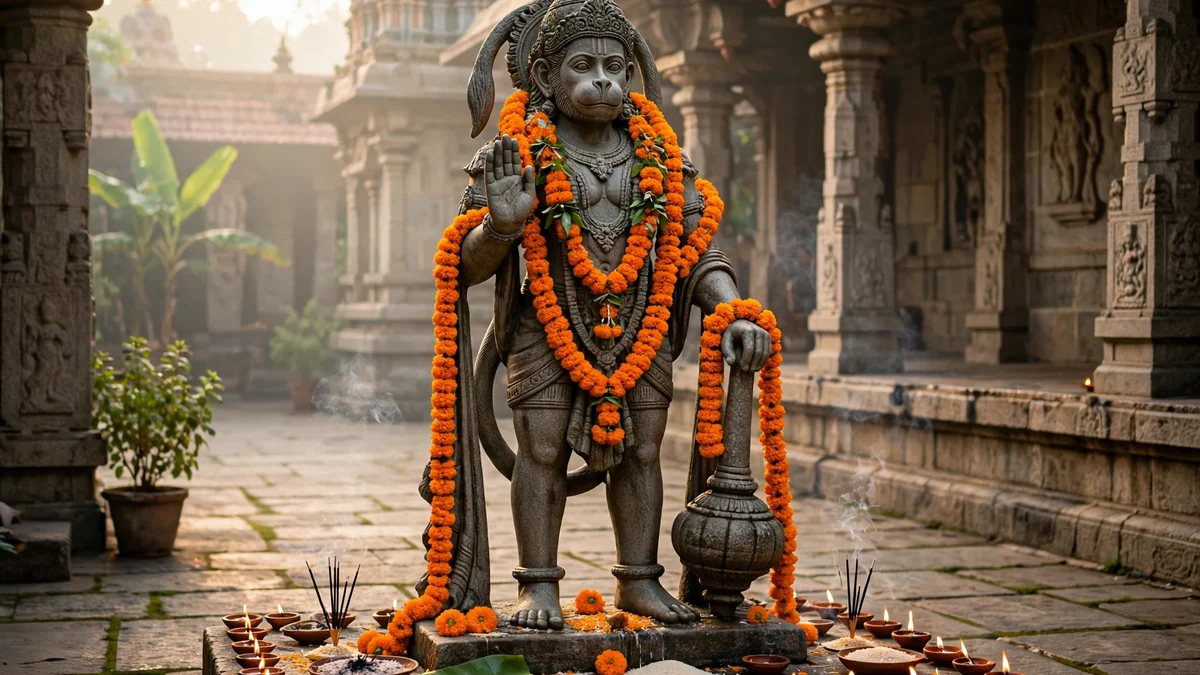

God Anjaneya, better known as Hanuman, is one of the most widely loved deities in Hinduism, honoured as the devoted helper of Rama, the embodiment of selfless service and a protector against fear. The central question newcomers ask is a fair one: who exactly is Anjaneya, and why does a monkey-faced god with a mace stand at the entrance of so many temples? The short answer is that he is the hero of the Ramayana’s most daring passages, a figure whose strength is always placed at the service of others, and whose devotion has made him a model for worshippers for well over a thousand years.
Key takeaways
- Anjaneya is another name for Hanuman, the vanara hero of the Ramayana and devotee of Rama.
- His best-known stories are the search for Sita, the burning of Lanka and the carrying of the healing mountain.
- He stands for devotion, strength, humility and selfless service, and is honoured as a protector.
- Hanuman Jayanti, and the weekly days of Tuesday and Saturday, are his main occasions of worship.
- The Hanuman Chalisa, a forty-verse hymn composed by Tulsidas, is his most widely recited prayer.
- His temples range from small roadside shrines to some of the tallest statues in India.
Who Anjaneya is
Anjaneya means the son of Anjana, his mother, and the name is used alongside Hanuman in temples and prayers across India and the Hindu diaspora. In the Ramayana, the ancient Sanskrit epic, he appears as a vanara, a member of the forest-dwelling people described in the story, with the face and tail of a monkey and the strength, speech and devotion of a hero. He is also called Pawanputra, son of the wind god Vayu, Maruti, Bajrangbali and Kesari Nandan, after his father Kesari.
His place in the story is that of the perfect servant and friend. When Rama, the prince at the centre of the Ramayana, loses his wife Sita to the demon king Ravana, it is Hanuman who finds her in Lanka, carries Rama’s message to her and returns with news of where she is held. He is not a king or a prince himself, and that is part of the point: the epic gives its most daring missions to a figure who asks for nothing in return. The Wikipedia page on Hanuman gives a clear account of his names, his stories and his place in Hindu tradition.
He is usually shown with a mace, or gada, in one hand and a long tail curving behind him. In many temples his image is painted orange or red with sindoor, the vermilion powder offered by devotees, and in others he is shown kneeling before Rama and Sita in prayer. The kneeling image matters as much as the heroic one: he is remembered as much for his humility as for his power.
The stories people tell about him
The best-known story of Anjaneya is the leap to Lanka. When Rama’s search for Sita reaches the southern shore, the sea stands between the searchers and the island kingdom of Ravana. Hanuman grows to a great size and leaps across the ocean, finds Sita in the grove where she is held, and gives her Rama’s ring as proof. On the way back he allows himself to be captured, and when Ravana orders his tail set alight, he escapes and sets fire to Lanka with his burning tail before leaping home.
A second story explains why he is honoured as a healer and protector. During the great battle in Lanka, Rama’s brother Lakshmana is gravely wounded, and the only cure is a herb that grows on a distant mountain. Hanuman flies to the mountain and, unable to identify the single herb, carries the whole mountain back to the battlefield. The image of Hanuman flying with a mountain in his hand is one of the most familiar in Hindu art.
A third set of stories comes from his childhood. As a young child, so the tales tell, he saw the rising sun, mistook it for a fruit, and leapt up to seize it, only to be struck down by Indra’s thunderbolt and then restored to life. The gods then granted him powers, but also said he would forget his own strength until someone reminded him of it. That is why, in the Ramayana, another character must remind him of his powers before he makes the leap to Lanka.
What Anjaneya represents
For devotees, Anjaneya represents devotion without self-interest. He is the model of seva, or selfless service, and his life in the stories is a series of tasks taken on for others: carrying a message, finding a lost person, bringing a cure, guarding a camp through the night. People turn to him for courage, for protection from fear and for help in facing a difficulty that feels too large.
He is also a symbol of controlled strength. The stories insist that his power is always disciplined: he uses it to serve Rama, to protect the weak and to carry out a duty, never to dominate or to take. That is why his image stands at the gates of temples and villages as a guardian, and why the mace he carries is a sign of that guardianship.
His place in daily life is unusually practical. Many Hindus begin the day with his name, recite his hymn before a journey or an examination, and keep his image in the home for protection. He is not a distant figure of scripture alone; he is a companion in ordinary life, called on in small troubles as well as great ones. Our guide to candlelight concerts looks at another setting where music and light bring people together in quiet attention, and the atmosphere of an evening Hanuman aarti, with lamps and song, has something of the same feeling.
Temples and places of pilgrimage
Temples dedicated to Hanuman are found in almost every town in India, and many stand outside villages, at crossroads and along pilgrimage routes, where a small shrine with an orange-painted image serves travellers and local people alike. Larger temples draw crowds on Tuesdays and Saturdays, his days of worship, and on Hanuman Jayanti, the festival of his birth. The guide to where to meet people in a new place notes how shared routines create community, and a temple courtyard on a festival morning is a good example: strangers become neighbours over prasad and prayer.
Among the best-known temples is the Sankat Mochan temple in Varanasi, dedicated to Hanuman as the remover of troubles, which draws large crowds on Tuesdays. The Hanuman temple at Connaught Place in New Delhi is another famous one, with its tall image visible from the street. In Gujarat, the temple at Salangpur is a major pilgrimage centre, and in the hills above Shimla the Jakhoo temple is reached by a climb through deodar forest. In Andhra Pradesh, the Paritala Anjaneya statue stands about 135 feet tall.
The hills of Hampi in Karnataka are also linked to his story. Tradition identifies the region with Kishkindha, the vanara kingdom of the Ramayana, and the Anjaneya hill near Hampi is held to be his birthplace, with a temple at the top reached by a long flight of steps. Pilgrims climb at dawn to see the sun rise over the boulder-strewn landscape. Whether or not a visitor accepts the traditional identification, the place itself is worth the climb. Artists return to his image again and again, and our notes on keeping a sketchbook touch on the habit of studying one subject until it is understood.
How devotees worship him
Worship of Anjaneya is simple and direct. Devotees offer flowers, especially marigolds, and sweets, above all the round laddoos that are his favourite offering in the stories. Sindoor is applied to his image, and a little is often taken home as a blessing. Tuesdays and Saturdays are his days, and on those days temples are busy from early morning, with queues for darshan, the sight of the deity, and the distribution of prasad, the blessed food shared after worship.
The Hanuman Chalisa is the prayer most closely tied to him. Composed by the poet-saint Tulsidas in the sixteenth century, it is a hymn of forty verses, recited daily by millions of people. Many learn it by heart as children, and its verses are sung in temples and recited before journeys and examinations. The hymn praises his deeds, his devotion to Rama and his power to remove fear.
Hanuman Jayanti, the festival of his birth, is celebrated on different dates in different regions, most commonly on the full moon day of the Hindu month of Chaitra, which falls in March or April. Devotees fast, visit temples, recite the Chalisa and listen to readings from the Ramayana, and in some places processions carry his image through the streets.
Names of Anjaneya compared
| Name | Meaning | When it is used |
|---|---|---|
| Anjaneya | Son of Anjana | Temples and formal prayer |
| Hanuman | From the Sanskrit for jaw, recalling the childhood story | Everyday speech and stories |
| Pawanputra | Son of Vayu, the wind | Hymns and devotional songs |
| Bajrangbali | Strong-bodied one, linked to the thunderbolt | North Indian devotion |
| Maruti | Son of the wind, from Marut | Maharashtra and the west |
| Kesari Nandan | Son of Kesari | Devotional verse |

A checklist for visiting a Hanuman temple
- Remove your shoes before entering, and leave them in the place provided.
- Dress modestly, covering shoulders and knees, as a mark of respect.
- Bring a small offering, such as flowers or fruit, if you wish to take part.
- Join the queue for darshan patiently, and do not push ahead of others.
- Ask before taking photographs inside the shrine.
- Accept prasad with your right hand, or both hands, and eat it with respect.
- Keep your voice low inside the shrine, and switch your phone to silent.
- Learn a little of the story before you go.
Frequently asked questions
Is Anjaneya the same as Hanuman?
Yes. Anjaneya is one of the names of Hanuman, meaning the son of Anjana, his mother. Hanuman is the name used most often in everyday speech, while Anjaneya appears more often in temples, prayers and formal writing.
Why does Hanuman have a monkey face?
In the Ramayana he is a vanara, a forest-dwelling being described with the face and tail of a monkey, and the stories present that form as his nature, not a disguise.
What is the Hanuman Chalisa?
The Hanuman Chalisa is a hymn of forty verses composed by the poet-saint Tulsidas in the sixteenth century. It praises Hanuman’s deeds and devotion, and it is recited daily by millions of people, often at dawn, before journeys or before sleep.
When is Hanuman Jayanti?
Hanuman Jayanti, the festival of his birth, is celebrated on different dates in different regions, most commonly on the full moon day of the Hindu month of Chaitra, in March or April.
Why is Hanuman offered laddoos?
Laddoos, the round sweet balls, are his favourite offering in the stories and in temple practice. After worship they are shared as prasad, the blessed food distributed to everyone present.
What does Hanuman protect people from?
Devotees honour him as a protector against fear, trouble and harmful influences, and his image is placed in homes, at temple gates and above doorways for that reason.
The bottom line
God Anjaneya is best understood through the two things the stories never separate: his strength and his service. He can leap an ocean and carry a mountain, and he uses both feats to help someone else. That is why he is loved not only as a hero of the Ramayana but as a presence in daily life, honoured with flowers, sweets and a forty-verse hymn. To meet him is to meet devotion in its most practical form: power placed entirely at the service of others.