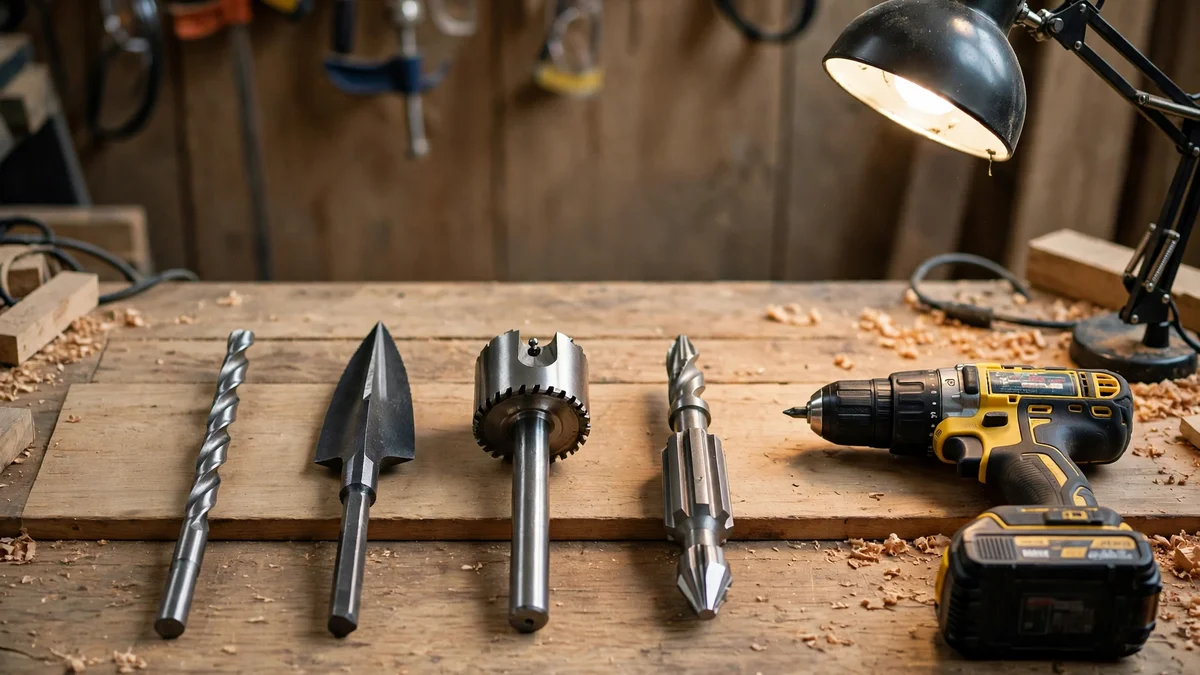

A drill bit is the small steel tool that does the actual cutting when you drill a hole, and choosing the wrong one is the most common reason a job goes badly. The right drill bit cuts cleanly, stays sharp and leaves a tidy hole, while the wrong one wanders, overheats, burns the material or snaps. This guide explains the main types of drill bit, which material each one suits, how sizes work, and how to choose the right bit for the job in front of you.
Key takeaways
- A drill bit must match the material: wood, metal, masonry and plastic each need different bits.
- Twist bits are the general-purpose default for wood, plastic and soft metal.
- Masonry bits have a tungsten carbide tip and need a drill with hammer action.
- Spade and auger bits make large holes in wood fast, while Forstner bits make clean flat-bottomed ones.
- Bit size is usually given in millimetres or fractions of an inch, and the shank must fit your drill’s chuck.
- Start with a small set of twist bits plus a few wood and masonry bits for most home jobs.
What a drill bit is, and how it works
A drill bit is a cutting tool with a sharp point, flutes that carry waste out of the hole, and a shank that grips in the drill’s chuck. When the drill spins, the point bites into the material and the cutting edges shave it away, while the flutes lift the waste clear so the bit can keep cutting. If the waste cannot escape, the bit overheats and the hole goes ragged. That is why the shape of the flutes matters as much as the sharpness of the point.
Bits are made from different steels for different jobs. High-speed steel, usually shortened to HSS, is the standard material for general-purpose twist bits, and it holds an edge well in wood, plastic and soft metals. Cobalt bits are HSS with cobalt added, which keeps them hard at higher temperatures, so they suit stainless steel and harder alloys. Carbide-tipped bits have a tungsten carbide insert brazed onto a steel body, which is extremely hard and survives masonry that would blunt steel in seconds. The drill bit page on Wikipedia lists the main types and materials, and it is a useful reference if you want the full technical picture.
Twist bits: the default choice
The twist bit is the one most people picture when they hear the words drill bit. It has a helical flute that spirals up the body, a pointed tip, and a plain round shank, and it is sold in the widest range of sizes, from tiny 1-millimetre bits up to 13 millimetres and beyond. It drills wood, plastic and soft metals well, and it is the bit to reach for when you are not sure what you need. Most home drill sets are mostly twist bits, and for good reason: they cover the majority of everyday jobs.
Twist bits have limits, though, and knowing them saves broken bits. They are not made for masonry, where they blunt quickly and make almost no progress, and they struggle in hard steel, where they overheat and lose their edge. In metal, run them at a slower speed, use a drop of cutting oil, and drill a small pilot hole first for larger sizes, stepping up gradually.
Wood bits: spade, auger, brad point and Forstner
Wood deserves its own bits, because a twist bit is only the start of what woodwork needs. A spade bit, also called a paddle bit, is a flat blade with a sharp centre point that bores large holes in wood very fast, for framing and running cables through joists. The finish is rough and the exit hole can splinter, so back the work with a scrap of wood. An auger bit is slower but more accurate: a screw tip pulls it in while a deep flute lifts out shavings, making it right for deep, clean holes in timber.
A brad point bit is the precision option for wood. It has a sharp centre point and spurs that cut the edge of the hole before the main cutting edge, which stops the bit wandering and reduces splintering, so it suits furniture work and dowel holes. A Forstner bit cuts flat-bottomed holes with clean walls, even at an angle, which makes it the standard choice for hinge cups in cabinet doors. Forstner bits need a slow speed and a firm grip on the work, since they take a big bite and can grab.
Masonry, tile and glass bits
Brick, block, concrete and stone need a masonry bit, and nothing else will do the job properly. A masonry bit looks like a twist bit but has a tungsten carbide tip, which is hard enough to chip away at masonry while the drill’s hammer action pounds it forward. Use hammer mode for masonry, keep the speed moderate, and pull the bit out now and then to clear the dust. For repeated or large holes in concrete, a rotary hammer with SDS bits is far more efficient, though SDS bits only fit SDS chucks.
| Bit type | Best for | Key feature | Avoid using on |
|---|---|---|---|
| Twist bit (HSS) | Wood, plastic, soft metal | General purpose, widest size range | Masonry, hard steel |
| Cobalt bit | Stainless steel, hard alloys | Keeps its edge at high heat | Masonry, wood |
| Masonry bit | Brick, concrete, block, stone | Tungsten carbide tip, hammer action | Wood, metal, tile |
| Spade bit | Large holes in wood | Fast, cheap, flat blade | Finished work, metal |
| Forstner bit | Flat-bottomed holes in wood | Clean walls, hinge cups | Metal, masonry |
| Step bit | Sheet metal, thin material | Several diameters in one bit | Thick wood, masonry |

Tile and glass need their own approach. Ordinary bits crack tile, so use a spear-point or diamond-tipped bit made for tile, run it slowly, and keep the tip cool with a little water. Always check for hidden pipes and cables before drilling into any wall. Masonry dust can contain crystalline silica, so wear a mask and eye protection. The guide to calculation of calories burned is another practical guide in this series, and it follows the same rule: measure first, then act.
Sizes, shanks and chucks
Drill bit sizes are usually given in millimetres or in fractions of an inch, and most home sets cover roughly 1.5 to 10 millimetres, which handles most household jobs. The size you need depends on the job: a pilot hole for a screw is smaller than the screw itself, a clearance hole is slightly larger so the screw passes through freely, and a hole for a wall plug must match the plug exactly, so check the plug’s size before you drill.
The shank is the part the drill grips, and it must fit your drill’s chuck. Most home drills have a 10-millimetre or 13-millimetre chuck, which takes any bit with a smaller shank, while SDS bits have a special grooved shank that only fits SDS rotary hammers. The length of the bit matters too: a standard bit is fine for most jobs, but deep holes in timber need a longer auger bit, and the bit must be long enough to reach through the material with room to spare.
How to choose the right drill bit
Choosing a bit comes down to four questions, asked in order. First, what is the material? Wood, metal, masonry, plastic, tile and glass each point to a different bit, and this is the question that matters most. Second, what size hole do you need, and how deep? Third, what finish do you need: a rough hole that will be hidden, or a clean one that will be seen? Fourth, what drill are you using, and does it have the chuck and the power for the bit you have in mind? The guide to burial plot is another practical guide in this series, and like this one it is about getting a small job right the first time.
For a first set, buy a good set of HSS twist bits, a few spade bits in common sizes, one or two Forstner bits if you do woodwork, and a small set of masonry bits for walls. Add a step bit if you work with sheet metal or thin plastic, since one step bit replaces a whole row of twist bits for enlarging holes. Buy quality over quantity: a few sharp, well-made bits beat a large set of soft ones. Replace a bit when it stops cutting cleanly, since a blunt bit is slower, hotter and more likely to snap. The guide to the 865 area code is another guide in this series built around a simple question with a practical answer, and choosing a bit works the same way.
Your drill bit checklist
- Match the bit to the material first: wood, metal, masonry and plastic all need different bits.
- Start with twist bits for general work, and add spade, Forstner and masonry bits as needed.
- Check the shank fits your drill’s chuck before you buy, especially for SDS bits.
- Mark the spot and drill a small pilot hole for larger holes, especially in metal.
- Use hammer mode only for masonry, and slow speeds for metal, tile and glass.
- Clear dust from the hole as you go, and let the bit cool rather than forcing it.
- Wear eye protection and a mask, and check for hidden pipes and cables first.
- Replace blunt bits promptly, since they are slower, hotter and more likely to snap.
What drill bit do I need for wood?
Use twist, brad point, spade, auger or Forstner bits, depending on the hole. Twist bits suit small general holes, brad point bits suit precise ones, spade and auger bits suit large ones, and Forstner bits suit flat-bottomed holes such as hinge cups.
What drill bit do I need for brick or concrete?
Use a carbide-tipped masonry bit with the drill set to hammer mode. For repeated or large holes in concrete, an SDS rotary hammer with SDS bits is more efficient, though SDS bits only fit SDS chucks.
What drill bit do I need for metal?
Use a high-speed steel twist bit for soft metals, and a cobalt bit for stainless steel and harder alloys. Run at a slow speed, use cutting oil, and drill a pilot hole first for larger sizes.
Can I use a wood bit on metal?
No, not well. Wood bits are shaped for cutting fibres, not metal, and they will blunt quickly and can snap. Use the bit made for the material, and keep wood bits for wood.
Why does my drill bit keep overheating?
It is usually the wrong bit for the material, too high a speed, or too much pressure. Slow down, ease off, clear the waste from the hole, and use cutting oil on metal or water on tile.
How do I know what size drill bit to use?
Match the bit to the job: a pilot hole is smaller than the screw, a clearance hole is slightly larger, and a hole for a wall plug must match the plug exactly. When in doubt, start small and step up.
The bottom line
A drill bit is a simple tool, but it only works well when it matches the material, the size and the drill. Start with the material, pick the bit type from there, check the size and the shank, and let the bit do the cutting rather than forcing it. A small set of good bits, kept sharp and used correctly, will handle almost every job a home drill ever faces.