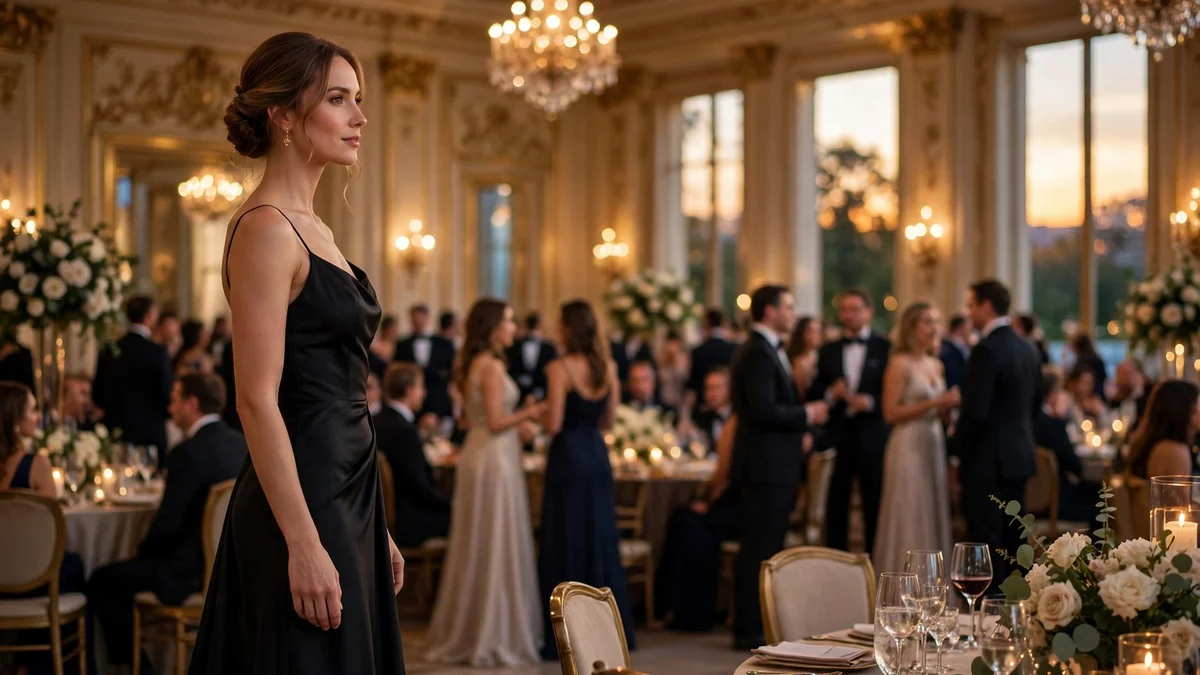

A black tie wedding guest dress is a formal, floor-length gown in a rich fabric, and the question every guest asks is the same: how formal is formal enough? The short answer is that a black tie wedding calls for your most elegant outfit, a full-length dress in a fabric such as silk, satin, velvet or chiffon, with refined shoes and understated jewellery. This guide explains the dress code in plain terms, so you can choose with confidence and enjoy the day instead of worrying about what you are wearing.
Black tie is the most formal dress code most wedding guests will ever meet. It sits above cocktail and semi-formal dress, and below white tie, which is so rare at weddings that most people never encounter it. The invitation may simply say black tie, or it may say black tie optional, and those two phrases mean different things. Knowing the difference saves you from arriving underdressed, which is the one mistake that is hard to fix once you are there.
Key takeaways
- Black tie means formal: a floor-length dress in a rich fabric is the safest choice.
- Silk, satin, velvet and chiffon read as formal; cotton, linen and jersey do not.
- Dark, rich colours suit evening weddings; lighter tones work for daytime or summer events.
- Avoid white, ivory and anything that could be mistaken for a bridal gown.
- Keep accessories refined: one statement piece, elegant shoes, and a small evening bag.
- When in doubt, dress up rather than down, and check the venue and time of day.
What black tie means at a wedding
Black tie began as an evening dress code for men, built around the dinner jacket, and the Wikipedia page on black tie traces how it became the standard for formal evening occasions. For women, the equivalent has always been a long, formal dress. At a wedding, black tie tells guests that the celebration is a grand occasion, usually held in the evening, often in a hotel ballroom, a stately home or a venue with a formal dinner and dancing.
The time of day matters. A black tie wedding that starts in the late afternoon and runs into the evening is the most common pattern, and the dress code holds for the whole event. A black tie wedding in the middle of the day is unusual, but the same standard applies if the invitation says so. The venue gives a further clue: a grand room with chandeliers and a seated dinner points to full formality, while a garden ceremony followed by a marquee reception may allow a slightly softer interpretation, though the dress should still be long and formal.
Black tie optional is a different instruction, and it confuses many guests. It means the couple would like a formal atmosphere but will not mind if some guests wear a shorter formal dress or a dark suit instead of a dinner jacket. If the invitation says black tie optional, a floor-length dress is still the best choice, but a very elegant knee-length or midi dress in a formal fabric is acceptable. The word optional softens the rule; it does not cancel it.
Choosing the right length and shape
Length is the first decision, and for black tie it is the easiest one: floor-length is correct. A gown that reaches the floor, or falls just above it so that your shoes show when you walk, is the classic black tie wedding guest dress. A tea-length dress, which falls between the knee and the ankle, can work at a less formal evening wedding, but it is a compromise rather than the standard.
Shape is a matter of personal taste and comfort, and almost every silhouette can be formal if the fabric and finish are right. An A-line gown suits most figures and moves well on a dance floor. A sheath dress in silk or crepe looks sleek and modern. A full skirted gown feels grand and suits a ballroom. The shape to be careful with is anything very tight or very short, since a formal wedding is a family occasion and the photographs will be kept for years.
Fabrics, colours and details
Fabric is what makes a dress read as formal. Silk, satin, velvet, chiffon and fine crepe all have a depth and a movement that suits evening light. Sequins and beading can be beautiful on a black tie dress, provided the overall effect stays elegant rather than glittering from across the room. Lace is a classic choice, especially for a wedding, and it photographs beautifully.
Colour is where you can show personality. Deep jewel tones such as emerald, sapphire, burgundy and plum are reliable choices for evening weddings, and they suit most skin tones. Navy and dark green are elegant without being as stark as black. Metallic shades, in gold, silver or bronze, catch the light beautifully, though a fully metallic dress can be a lot to carry, and a metallic accent may be easier to wear.
White, ivory, cream and anything close to them should be left alone, since those colours belong to the bride. This rule still holds even if the bride is wearing a coloured dress, because white reads as bridal in photographs. Very pale pastels can also be risky in bright light, so if you love a pale shade, choose one with enough depth to photograph clearly as a colour rather than as white.
Wedding dress codes compared
| Dress code | Expected dress | What to avoid |
|---|---|---|
| White tie | Full-length ball gown, formal gloves optional | Anything short or casual |
| Black tie | Floor-length gown in silk, satin, velvet or chiffon | Short dresses, cotton, linen, jersey |
| Black tie optional | Floor-length preferred; elegant midi acceptable | Day dresses, casual fabrics |
| Formal | Long dress or dressy midi in a formal fabric | Jeans, trainers, sundresses |
| Cocktail | Knee-length or midi party dress | Floor-length gowns, which look overdressed |
| Semi-formal | Smart midi dress or dressy separates | Full-length gowns, very casual clothes |

Accessories, hair and shoes
Accessories complete a black tie outfit, and restraint is the rule. Choose one statement piece, such as earrings or a bracelet, and keep the rest simple. A small evening bag in a metallic or dark shade is the practical choice, since it holds a phone, a lipstick and a card without spoiling the line of the dress. A large handbag or a daytime tote will look out of place in a ballroom.
Shoes should be elegant and, above all, wearable. A heel is the classic choice, but a low heel or an elegant flat is better than a high heel you cannot walk in. Consider the venue: a garden or a lawn will swallow a stiletto heel, and heel protectors are worth packing if any part of the day is outdoors. A light wrap can help in a cold venue too, and our guide to scarf rings shows how to wear one neatly without it slipping.
Hair and make-up should match the formality of the dress. An updo, soft waves or a polished blow-dry all work, and the choice depends on the neckline of your dress and on what you feel comfortable wearing. If the dress has a detailed neckline, hair worn up shows it off. If the dress is simple, hair worn down softens the look. Our guide to eyelash and hair extensions covers ways to add volume and length for a special occasion, though natural hair styled well is always a safe choice.
What to avoid as a black tie guest
The most common mistake is wearing white or a colour so pale that it photographs as white. The second is wearing a dress that is too short or too casual for the occasion, which can make you feel conspicuous in a room full of long gowns. The third is wearing something that competes with the bridal party, such as a dress in the same colour and style as the bridesmaids, which can cause confusion in photographs. Keeping the focus on the couple is the simplest guide: our article on marriage counseling is about the relationship itself, and that is what the day is really celebrating.
There are smaller mistakes worth avoiding too. A dress with a very loud print can draw the eye in group photographs. A dress that is too tight to sit in comfortably will make a long dinner feel endless. Very high heels that you have never worn before are a risk on polished floors and stairs. And a large, heavy bag will be a burden by the end of the evening.
A checklist for choosing your dress
- Read the invitation carefully and note whether it says black tie or black tie optional.
- Choose a floor-length dress in silk, satin, velvet, chiffon or fine crepe.
- Pick a colour with depth, and avoid white, ivory and cream entirely.
- Check the venue and the time of day, and think about whether you will be outdoors.
- Try sitting, walking and dancing in the dress before the day.
- Choose shoes you can wear for hours, and pack heel protectors for grass.
- Keep accessories refined: one statement piece, a small evening bag, and a wrap if needed.
- Ask a trusted friend for an honest opinion, and look at the dress in photographs, not just in the mirror.
Frequently asked questions
Does a black tie wedding guest dress have to be floor-length?
Floor-length is the standard and the safest choice. A tea-length dress can work at a black tie optional wedding, but for a strict black tie invitation, a full-length gown is what the dress code asks for.
Can I wear black to a black tie wedding?
Yes, black is acceptable at a modern black tie wedding. Choose a black gown in a formal fabric with some texture, shine or detail, so it reads as evening wear rather than office dress.
Can I wear a short dress to a black tie wedding?
A short dress is not right for a strict black tie wedding, even a very elegant one. The dress code is defined by length as much as by fabric. If the invitation says black tie optional, a very dressy midi or knee-length dress in a formal fabric is acceptable, but a floor-length gown is still the better choice.
What colours should I avoid as a wedding guest?
Avoid white, ivory and cream, which belong to the bride, and be careful with very pale pastels that can photograph as white. It is also polite to avoid the exact colour of the bridesmaids’ dresses if you know what it is, so that you are not mistaken for part of the bridal party in photographs.
Are jumpsuits acceptable at a black tie wedding?
A formal jumpsuit in a rich fabric, with a wide leg and an elegant cut, can work at a black tie optional wedding. It is a bolder choice than a gown, so it suits a confident dresser and a modern venue.
What shoes should I wear with a black tie dress?
Choose elegant heels, low heels or dressy flats that you can wear comfortably for many hours. Metallic or dark shoes that match the dress are the usual choice. If any part of the day is on grass, pack heel protectors.
The bottom line
A black tie wedding guest dress is a floor-length gown in a formal fabric, chosen with care and worn with confidence. Pick a rich fabric, a colour with depth, and a length that reaches the floor, then keep your accessories refined and your shoes comfortable. Avoid white, avoid casual fabrics, and when in doubt, dress up rather than down. The dress code is there to make the occasion feel special, and a guest who meets it with elegance is doing the couple a kindness. Choose well, and you can forget about what you are wearing and enjoy the celebration.