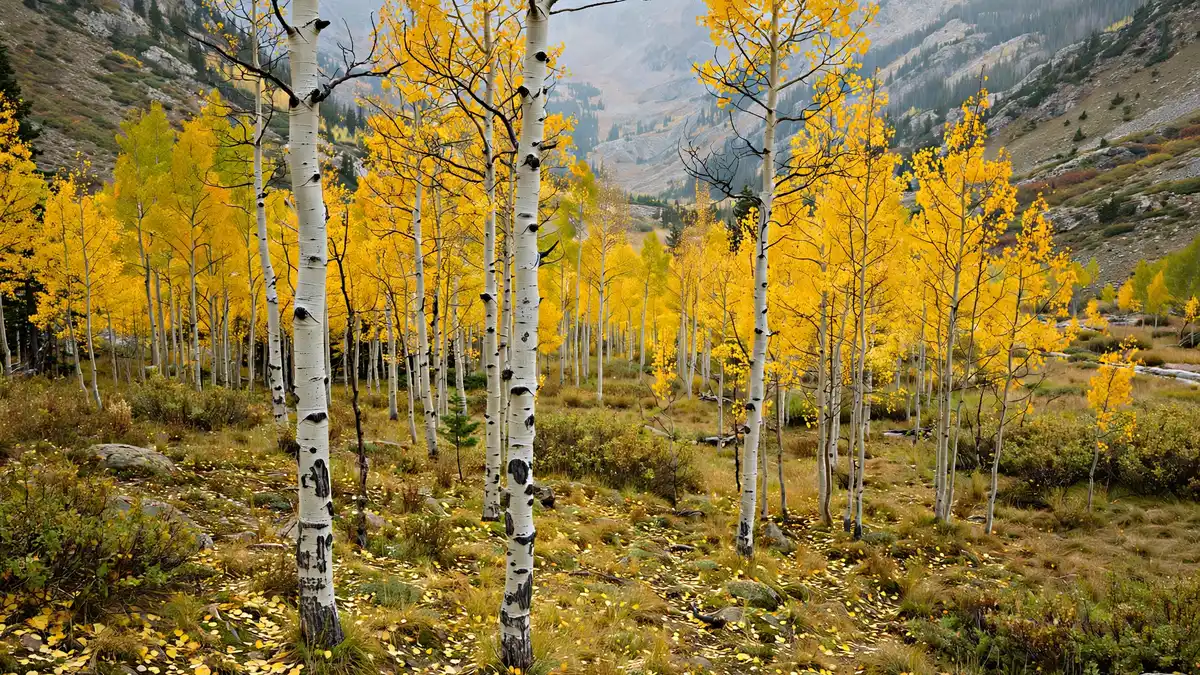

The aspen tree, known to botanists as Populus tremuloides, is the most widely distributed tree in North America, growing from Alaska and Canada down to central Mexico. Its leaves tremble in the lightest breeze, its bark is pale and smooth, and in autumn whole mountainsides turn gold at once, because what looks like a forest of separate trees is often a single organism joined underground by one root system. This guide explains how to identify an aspen tree, why it grows in clones, and how the most famous aspen of all became the largest living thing on Earth.
Key takeaways
- The aspen tree, Populus tremuloides, is also called the quaking aspen or trembling aspen.
- It is the most widely distributed tree in North America, from Canada to central Mexico.
- Its leaves tremble because they hang from long, flattened stalks.
- Aspens grow mainly from root sprouts, so a grove is often one clone sharing a single root system.
- Pando, a single male clone in Utah, has about 47,000 stems across 106 acres and is the heaviest known living organism.
- Individual stems usually live 80 to 100 years, but the root system can live for thousands of years.
How to identify an aspen tree
An aspen tree is a tall, fast-growing deciduous tree, usually 15 to 18 metres tall at maturity, with a trunk about 25 centimetres across. The tallest recorded specimens reach 36.5 metres, with trunks 1.37 metres across. The bark is the best field mark: smooth, pale grey-white, and scarred with black marks where the tree has shed its lower branches.
The leaves are small, green, almost round, with finely serrated edges, and they hang from long, flattened stalks called petioles. Those stalks make the leaves quiver in even the slightest breeze, which is where the names quaking aspen and trembling aspen come from. In autumn the leaves turn bright yellow, sometimes with a red blush. Because all the trees in one clone are identical, a whole grove changes colour at the same time.
Aspens are dioecious, which means male and female flowers grow on separate trees, and large stands are usually all clones of the same sex. Aspens do produce seeds, but they seldom grow from them: the seeds are tiny, about three million to the pound, and they stay viable for only a short time.
Why aspen trees grow in clones
The aspen tree spreads mainly through its roots. New stems, called suckers, sprout from a shared root system, and over time a single clone can cover a large area. Every stem in the clone is genetically identical. That is why one grove changes colour at the same time in autumn, and why one grove may turn colour earlier or later than its neighbour.
This way of growing has real advantages. A fire or a harsh winter may kill the stems above ground, but the root system survives underground and sends up new stems when conditions improve. A single stem may live only 80 to 100 years, with some reaching 200, but the root system can live for thousands of years.
There is a cost as well. Because a clone is genetically identical, it has little variety to draw on when conditions change. Heavy grazing by deer and elk is the main threat today: young sprouts are eaten before they can grow tall enough to survive, and the older stems die without being replaced.
Pando, the largest living thing on Earth
The most famous aspen tree in the world is not a single trunk at all. Pando, from the Latin for I spread, is a quaking aspen clone in the Fishlake National Forest in Sevier County, Utah. It has an estimated 47,000 stems that look like individual trees but are genetically identical parts of one male organism, connected by a root system spanning 42.8 hectares, or 106 acres. It is generally held to be the world’s single largest organism by weight, at roughly six million kilograms.
Pando was identified in 1976 by Jerry Kemperman and Burton V. Barnes, and in 1992 researchers at the University of Colorado confirmed it as a single male clone. A large genetic study published in 2008 confirmed the finding. Its age is hard to pin down, but most scientists agree that the seed it grew from set down between 8,000 and 12,000 years ago, as the climate shifted at the end of the last ice age. The Wikipedia page for Populus tremuloides gives a clear account of the species and its most famous clone.
Pando is also in trouble. Most of its stems are now more than a century old, and new growth has not kept pace with the stems that die, largely because mule deer and elk eat the young sprouts. About 84 acres of Pando is now protected by eight-foot fencing, and further fencing added in 2025 brought about 80 per cent of its landmass into protective care.
Where aspen trees grow
The aspen tree grows across Canada in all provinces and territories, with the possible exception of regions of Nunavut north of the James Bay islands, and across the United States from Alaska to central Mexico. It is a tree of cooler areas, and it favours mountainsides, valley floors and the edges of meadows.
In the mountains of the American West, aspen groves are a landmark of autumn, and whole towns organise festivals around the colour change. Wherever it grows, the aspen tree supports a wide range of wildlife: its buds, bark and leaves feed deer, elk, beavers and grouse, and its soft wood is used by woodpeckers. If you are heading out to see the autumn colour, our guide to the best water bottle will help you stay hydrated on the trail.

The aspen tree through the seasons
| Season | What to look for | Best time to visit |
|---|---|---|
| Spring | Small catkins appear before the leaves, then fresh green foliage | April to May, as the buds open |
| Summer | Green leaves trembling in the breeze, pale bark in full view | June to August, for shade and birdsong |
| Autumn | Whole groves turn bright yellow, sometimes with a red blush | September to October, at the peak of the colour |
| Winter | Bare white trunks with black scars, standing out against snow | December to February, for stark, quiet landscapes |
Autumn is the season most people plan around: few sights in North American woodland match a hillside of gold aspens under a blue sky. The colour usually peaks in late September in the high mountains and later at lower elevations, and it lasts about two weeks. Because each clone colours on its own schedule, neighbouring groves can be at different stages. If you are planning a picnic under the trees, our best picnic recipes will help with the food.
Winter is the quiet season for the aspen tree, but it is worth a visit too. The white trunks and black scars stand out against the snow, and the tree keeps working even without leaves: aspens can photosynthesise through their bark.
Growing an aspen tree
Growing an aspen tree is not like growing most garden trees, because the aspen tree wants to be a grove. A single stem planted alone will often send up suckers from its roots, and those suckers can spread well beyond where you planted the first tree. In a large garden or on open land that is fine, but in a small garden it can become a nuisance, so think about space before you plant.
Young aspens need protection from deer and rabbits, which eat the tender shoots, and they need regular water while they establish. Once settled, they grow fast. The main work is managing the suckers: cut them back if you want a single tree, or let them grow if you want a grove.
The wood of the aspen tree is light, soft and pale, and it has long been used for paper, matches, boxes and furniture parts. If you are working with pale wood indoors, our guide on how to polish wood furniture will help. Gardeners should also note that aspen roots can lift paving and invade beds, so plant well away from paths and foundations.
A checklist for visiting aspen country
- Check the autumn colour reports for your area before you travel, since the peak lasts about two weeks.
- Wear sturdy shoes: aspen groves grow on slopes, and the ground is uneven.
- Carry water and sun protection, even in autumn, since mountain sun is strong.
- Stay on paths and trails to protect the shallow root system underfoot.
- Do not carve initials into aspen bark: the pale bark scars easily and the wound lets in disease.
- Look for the black scars on the trunk and the flattened leaf stalks to confirm you are looking at an aspen.
- Visit at different times of day: morning light makes the gold leaves glow.
- Leave the grove as you found it, and take only photographs.
Frequently asked questions
What is the difference between an aspen tree and a birch tree?
Aspen and birch both have pale bark, but they are different trees. Aspen bark is smooth and grey-white with black scars, and its leaves are almost round with flattened stalks that make them tremble. Birch bark peels in thin papery sheets, and its leaves are pointed. Aspens also grow in clones from a shared root system, while birches grow as separate trees.
Why do aspen leaves tremble?
Aspen leaves hang from long, flattened stalks, and the flat shape catches the wind, so the leaves quiver and rustle in even the slightest breeze. The trembling is thought to help the tree by letting light reach the lower leaves and by cooling the canopy. Whatever the reason, it is the feature that gives the quaking aspen its name.
How old is Pando, the giant aspen clone?
Pando’s age is hard to pin down, and estimates vary widely. Most scientists agree that the seed it grew from set down between 8,000 and 12,000 years ago, at the end of the last ice age. What is certain is that Pando is one of the oldest living organisms on Earth, with about 47,000 stems across 106 acres in Utah.
Can I grow an aspen tree in my garden?
Yes, if you have space and a cool climate. Aspens like sun and well-drained soil, and they grow fast once established. The main issue is suckering: the roots will send up new stems, sometimes well away from the original tree. Plant well away from paths, paving and foundations, and protect young shoots from deer and rabbits.
Are aspen trees good for wildlife?
Yes. Aspen groves support a wide range of wildlife, from deer and elk that eat the buds and bark to beavers that use the wood, and from woodpeckers that nest in the soft trunks to grouse that feed on the buds. Because aspens are often the first trees to return after fire, they provide food and cover in young woodland.
When is the best time to see aspen trees in autumn?
The colour usually peaks in late September in high mountain areas and later at lower elevations, and it lasts about two weeks. Check local colour reports before you travel, since the timing varies from year to year with the weather. Morning light is often the best for viewing, as it makes the gold leaves glow.
The bottom line
The aspen tree is North America’s most widespread tree, and it is also one of its most remarkable. Its trembling leaves, pale scarred bark and sudden autumn gold make it easy to recognise, and its habit of growing in clones from a single root system makes it unlike almost any other tree. At its most extreme, that habit produces Pando, a single organism of 47,000 stems covering 106 acres in Utah, and the heaviest living thing known.