
5 eighths of an inch is 0.625 inches, or 15.875 millimetres, and it is one of the commonest fractional measurements in woodworking, engineering and DIY. Written as 5/8 in, it sits exactly halfway between half an inch and three quarters of an inch, and it turns up wherever drill bits, bolts, spanners and boards are sized in fractions. This guide explains what it is, how to find it on a ruler or a tape measure, how to convert it, and where it is used.
Key takeaways
- 5 eighths of an inch is 0.625 inches, worked out as 5 divided by 8.
- In metric units, 5/8 of an inch is 15.875 millimetres, or 1.5875 centimetres.
- On a ruler marked in sixteenths, 5/8 of an inch is the tenth mark after the inch line.
- 5/8 of an inch sits exactly halfway between 1/2 inch and 3/4 inch.
- It is a standard drill bit size, a standard bolt diameter and a standard drywall thickness.
- For most practical work, 16 mm is a close metric substitute, but it is 0.125 mm larger than the exact value.
What 5 eighths of an inch is
5 eighths of an inch is five parts of an inch that has been divided into eight equal parts. As a decimal it is 0.625 inches, because five divided by eight equals 0.625 exactly, with no rounding needed. That exactness is part of why the fraction is so widely used: it converts cleanly between fractions, decimals and metric units without the repeating decimals that some other fractions produce.
In metric units, 5/8 of an inch is 15.875 millimetres. The conversion uses the definition of the inch: one inch is exactly 25.4 millimetres, so five eighths of 25.4 is 15.875. In centimetres that is 1.5875 cm. The inch entry on Wikipedia sets out the unit’s definition and its history on both sides of the Atlantic.
It helps to place 5/8 of an inch beside its neighbours. It is one eighth of an inch, or 3.175 mm, larger than half an inch, and one eighth smaller than three quarters of an inch. It is five times one eighth, two and a half times one quarter, and five eighths of the way from zero to a full inch. On a twelve-inch ruler it is a short distance, a little over half an inch, but in the world of drill bits and bolts it is a substantial size.
How to read 5 eighths on a ruler
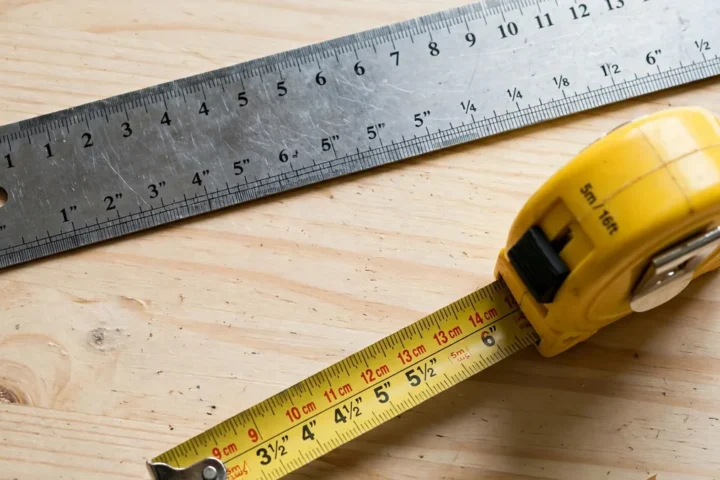
Finding 5/8 of an inch on a ruler is a matter of counting marks. On a ruler divided into sixteenths, which most workshop rulers are, 5/8 of an inch is the tenth mark after the inch line, because five eighths equals ten sixteenths. Count ten small marks from zero and you are there. The mark itself is usually one of the longer ticks, because eighths are marked longer than sixteenths.
On a ruler divided into thirty-seconds, which finer engineering rulers are, 5/8 of an inch is the twentieth mark, because five eighths equals twenty thirty-seconds. On a tape measure, look for the mark halfway between the 1/2 inch and 3/4 inch marks: the 1/2 mark is the longest tick in the inch, the 3/4 mark is the next longest, and 5/8 sits exactly between them, marked with a tick of its own.
The commonest mistake is to miscount by one mark, landing on 9/16 or 11/16 instead. The way to avoid it is to count from the nearest whole inch rather than from the nearest half inch, and to check the reading against a second scale if the ruler has one. A steel ruler with both imperial and metric edges lets you check at once: 5/8 of an inch should line up with 15.875 mm, a shade short of the 16 mm mark. The guide to transform mm to inches covers the conversion in the other direction, for measurements that start in millimetres.
Where 5 eighths of an inch is used
Drill bits are the first place most people meet 5/8 of an inch. It is a standard bit size, used for boring holes for large bolts, for dowels and for cable runs through studs, and a 5/8 inch bit cuts a hole 15.875 mm across. A hole drilled with a 5/8 inch bit will take a 5/8 inch bolt or dowel with a close fit, which is the point of matching the sizes.
Bolts are the second. A 5/8 inch bolt is a heavy-duty fastener, used in structural timber work, in machinery and in construction, and it takes a 15/16 inch spanner on its hex head. Wrenches and spanners are themselves sized in fractions, and a 5/8 inch wrench is a different tool from a 5/8 inch bolt: the wrench size is the distance across the flats of the nut it fits, not the diameter of the bolt.
Boards and panels are the third. Five-eighths of an inch is a standard nominal thickness for plywood and for fire-rated plasterboard, known as Type X, which is used where building rules call for extra fire resistance. In woodworking, a 5/8 inch thickness is a common choice for shelves, drawer bottoms and cabinet backs, thick enough to hold a screw well and thin enough to keep the weight down. The guide to 12 cm to inches uses the same conversion method for a metric measurement, and it works for any value at all.
Fractions of an inch compared
Fractions are easier to use when they are laid out side by side. The table below gives the decimal and metric equivalent of the eighths of an inch from 1/8 up to a full inch, so 5/8 can be seen in its proper place.
| Fraction | Decimal inches | Millimetres | Nearest sixteenth |
|---|---|---|---|
| 1/8 in | 0.125 | 3.175 | 2/16 in |
| 1/4 in | 0.25 | 6.35 | 4/16 in |
| 3/8 in | 0.375 | 9.525 | 6/16 in |
| 1/2 in | 0.5 | 12.7 | 8/16 in |
| 5/8 in | 0.625 | 15.875 | 10/16 in |
| 3/4 in | 0.75 | 19.05 | 12/16 in |
| 7/8 in | 0.875 | 22.225 | 14/16 in |
| 1 in | 1.0 | 25.4 | 16/16 in |

Converting 5 eighths of an inch
Converting 5/8 of an inch to millimetres is a single multiplication: multiply 0.625 by 25.4, because one inch is 25.4 millimetres, and the answer is 15.875 mm. Converting the other way, divide the millimetres by 25.4: 15.875 divided by 25.4 equals 0.625 inches. To get centimetres, divide the millimetres by ten, giving 1.5875 cm.
In practice, most people round 15.875 mm to 16 mm, and for most jobs that is close enough: the difference is 0.125 mm, about the thickness of a sheet of paper. But for a drilled hole or a bolt, that eighth of a millimetre can be the difference between a fit that slides together and one that binds, so keep the full value when the part has to fit. A 16 mm drill bit is not the same as a 5/8 inch bit, even though the sizes look alike on paper.
There is one more conversion worth knowing. Five eighths of an inch is 0.0521 feet, since there are twelve inches in a foot, but feet are not a useful unit at this scale, and nobody in a workshop reaches for them. Inches, millimetres and fractions are the units that do the work here, and 5/8 of an inch sits comfortably in all three. The time card calculator is a different kind of everyday calculation, but it rests on the same habit of working a small sum carefully and writing the answer down.
Your 5 eighths of an inch checklist
- Remember that 5 eighths of an inch is 0.625 inches, or 15.875 millimetres.
- On a sixteenths ruler, 5/8 of an inch is the tenth mark after the inch line.
- On a tape measure, find the mark halfway between the 1/2 inch and 3/4 inch marks.
- Check the reading against the metric edge: it should sit a shade short of 16 mm.
- Remember that 5/8 of an inch is a standard drill bit size and a standard bolt diameter.
- Match the bit to the bolt: a 5/8 inch hole takes a 5/8 inch bolt or dowel.
- Do not swap a 16 mm bit for a 5/8 inch bit when the fit has to be exact.
- Count from the nearest whole inch to avoid landing on 9/16 or 11/16 by mistake.
What is 5 eighths of an inch as a decimal?
5 eighths of an inch is 0.625 inches. Five divided by eight equals 0.625 exactly, with no rounding needed, which is one reason the fraction is so widely used.
What is 5/8 of an inch in millimetres?
5/8 of an inch is 15.875 millimetres. Multiply 0.625 by 25.4, because one inch is exactly 25.4 millimetres, and the answer is 15.875 mm, or 1.5875 centimetres.
How do I find 5/8 of an inch on a ruler?
On a ruler marked in sixteenths, count ten small marks from the inch line, because 5/8 equals 10/16. On a tape measure, look for the mark halfway between the 1/2 inch and 3/4 inch marks.
Is 5/8 of an inch the same as 16 mm?
No, but it is very close. 5/8 of an inch is 15.875 mm, which is 0.125 mm smaller than 16 mm. For rough work the difference does not matter, but for a drilled hole or a bolt it can.
What is 5/8 of an inch used for?
It is a standard drill bit size, a standard bolt diameter and a standard nominal thickness for plywood and fire-rated plasterboard. It is also the size of some spanners and sockets, and a common thickness for shelves and cabinet backs.
What is half of 5/8 of an inch?
Half of 5/8 of an inch is 5/16 of an inch, which is 0.3125 inches or 7.9375 millimetres. Double it and the answer is 1 1/4 inches, which is 31.75 millimetres.
The bottom line
5 eighths of an inch is 0.625 inches, or 15.875 millimetres, and it is the tenth mark on a sixteenths ruler and the mark halfway between half an inch and three quarters on a tape measure. It is a standard size for drill bits, bolts, plywood and fire-rated plasterboard, and it converts cleanly in every direction. Count ten sixteenths from the inch line, check it against 16 mm on the metric edge, and the measurement is made.