
5 9 centimeter is how the measurement 5.9 centimetres is often typed into a search box, and the answer is 2.32 inches. The figure 5.9 cm is a small length, a little under two and a third inches, and it comes up whenever something is measured in metric and needs to be understood in imperial units, or the other way round. This guide works out the conversion exactly, shows the simple method behind it, and sets 5.9 cm beside objects of about the same size so it is easy to picture.
Key takeaways
- 5.9 centimetres is 2.32 inches, worked out as 5.9 divided by 2.54.
- To convert centimetres to inches, divide the centimetres by 2.54; to go back, multiply the inches by 2.54.
- 5.9 cm is also 59 millimetres and 0.059 metres.
- Rounded to the nearest sixteenth of an inch, 5.9 cm is about 2 5/16 inches.
- A bank card is 5.4 cm wide and an AA battery is 5.05 cm long, so 5.9 cm is a little longer than either.
- For most everyday purposes, 2.32 inches is accurate enough; keep more decimal places only for precise work.
What 5.9 centimetres converts to
5.9 centimetres converts to 2.3228 inches, which rounds to 2.32 inches. The conversion is exact because the inch is defined in metric terms: one inch is exactly 2.54 centimetres, a definition agreed internationally in 1959. Dividing 5.9 by 2.54 gives 2.3228346, and the first two decimal places are all most people ever need.
In other metric units, 5.9 cm is 59 millimetres, since there are ten millimetres in a centimetre, and 0.059 metres, since there are one hundred centimetres in a metre. In feet it is 0.1936 feet, which is not a useful way to describe so small a length, and in yards it is 0.0645 yards. Inches and millimetres are the units that make sense at this scale.
On a ruler marked in sixteenths of an inch, 5.9 cm sits just past the 2 5/16 inch mark. Working it out: the fractional part, 0.3228 of an inch, multiplied by 16 gives 5.16 sixteenths, so 2 5/16 inches is the nearest sixteenth, and it is only about a hundredth of an inch short of the exact value. Anyone measuring with an imperial ruler can aim for a shade past the 5/16 mark and be close enough for almost any practical purpose.
How to convert centimetres to inches
The method is a single division. Take the number of centimetres and divide it by 2.54, because one inch equals 2.54 centimetres. For 5.9 cm, the sum is 5.9 divided by 2.54, which equals 2.3228 inches. To convert the other way, multiply the inches by 2.54: 2.32 inches multiplied by 2.54 gives 5.89 centimetres, which rounds back to 5.9.
There is a rough shortcut for quick estimates. Dividing by 2.5 instead of 2.54 is easier mental arithmetic, and for 5.9 cm it gives 2.36 inches, which is about a twenty-fifth of an inch too long. That is fine for a rough guess, but for anything that has to fit, use 2.54. The centimetre entry on Wikipedia sets out the unit’s definition and its place in the metric system.
Rounding is a matter of choosing how much accuracy the job needs. Two decimal places, 2.32 inches, is right for shopping, crafts and schoolwork. Three decimal places, 2.323 inches, suits most workshop measuring. The full value, 2.3228 inches, is there when a drawing or a machine setting demands it. The guide to 12 cm to inches uses the same method for a larger measurement, and it works for any value at all.
What 5.9 centimetres looks like
A length of 5.9 cm is easy to picture once it is set beside familiar objects. A standard bank card is 8.56 cm long and 5.4 cm wide, so 5.9 cm is about half a centimetre longer than the short edge of a bank card. Hold a card across its width, add a fraction more, and that is roughly 5.9 cm.
An AA battery is 5.05 cm long, so 5.9 cm is a little longer than a standard AA battery stood on end. A golf ball is 4.27 cm across, so 5.9 cm is about one and a third golf balls side by side. These are all ordinary objects with standard sizes, which is what makes them useful as rough gauges when no ruler is to hand.
It is also worth knowing what 5.9 cm is not. It is not the length of a typical smartphone, which is usually around 15 cm tall, and it is not the width of a hand, which is usually around 8 or 9 cm across the palm. It is a small measurement, the sort that comes up in sewing, paper craft, model making and jewellery, where a few millimetres one way or the other can change whether something fits. The guide to transform mm to inches covers the same ground in millimetres, for measurements finer still.
Centimetres to inches compared
Conversions are easier to use when they are laid out side by side. The table below gives the inch equivalent of whole centimetre values from 1 to 10, with 5.9 cm included in its proper place, all rounded to two decimal places.
| Centimetres | Inches | Millimetres | Nearest fraction |
|---|---|---|---|
| 1 | 0.39 | 10 | 3/8 in |
| 2 | 0.79 | 20 | 13/16 in |
| 3 | 1.18 | 30 | 1 3/16 in |
| 4 | 1.57 | 40 | 1 9/16 in |
| 5 | 1.97 | 50 | 1 15/16 in |
| 5.9 | 2.32 | 59 | 2 5/16 in |
| 6 | 2.36 | 60 | 2 3/8 in |
| 7 | 2.76 | 70 | 2 3/4 in |
| 8 | 3.15 | 80 | 3 1/8 in |
| 9 | 3.54 | 90 | 3 9/16 in |
| 10 | 3.94 | 100 | 3 15/16 in |

When a measurement like 5.9 cm comes up
Measurements around 5.9 cm come up most often in small, precise work. In sewing and dressmaking, a hem, a seam allowance or a button spacing can be 5.9 cm, and the pattern will give it in centimetres even when the sewer thinks in inches. In paper craft and card making, a border or a fold can measure 5.9 cm, and a fraction of a centimetre shows plainly in the finished piece.
In model making, 5.9 cm can be the length of a part, a wheelbase or a gap between fittings, and the instructions for a kit made in one country will use the units of that country, leaving the builder to convert. In jewellery, a chain length, a bead or a pendant can measure 5.9 cm, and the difference between 5.9 cm and 6 cm is visible when the piece is worn.
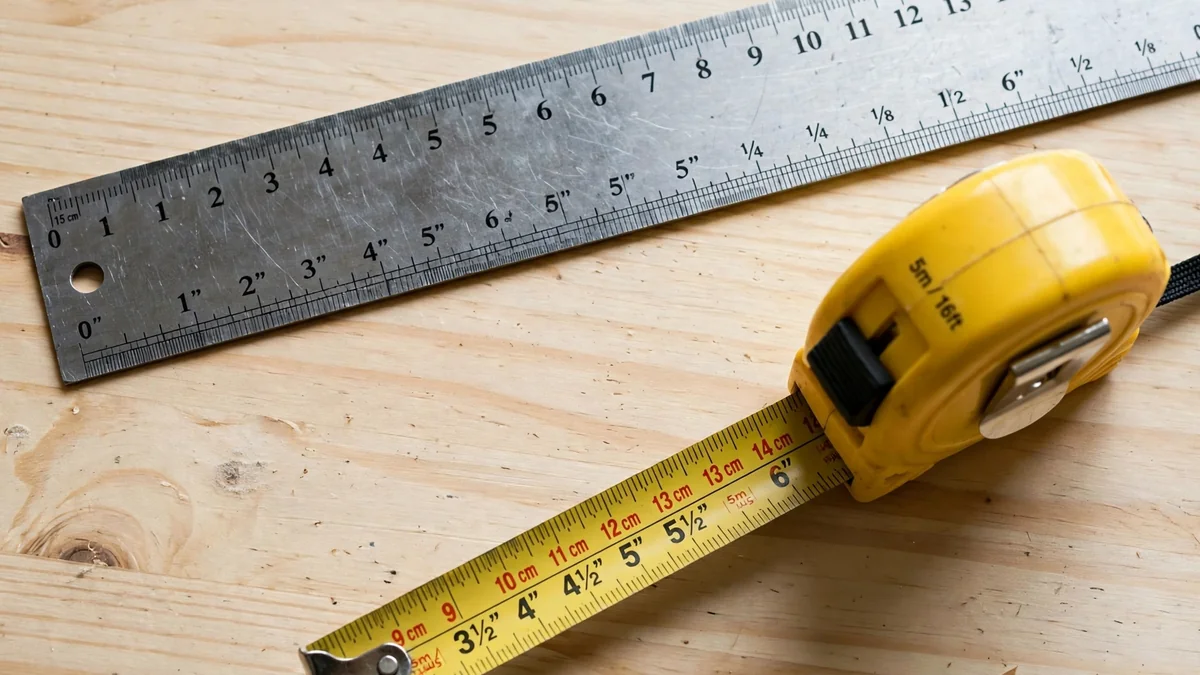
It also comes up in schoolwork, where converting between metric and imperial units is a standard exercise, and in online shopping, where a listing written in centimetres has to be understood by a buyer who thinks in inches. A tape measure that shows both scales takes the arithmetic out of it entirely: find 5.9 cm on the metric edge and read the inches straight off the other side. The time card calculator is a different kind of everyday calculation, but it rests on the same habit of working a small sum carefully and writing the answer down.
Your 5.9 centimetres checklist
- Remember that 5.9 centimetres is 2.32 inches, or 2.3228 inches unrounded.
- Convert centimetres to inches by dividing by 2.54; convert back by multiplying by 2.54.
- Remember that 5.9 cm is 59 millimetres and 0.059 metres.
- On an imperial ruler, 5.9 cm is about 2 5/16 inches, a shade past the 5/16 mark.
- Picture it as a little longer than the short edge of a bank card, which is 5.4 cm wide.
- Use two decimal places for everyday purposes and more only for precise work.
- Check the units on a pattern, a kit or a listing before cutting or ordering.
- When in doubt, measure twice: once in centimetres and once in inches.
What is 5.9 centimetres in inches?
5.9 centimetres is 2.32 inches. The exact value is 2.3228 inches, worked out as 5.9 divided by 2.54, because one inch is exactly 2.54 centimetres.
How do I convert centimetres to inches?
Divide the number of centimetres by 2.54. For 5.9 cm, 5.9 divided by 2.54 equals 2.3228 inches. To convert inches back to centimetres, multiply the inches by 2.54.
What is 5.9 cm in millimetres?
5.9 cm is 59 millimetres. There are ten millimetres in a centimetre, so multiply the centimetres by ten: 5.9 times 10 equals 59.
What is 5.9 cm as a fraction of an inch?
5.9 cm is about 2 5/16 inches. The fractional part, 0.3228 of an inch, multiplied by 16 gives 5.16 sixteenths, so 2 5/16 inches is the nearest sixteenth.
How big is 5.9 cm in everyday terms?
5.9 cm is a little longer than the short edge of a bank card, which is 5.4 cm wide, and a little longer than an AA battery, which is 5.05 cm long. It is about one and a third golf balls side by side.
Why is 5.9 cm written as 5 9 centimeter in searches?
Search boxes often drop the decimal point, so a search for 5.9 centimetres is typed as 5 9 centimeter. The measurement meant is 5.9 centimetres, which is 2.32 inches.
The bottom line
5.9 centimetres is 2.32 inches, worked out by dividing 5.9 by 2.54, and it is 59 millimetres into the bargain. It is a small length, a little longer than a bank card is wide and a little longer than an AA battery, and it turns up in sewing, craft, model making and jewellery, where a few millimetres matter. Divide by 2.54, round to two decimal places, and the conversion is done.