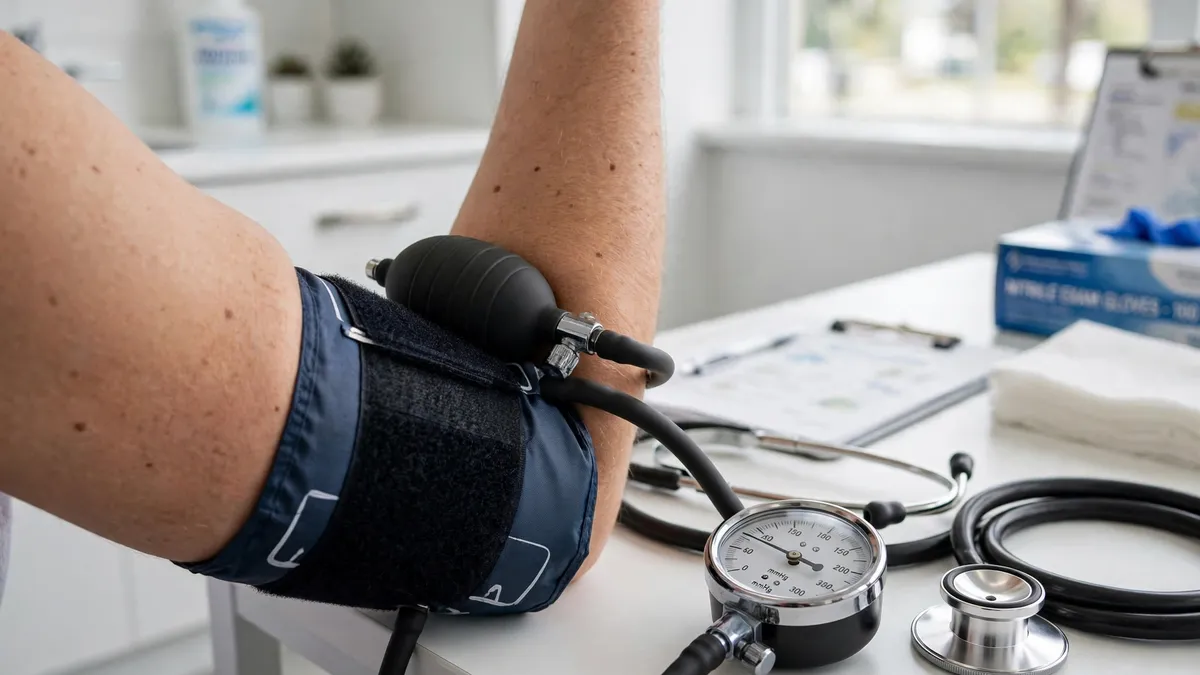

A sphyg cuff is the inflatable band that wraps around your upper arm when your blood pressure is measured, and it is the part of the sphygmomanometer that does the actual work of squeezing the artery. The word sphyg comes from the Greek word for pulse, and the cuff is what turns a simple squeeze of the arm into two numbers that tell a clinician how hard your heart is working. If you have ever sat in a clinic while a band tightened around your arm and then slowly loosened, you have already met one, even if you never knew its name.
Key takeaways
- A sphyg cuff is the inflatable band of a sphygmomanometer, the instrument used to measure blood pressure.
- It works by briefly squeezing the brachial artery in the upper arm, then releasing pressure in a controlled way.
- The bladder inside should be about 40 per cent as wide as the arm is round, and long enough to cover at least 80 per cent of it.
- The lower edge of the cuff sits about 2 to 3 centimetres above the bend of the elbow.
- A cuff that is too small reads too high, while one that is too large reads too low.
- Resting for five minutes, keeping the arm bare and supported at heart level, and staying quiet all help the reading stay accurate.
What a sphyg cuff is
A sphyg cuff is a wide fabric band with an inflatable rubber bladder sewn inside it, attached by tubing to a pump and a pressure gauge. The full instrument is called a sphygmomanometer, which simply means a measurer of pulse pressure. The cuff is the part that touches the patient, and it comes in several sizes to fit arms from a small child to a large adult.
There are two broad kinds of sphygmomanometer, and both use the same kind of cuff. A manual device pairs the cuff with a hand pump and a round dial gauge, and the person taking the reading listens with a stethoscope for the sounds of blood returning to the artery. Mercury devices were once the standard, but they have largely been replaced because mercury is toxic if a column breaks. An automatic device has a small electric pump and a screen instead, and senses the pulse in the artery wall itself. Home monitors are almost always automatic. Wrist and finger cuffs also exist, but guidelines generally advise against them for routine use, because the wrist is harder to hold at heart level and the small arteries there give less reliable readings.
How a sphyg cuff works
The principle behind the cuff is simple, and it has barely changed since the instrument was developed more than a century ago. When the cuff inflates, it presses on the upper arm and squeezes the brachial artery shut, so no blood can pass. As the air is let out slowly, the pressure falls, and at a certain point the blood forces its way through again in spurts, once with each heartbeat. The pressure at which that first happens is the systolic pressure, the higher of the two numbers in a reading, reflecting the force when the heart contracts.
As the cuff keeps deflating, the spurts become a steady flow, and the sounds heard through the stethoscope change and then disappear. The point at which they vanish is the diastolic pressure, the lower number, which reflects the pressure when the heart rests between beats. These sounds are called Korotkoff sounds, after the Russian surgeon who first described them.
An automatic cuff works on the same squeeze-and-release idea, but instead of listening it senses tiny oscillations in pressure inside the cuff as the artery pulses beneath it, and shows the result on a screen. The sphygmomanometer entry on Wikipedia explains the history of the instrument and the difference between manual and automatic designs.
Cuff sizes and how to choose the right one
Size matters more than most people realise, and it is the single most common reason for a wrong reading. The part that counts is the inflatable bladder inside the cuff, not the fabric band around it. The bladder should be wide enough to cover about 40 per cent of the circumference of the upper arm, and long enough to wrap around at least 80 per cent of it. When those proportions are right, the pressure spreads evenly across the artery. When they are wrong, the reading shifts: a cuff that is too small can push the reading up by a wide margin, while one that is too large can push it down.
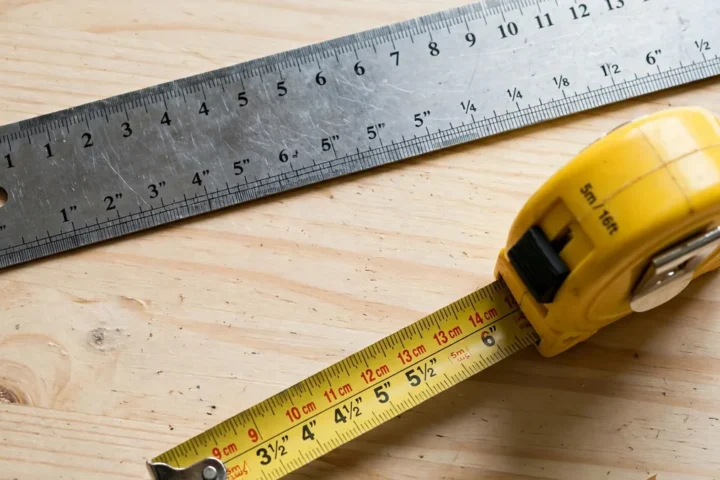
The simplest way to choose is to measure the arm. Wrap a tape measure around the middle of the upper arm, halfway between the shoulder and the elbow, with the arm relaxed, then match the measurement to the sizes below. If the arm falls between two sizes, the larger cuff is usually the safer choice.
| Cuff size | Arm circumference | Bladder size | Who it suits |
|---|---|---|---|
| Small adult | 22 to 26 cm | 12 by 22 cm | Slender adults and older children |
| Standard adult | 27 to 34 cm | 16 by 30 cm | Most adults |
| Large adult | 35 to 44 cm | 16 by 36 cm | Adults with larger upper arms |
| Adult thigh | 45 to 52 cm | 16 by 42 cm | Very large arms, or the thigh |

How to place and use a sphyg cuff correctly
Good technique starts before the cuff goes on. Sit quietly for at least five minutes in a calm room, with your back supported and both feet flat on the floor, legs uncrossed. Empty your bladder first, and avoid caffeine, smoking and exercise for at least half an hour beforehand, since all of them can lift the reading. Do not talk during the rest period or while the measurement is being taken.
Bare the upper arm completely, or wear only a very thin sleeve that lies flat. Support the arm on a table so the middle of the upper arm is level with the middle of the chest, roughly heart level. An arm left dangling will give a reading that does not reflect the true pressure.
Wrap the cuff snugly around the bare upper arm, with the middle of the bladder centred over the brachial artery on the inside of the arm. The lower edge of the cuff should sit about 2 to 3 centimetres above the crease of the elbow, leaving room for a stethoscope if one is being used. The cuff should be firm enough that only one or two fingers fit beneath it. With a manual device, inflate quickly until the pulse at the wrist disappears, then add about 30 millimetres of mercury more, and let the air out slowly, at about 2 to 3 millimetres of mercury per second, listening for the first and last Korotkoff sounds. With an automatic device, press start and keep still while the machine works. A second reading, taken after a minute or two, is worth doing if the first seems high.
Common mistakes that give wrong readings
Most wrong readings come from small, avoidable errors rather than faulty equipment. The wrong cuff size is the most frequent, and the most damaging: a narrow cuff on a large arm can read far higher than the true pressure, and that error has led many people to be treated for high blood pressure they do not have. Measuring over a thick sleeve is another classic mistake.
Position causes trouble too. An unsupported arm reads higher than a supported one, and an arm held below heart level reads higher still. Crossing the legs, sitting without back support, talking, or taking a reading straight after climbing stairs or drinking coffee can each push the numbers up. Taking a single reading and acting on it is another trap: blood pressure varies through the day, and one high number proves very little. Two or three readings, taken a few minutes apart and averaged, give a much fairer picture.
Equipment needs care as well. A manual gauge that has been dropped or knocked may read wrong, and cuffs wear out: tubing cracks, bladders leak and hook-and-loop fastenings lose their grip. A cuff that will not hold pressure, or a gauge needle that does not sit at zero when deflated, should be checked or replaced, and a home monitor is worth comparing with a clinic reading about once a year. Devices that look alike can still work very differently, as the guide to NMES vs TENS shows. Good treatment so often starts with good measurement, as the guide to plasma rich injections shows, and for a sense of how muscle tension can affect the arm and the reading, the guide to muscle spasm explains how tight, cramped muscles behave and why a relaxed arm matters.
Your sphyg cuff checklist
- Rest for five minutes before measuring, sitting with your back supported and feet flat on the floor.
- Measure the upper arm and choose a cuff whose bladder covers about 40 per cent of the width and 80 per cent of the length.
- Bare the arm and support it at heart level on a flat surface.
- Centre the bladder over the brachial artery, with the lower edge 2 to 3 centimetres above the elbow crease.
- Wrap the cuff snugly: only one or two fingers should fit beneath it.
- Stay quiet and still while the cuff inflates and deflates.
- Take two or three readings a few minutes apart and average them.
- Check the cuff, tubing and gauge regularly, and replace anything that leaks or will not hold pressure.
What is a sphyg cuff?
A sphyg cuff is the inflatable band of a sphygmomanometer, the instrument used to measure blood pressure. It wraps around the upper arm and squeezes the brachial artery shut, then releases pressure slowly so the systolic and diastolic pressures can be found.
What size sphyg cuff do I need?
Measure around the middle of your upper arm. A small adult cuff suits arms of 22 to 26 centimetres, a standard adult cuff suits 27 to 34 centimetres, and a large adult cuff suits 35 to 44 centimetres. Between sizes, choose the larger one.
Where should the cuff sit on the arm?
On the bare upper arm, with the middle of the bladder centred over the brachial artery on the inside of the arm. Its lower edge should sit about 2 to 3 centimetres above the crease of the elbow, and the arm should be supported at heart level.
Can a wrong cuff size affect my reading?
Yes, and by a large amount. A cuff that is too small gives a reading that is falsely high, while a cuff that is too large gives one that is falsely low. Using the right size is the most important step in getting an accurate reading.
Should the cuff go over clothing?
No. Place it on the bare arm, or over only a very thin sleeve that lies flat. A thick or bunched sleeve under the cuff can distort the reading.
How often should a home blood pressure cuff be checked?
Check the cuff, tubing and fastening before each use, and have the monitor compared with a clinic reading about once a year. Replace the cuff if it leaks, bulges, slips, or will not hold pressure.
The bottom line
A sphyg cuff is a modest piece of equipment, but it carries a heavy responsibility: every blood pressure reading, and every decision that follows from it, depends on this band being the right size, in the right place, on a rested and relaxed arm. Get those few details right and the numbers can be trusted. If your readings at home are consistently high, or very different from those taken in the clinic, take the cuff and monitor with you to your next appointment and ask for the technique to be checked.