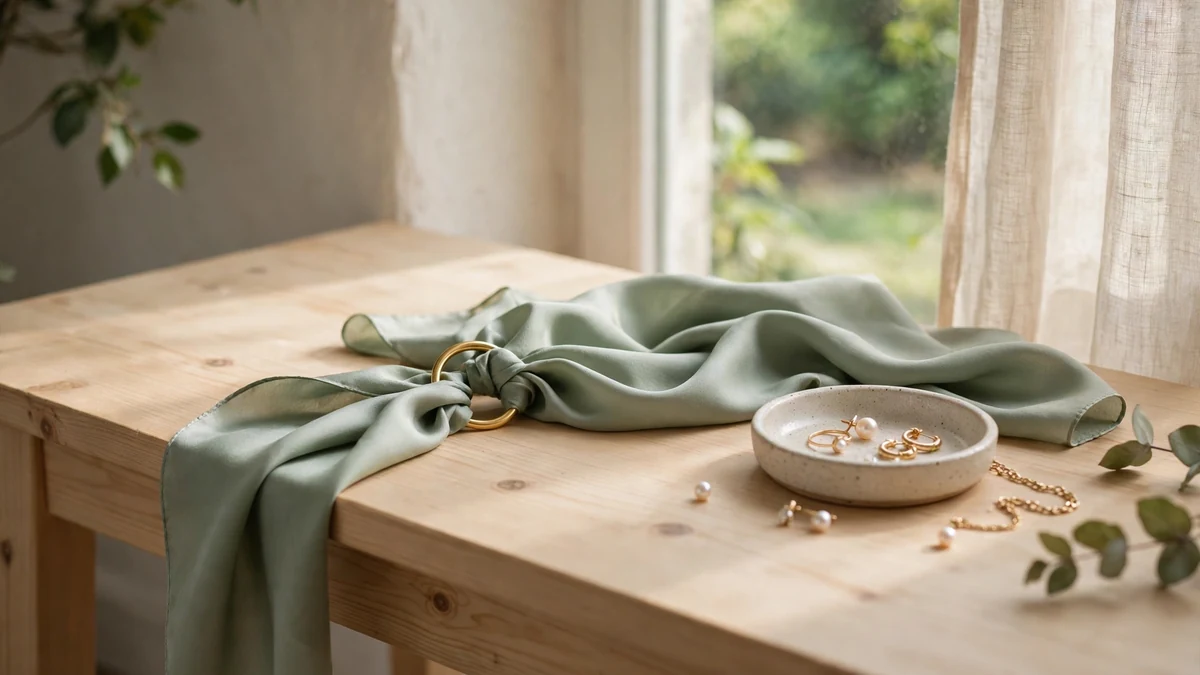

A scarf ring is a small loop, usually metal, that holds a scarf in place without a knot, and it is the simplest way to keep a silk scarf neat all day. You thread the two ends of the scarf through the ring, slide it to the position you want, and the fabric stays put while still looking soft and relaxed. If your scarves always slip, bunch or come undone, a scarf ring solves the problem in seconds, and it works with almost any scarf you already own.
Rings come in gold, silver, wood, resin and horn, in sizes from a slim band to a bold statement circle. The right choice depends on the weight of your scarf and the look you want: a slim ring suits fine silk, a chunky ring suits heavy wool, and a decorative ring can be the jewellery of the outfit. This guide explains how to wear a scarf ring, how to match it to your scarves, and how to choose one that lasts.
Key takeaways
- A scarf ring holds a scarf in place without a knot, so the fabric stays neat and the ends stay even.
- Thread both ends of the scarf through the ring, then slide the ring to the height you want.
- Slim rings suit fine silk, while wider rings suit chunky wool and heavy cotton.
- Match the ring’s metal to your other jewellery for a calm, finished look.
- A ring works best with a scarf that is long enough to pull through and adjust.
- Store rings separately so they do not scratch each other or snag delicate fabric.
What is a scarf ring?
A scarf ring is a small, closed loop designed to gather and hold the ends of a scarf. It is usually a simple circle, oval or square, and it is made from metal, wood, resin, horn or fabric-covered wire. Unlike a brooch, it does not pierce the fabric, and unlike a knot, it does not crease the scarf or create a bulky lump. The ring simply holds the fabric together by friction, which is why it works so well with slippery silk and fine wool that refuse to stay knotted.
Scarf rings have been worn for decades, and they come back into fashion every few years as silk scarves return to the high street. A plain ring is the most useful first buy, because it disappears into the outfit and lets the scarf do the talking. A decorative ring, on the other hand, acts as a piece of jewellery in its own right and can lift a plain coat or jumper. Either way, the job is the same: hold the scarf where you put it.
How to wear a scarf ring
The basic move is easy. Drape the scarf around your neck with both ends hanging in front, then gather the two ends together and thread them through the ring from the front. Pull the ends through until the ring sits at the height you want, usually at the chest or just below the collarbone, then gently fan the ends out so they lie flat. The ring should feel snug but not tight: if the fabric slides through too easily, the ring is too big for that scarf, and if it will not pull through at all, the ring is too small.
There are several ways to vary the look. For a simple loop, fold the scarf in half, drape the folded end around your neck and pull the loose ends through the loop. For an asymmetric style, wear the scarf with one end longer than the other and let the ring sit off centre. For a belted look, thread a long, narrow scarf through a larger ring at the waist of a coat or dress. A pair of classic penny loafers shows the same principle at work: a small, well-chosen detail can finish an outfit without shouting about it.
The most common mistake is pulling the fabric too tight through the ring, which creases silk and flattens wool. Thread the scarf through gently, then adjust the drape with your fingers rather than yanking the ends. If the ring keeps slipping down, the scarf is probably too light for it; try a smaller ring, or fold the scarf double before threading it. With a little practice, the whole move becomes as automatic as tying a shoelace.
Which scarf ring suits which fabric?
Fine silk needs a slim ring with a smooth inner edge, because anything rough will snag the weave and anything heavy will drag the scarf down.
Medium-weight wool and cashmere need a slightly larger ring, around three to four centimetres, with enough weight to hold the fabric without slipping. A brushed metal or wooden ring suits these fabrics, and a ring with a flat profile sits more comfortably against a jumper. Chunky knitted scarves need the largest rings of all, and a wide band of metal, resin or leather works best, because a narrow ring will pinch the knit and spoil its shape. When you are unsure, try the ring with your heaviest scarf first: if it holds that, it will hold everything lighter.
| Scarf fabric | Best ring size | Best ring material | Watch out for |
|---|---|---|---|
| Fine silk | 2 to 3 cm, slim | Polished gold or silver | Rough edges that snag the weave |
| Light cotton or linen | 2 to 3 cm, slim | Gold, silver or wood | Rings too heavy for the fabric |
| Medium wool or cashmere | 3 to 4 cm | Brushed metal or wood | Rings that slip on smooth knit |
| Chunky knit | 4 cm or wider | Wide metal, resin or leather | Narrow rings that pinch the knit |
| Printed viscose | 2 to 3 cm, slim | Gold or silver | Printed fabric creasing at the fold |

How to choose a scarf ring
Start with the scarves you already wear most, and choose a ring that suits them rather than the other way round. A slim, plain ring in gold or silver is the safest first purchase, because it works with silk, cotton and light wool and it matches most jewellery. Hold it in your hand before you buy if you can: it should feel smooth, with no sharp joins or rough edges, and it should be heavy enough to stay put but light enough not to drag a silk scarf down.
Think about colour as you would with any other jewellery. Gold rings warm up autumn colours and camel coats, while silver suits cooler tones and grey wool. Wooden rings are a good choice for relaxed, daytime outfits, and they are kind to delicate fabric. Resin and enamel rings come in every colour, so they can pick out a shade in a printed scarf, but choose one colour and let it repeat elsewhere in the outfit rather than adding a new colour. If you wear a ring on your finger as well, keep the two metals the same, so the outfit reads as considered rather than accidental. A neatly held scarf helps an outfit feel finished, as our guide to where to meet people notes about dressing with confidence for social occasions.
If your scarf carries a bold animal print, keep the ring plain. A print inspired by a desert animal such as the fennec fox already has plenty going on, and a quiet ring lets the pattern breathe instead of competing with it.
Check the finish before you buy. A ring with a rough seam will catch on silk, so run a fingertip around the inside edge. A ring that is plated rather than solid will wear over time, which is fine at a low price but worth knowing. Wooden rings should be sealed, so they do not swell in the rain. Buy one good ring before you buy five cheap ones, and you will reach for it every time.
A checklist for wearing a scarf ring
- Choose a ring that matches the weight of your scarf, slim for silk and wider for chunky wool.
- Run a fingertip around the inside edge and reject any ring with a rough seam.
- Thread both ends through gently, then fan the fabric out so they lie flat.
- Slide the ring to chest height or just below the collarbone.
- Match the ring’s metal to your other jewellery for a calm, finished look.
- Check the drape in a mirror and adjust the ends rather than pulling them tight.
- Take the ring off before folding the scarf away, so it does not crease the fabric.
- Store rings separately in a small pouch so they do not scratch each other.
Frequently asked questions
How do you put a scarf through a scarf ring?
Drape the scarf around your neck with both ends in front, gather the ends together, and thread them through the ring from the front. Pull the ends through until the ring sits at the height you want, then fan the ends out gently so they lie flat. The ring holds the fabric by friction, so there is no knot to tie.
What size scarf ring should I buy?
A slim ring of two to three centimetres suits fine silk, cotton and linen, while a ring of three to four centimetres suits medium wool and cashmere. Chunky knitted scarves need a ring of four centimetres or wider. If the ring is too big, the scarf slips through; if it is too small, the fabric will not pull through at all.
Can you wear a scarf ring with a wool scarf?
Yes, as long as the ring is wide enough for the fabric. A narrow ring will pinch a chunky knit and spoil its shape, so choose a wide band of metal, resin or leather. Medium-weight wool and cashmere work well with a ring of three to four centimetres, and the ring stops the scarf from slipping off your shoulders.
Does a scarf ring damage silk?
A smooth, well-finished ring will not damage silk, but a ring with a rough seam or sharp join can snag the weave. Run a fingertip around the inside edge before you buy, and choose polished metal or sealed wood. Thread the scarf through gently rather than yanking it, and the silk will stay unmarked.
Can a scarf ring be worn as jewellery?
Yes, many people wear decorative scarf rings as a piece of jewellery in their own right. A ring set with stones, enamel or carved detail can lift a plain coat or jumper, and it draws the eye to the neckline. Match its metal to your other jewellery, and let it be the one bold detail in the outfit.
How do I stop my scarf ring from slipping down?
A ring slips when it is too big for the scarf, so try a smaller ring or fold the scarf double before threading it through. A ring with a little weight holds better than a very light one, and a textured fabric such as wool grips better than slippery silk. If the ring still slips, move it higher, closer to the neck, where the fabric is doubled.
The bottom line
A scarf ring is a small purchase that solves a daily annoyance: it keeps a scarf in place without a knot, a crease or a bulky lump. Match the ring to the weight of your fabric, choose a smooth finish, and keep the metal in step with your other jewellery. Once you have worn one for a week, you will wonder why you spent so long retying your scarves.