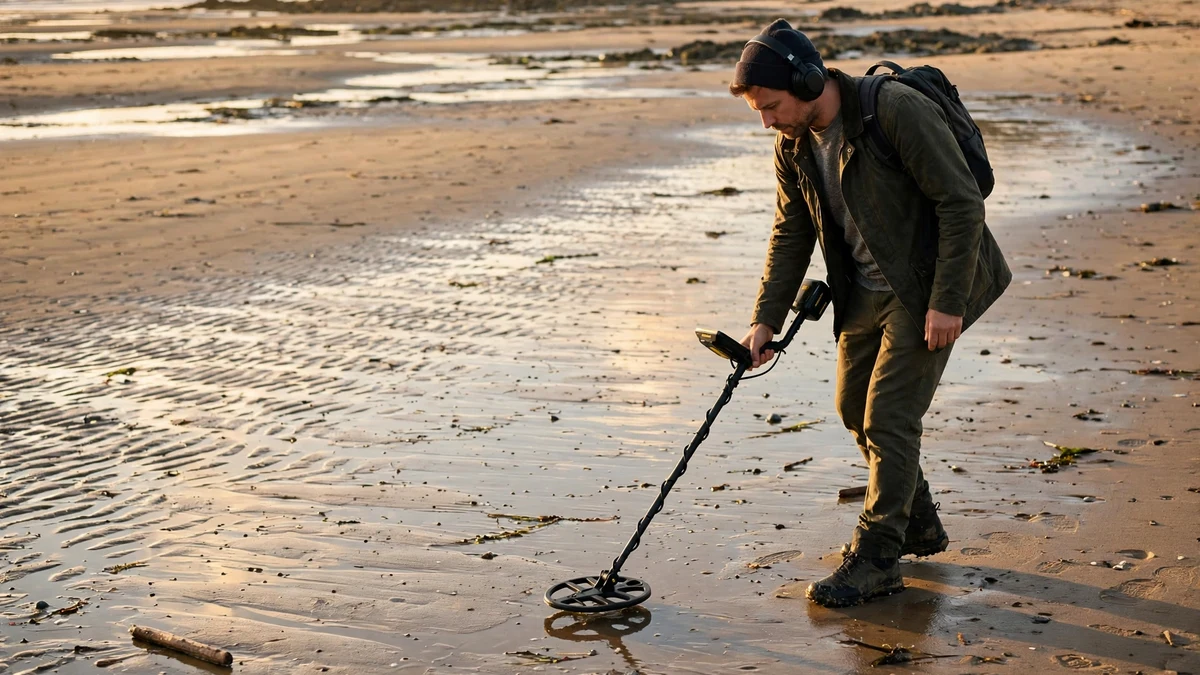

A metal detector is a device that finds metal objects buried in the ground or hidden in sand, by using electromagnetic induction. A coil in the search head sends out a changing magnetic field, that field creates tiny electric currents in any metal it reaches, and those currents create a second, weaker field that the detector picks up and turns into a beep or a number on a screen. It cannot see underground, and it cannot tell you exactly what an object is, but it can tell you that something metallic is there and give a good guess about the metal. This guide explains how the technology works, how the main types differ, and how to start detecting.
Key takeaways
- A metal detector works by electromagnetic induction: a coil sends a field into the ground and listens for the reply.
- VLF detectors are the common beginner choice, with good discrimination and a low price.
- Pulse induction detectors handle salt beaches and mineralised ground, but tell iron and treasure apart poorly.
- Multi-frequency detectors transmit several frequencies at once and cope best with changing ground.
- Depth depends on the target, the soil and the coil, not on the price of the machine.
- Always get permission, fill your holes and check local rules first.
How a metal detector works
Every metal detector works on the same principle. The control box drives a changing electric current through a coil in the search head, creating a changing magnetic field that reaches into the ground. When the field meets metal, it induces tiny circular electric currents, called eddy currents, inside it. Those currents create their own weak magnetic field, which a receive coil picks up. The electronics amplify it, filter out interference, and signal with a tone or a target number. How a metal detector works is explained step by step in an interactive tutorial from Florida State University. Highly conductive metals, such as silver and copper, are easier to detect, while small or deeply buried objects give a weaker signal.
VLF, pulse induction and multi-frequency
The three main technologies differ in how they send the field and read the echo. VLF, short for very low frequency, is the most common and the one most beginners start with. A VLF detector sends a continuous sine wave through its transmit coil, usually between 3 and 30 kHz, and a receive coil picks up the return. The electronics compare the timing of the returning signal with the transmitted wave, a difference known as phase shift, and different metals shift it differently, which is how the detector estimates what is underground. Low frequencies reach deeper, high frequencies suit small targets, and VLF machines are cheap with good discrimination, but they struggle on wet salt sand and mineralised ground.
Pulse induction, or PI, works differently. Instead of a continuous wave, it sends short pulses of current, then listens to how long the reflected signal takes to decay. That timing ignores most of the ground’s own response, so PI detectors keep working in salt water and mineralised soil where VLF machines give false signals. The trade-off is discrimination: a PI machine is poor at telling iron from gold, so the user digs far more junk. Multi-frequency detectors transmit several frequencies at once and combine the results, gaining the depth of low frequencies and the small-target sensitivity of high frequencies. They hold a steadier identification in salt and mineralised ground, but they cost more.
| Type | How it transmits | Strengths | Weaknesses | Best for |
|---|---|---|---|---|
| VLF, single frequency | One continuous sine wave | Good discrimination, low cost | Struggles in salt and mineralised ground | Parks, gardens, relics |
| VLF, selectable frequency | One frequency at a time, chosen by the user | Tune for coins or beach | One frequency at once | All-round detecting |
| Simultaneous multi-frequency | Several frequencies at once | Steady identification in salt ground | Price, deeper menus | Beaches, mixed ground |
| Pulse induction | Short pulses, listens between them | Depth in mineralised ground and salt water | Weak discrimination, more junk dug | Gold prospecting, deep beach hunting |

What affects depth and target identification
Depth is the question every beginner asks, and there is no single answer: it depends on the target, the ground and the machine. A large object can be detected much deeper than a small coin, and a coin lying flat gives a stronger signal than one standing on edge. Dry, clean soil lets the field through easily, while wet salt sand and iron-rich soil create a background signal that can hide a target. Low frequencies penetrate deeper, high frequencies pick up smaller objects, and a large coil reaches deeper but is less sensitive to small targets.
Two settings do most of the work in difficult ground. Ground balance cancels out the signal from the minerals in the soil, so the detector only reports metal; many machines set it automatically, but a manual adjustment works better on difficult ground. Discrimination tells the machine which signals to ignore, so iron nails and bottle caps can be rejected while coins and rings are reported. Target identification assigns a number to each signal: low numbers usually mean iron, mid-range numbers foil and small gold, and high numbers silver and copper coins. These numbers are a guide, not a guarantee: a rusty bottle cap can read like a coin, and a gold ring can read like foil.
Where to use a metal detector
Where you can detect depends on permission and local law. Your own garden is the best place to start, followed by private land with the owner’s written permission. Parks, beaches and common land often need permission from the council or the landowner, and some places ban detecting altogether. In the United States, detecting is not allowed in national parks. In England and Wales, finds that may count as treasure must be reported, and detecting on scheduled monuments is an offence. Always check the rules before you go, and never detect on a building site or a military range. Buried cables and pipes are a real hazard: do not dig where services may run. Beaches are popular because the sand is easy to dig and people lose coins and jewellery there, but wet sand needs a machine that can handle salt.
How to start metal detecting
Start with a simple VLF machine, headphones, a small spade, a finds pouch and a pinpointer, the small device that narrows down a target once you have dug it out. Learn the machine in your own garden first: bury a few coins at different depths, sweep over them slowly, and listen to how the tone and the target number change. Keep the coil low and level, a few centimetres above the ground, and sweep slowly from side to side with the sweeps overlapping. Walk slowly: most beginners sweep too fast and too high, and miss targets a slower pass would have found. When you get a repeatable signal from two directions, dig a neat plug of turf, find the target with the pinpointer, and put the plug back. Carry a bag for litter: every detectorist digs far more bottle caps and nails than treasure.
Keep a simple record of what you find and where, with a photograph and a note of the location. It helps you learn which ground produces what, and it matters if you find something that needs reporting. Join a local detecting club if you can: clubs arrange permission to search farmland, and experienced members will help you learn your machine. Do not buy the most expensive machine first: a mid-range VLF detector, learned properly, will find more than a top machine in untrained hands.
Rules and etiquette for detectorists
Good detecting is as much about behaviour as about equipment. Always get permission before searching private land, and keep to the terms the landowner sets. Fill every hole, replace every plug of turf, and leave the ground as you found it. Take all litter away, and report anything that may be treasure or historically important. Never detect on protected sites, and never damage fences, crops or livestock. If you find something that might be dangerous, such as an old shell, do not touch it: mark the spot, move away and report it. Share finds with the landowner, who usually owns what is found on their land.
A checklist for your first metal detecting trip
- Choose a simple VLF detector and learn its tones first.
- Pack headphones, a small spade, a finds pouch, a pinpointer and a litter bag.
- Get permission for the land, and check the local rules before you go.
- Keep the coil low and level, sweep slowly, and overlap sweeps.
- Dig a neat plug, find the target, and put the plug back.
- Record finds with a photograph and a note of where they came from.
- Fill every hole, take all litter away, and leave the ground as found.
- Report anything that may be treasure or historic.
Frequently asked questions
How does a metal detector work?
A metal detector works by electromagnetic induction. A transmit coil sends a changing magnetic field into the ground, that field induces tiny electric currents, called eddy currents, in any metal it reaches, and those currents create a second magnetic field. A receive coil picks up that field, and the electronics turn it into a tone or a target number. Different metals change the signal differently.
What is the best metal detector for a beginner?
A simple single-frequency VLF detector is the best starting point for most people. It is affordable, it discriminates well between iron and coins, and it is easy to learn. Choose one with automatic ground balance and a clear target display, and learn its tones in your garden first. A more expensive machine is worth considering only once you know which ground you will search most.
How deep can a metal detector find a coin?
It depends on the coin, the soil and the machine. A coin-sized target in clean soil is usually found within the top few inches, and a larger object can be found deeper. Wet salt sand and iron-rich soil reduce depth, while a large coil and a low frequency increase it. No manufacturer can promise a fixed depth.
Can a metal detector find gold?
Yes. Gold prospecting is one of the main uses of pulse induction detectors, which handle the mineralised ground of goldfields well. Small nuggets are hard to detect because they give a weak signal, so prospectors use high frequencies or pulse induction machines with small coils. Gold rings often read like foil, so detectorists dig many foil signals hoping for a ring.
Do I need permission to use a metal detector?
Yes, in almost every case. You can detect in your own garden freely, but private land needs the owner’s permission, and parks, beaches and common land often need permission from the council or the landowner. Some places ban detecting altogether, including national parks in the United States and scheduled monuments in England and Wales. Always check the rules before you go.
What should I do if I find something valuable?
Record where you found it, photograph it, and keep it safe. If it may count as treasure, report it to the relevant authority: in England and Wales, that means the coroner. Agree in advance with the landowner about how finds are shared, since what is found on private land usually belongs to the landowner.
The bottom line
A metal detector finds buried metal by sending a magnetic field into the ground and listening for the field that metal sends back. A simple VLF detector is the right start for most beginners, with pulse induction and multi-frequency machines for salt beaches and difficult ground. Get permission, fill your holes and enjoy the hunt. For more outdoor reading, see our guide to golf range driving, our guide to the best water bottle, and our guide on where to meet people.