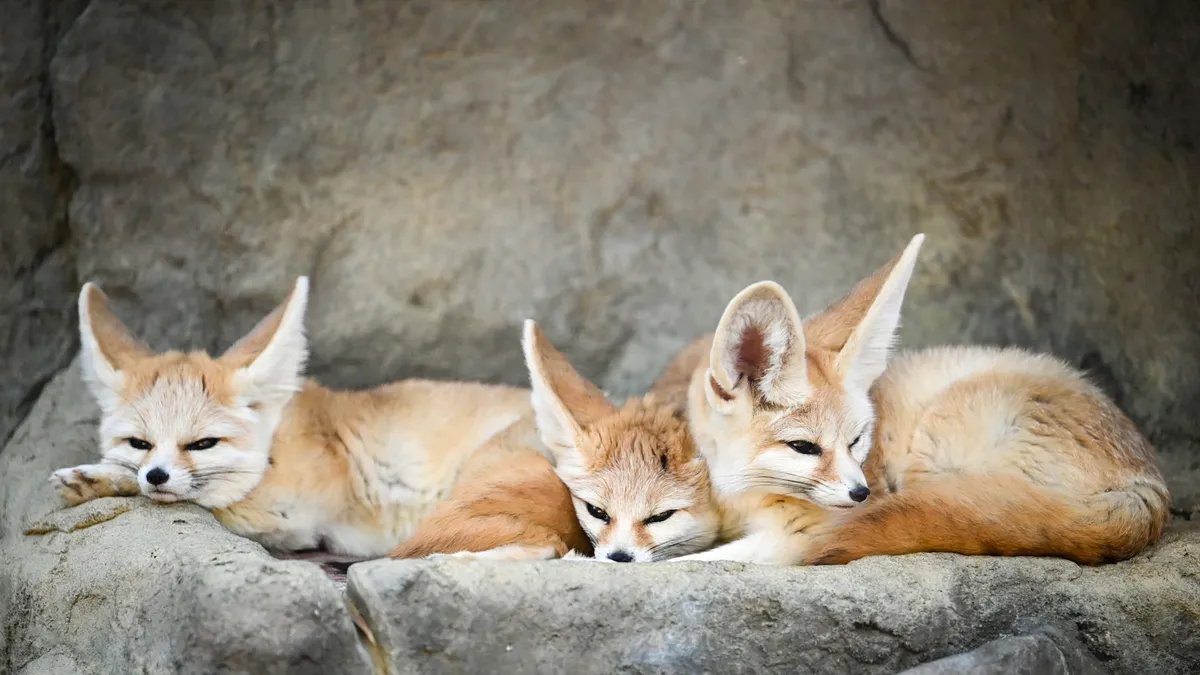

The fennec fox is the smallest fox in the world, a pale, big-eared desert animal that looks almost too delicate for the Sahara it calls home. Its scientific name is Vulpes zerda, and it is best known for ears that can reach 15 centimetres long on a body barely bigger than a house cat. Those ears are not just for show: they help the fox hear prey moving underground and let heat escape from its body in one of the hottest places on Earth. This guide explains where the fennec fox lives, what it eats, how it behaves and how it survives in the desert.
Fennec foxes live in the sandy deserts of North Africa, from Morocco and Algeria across to Egypt, and in parts of the Arabian Peninsula. They are nocturnal, spending the fierce heat of the day asleep in cool underground burrows and emerging at night to hunt. They live in small family groups, dig burrows with several entrances, and are remarkably well adapted to a life with very little water.
Key takeaways
- The fennec fox is the smallest fox species, weighing around one to one and a half kilograms.
- Its ears can reach 15 centimetres long, helping it hear prey underground and release body heat.
- It lives in the Sahara and other sandy deserts of North Africa and the Arabian Peninsula.
- Fennec foxes are nocturnal, sheltering in burrows by day and hunting at night.
- They eat rodents, birds, eggs, reptiles and insects, and get most of their water from food.
- They are listed as Least Concern, but habitat loss and the pet trade are pressures to watch.
What a fennec fox looks like
A fennec fox weighs around one to one and a half kilograms and measures roughly 24 to 41 centimetres in body length, with a tail of a similar length that is often carried with a dark tip. Its coat is pale sandy or cream coloured, which blends into the desert sand and reflects the sun’s heat, and its belly is lighter still. The fur is thick and soft, keeping the fox warm on cold desert nights, when temperatures can fall sharply after sunset.
The ears are the animal’s most famous feature. At up to 15 centimetres long, they are the largest ears relative to body size of any fox, and they serve two purposes. First, they act as radiators: blood vessels in the thin ears release heat into the air, helping the fox stay cool. Second, they give the fox exceptionally sharp hearing, so it can detect the faint sounds of rodents and insects moving beneath the sand. The soles of its feet are covered in thick fur, which protects them from hot sand and helps the fox walk on loose dunes without sinking.
Habitat and range
Fennec foxes live in sandy deserts and semi-deserts, where loose sand is deep enough to dig in. The Sahara is their stronghold, but they also occur in the Sinai Peninsula and in the deserts of the Arabian Peninsula. They avoid rocky ground and dense vegetation, because both make burrowing difficult and hunting harder. Within their range they prefer stable sand dunes and sandy plains, often near sparse desert plants that attract the small animals they hunt.
The desert is a demanding home. Daytime temperatures in the Sahara can pass 40 degrees Celsius, while nights can be cold, and water is scarce. The fennec fox copes by being nocturnal and by living underground: its burrow stays far cooler than the surface during the day and warmer at night. Burrows are dug into the sand, often at the base of a dune or a shrub, and a family burrow can have several entrances and chambers.
Behaviour and social life
Fennec foxes are social animals, which sets them apart from many other fox species that live alone. They live in family groups, usually a mated pair with their young from the current year, and sometimes with older offspring that stay to help. Group members share a burrow system and communicate with a range of sounds, including barks, squeaks and purr-like noises. They also scent-mark their territory, and males may defend the area around the burrow from other males.
They are active mainly at night, when the desert cools and their prey is out. During the day they rest in the burrow, often curled up with their long bushy tail wrapped around their body like a blanket. They are agile and quick, able to change direction suddenly while chasing prey. When threatened, a fennec fox will usually run for its burrow rather than fight, and its pale coat makes it hard to spot against the sand.

What fennec foxes eat
Fennec foxes are omnivores, eating whatever the desert provides. Their main prey is small rodents, especially gerbils, which they locate by hearing them move under the sand and then dig out with their paws. They also eat birds and their eggs, lizards and other small reptiles, insects and other invertebrates, and they will eat fruit, roots and leaves when animal prey is scarce. This flexible diet is part of what lets them survive in a place where food is never plentiful.
Water is the desert’s scarcest resource, and fennec foxes need very little of it. They get most of the moisture they need from their food, and their kidneys are efficient at conserving water. They can go for long periods without drinking at all, which is one reason they thrive in the deep desert, far from the waterholes that other animals depend on.
Breeding and raising young
Fennec foxes usually mate for life, and breeding takes place once a year. After a gestation of around seven weeks, the female gives birth to a litter of two to five kits in a chamber deep inside the burrow. The kits are born blind and helpless, with their eyes opening after about ten days. The male brings food to the female while she stays with the young, and both parents care for the kits as they grow.
The young start to explore outside the burrow at around a month old, and they are weaned at roughly two to three months. They stay with their parents for much of their first year, learning to hunt and to find shelter. In the wild, fennec foxes live for about a decade, while in captivity, with regular food and veterinary care, they can live into their early teens.
| Feature | Fennec fox | Red fox |
|---|---|---|
| Weight | Around 1 to 1.5 kilograms | Around 5 to 7 kilograms |
| Body length | 24 to 41 centimetres | 45 to 90 centimetres |
| Ear length | Up to 15 centimetres | Up to 10 centimetres |
| Habitat | Sandy deserts of North Africa | Forests, grassland and towns worldwide |
| Activity | Mainly nocturnal | Active day and night |
| Social life | Family groups | Usually solitary or in pairs |
Conservation and the pet trade
The fennec fox is listed as Least Concern by the International Union for Conservation of Nature, which means it is not currently considered at immediate risk of extinction. Its range is large, and it is still found across much of the Sahara. But that status should not be mistaken for safety. Desert habitats are under pressure from development, roads and disturbance, and the fox’s small size and appealing looks have made it popular in the exotic pet trade.
Keeping a fennec fox as a pet is a serious commitment that most people are not prepared for. They are wild animals, not domesticated ones: they are nocturnal, they dig, they scent-mark, they need a specialised diet and a great deal of space, and they can be difficult to handle. In many places, keeping one requires a licence, and in some it is not allowed at all. Anyone considering it should check local laws first. For most people, the best way to enjoy fennec foxes is to watch them in the wild or in a reputable zoo.
A checklist for spotting a fennec fox in the wild
Seeing a fennec fox in the wild takes patience, because they are small, nocturnal and well camouflaged. Use this checklist if you are travelling in their range.
- Go out at dusk or at night, when fennec foxes leave their burrows to hunt.
- Look in sandy desert with loose dunes, not rocky ground or dense scrub.
- Listen for movement: fennec foxes often hear prey before you see them.
- Watch for large ears silhouetted against the sky, which are visible from a distance.
- Use a red-filtered torch if you search at night, so you do not dazzle the animals.
- Keep your distance and stay quiet: a startled fox will run for its burrow and may not return.
- Never try to feed a wild fox, and never approach a burrow with young inside.
- Travel with a local guide who knows where family groups are active.
Frequently asked questions
How big is a fennec fox?
A fennec fox weighs around one to one and a half kilograms and measures roughly 24 to 41 centimetres in body length, with a tail of similar length. It is the smallest fox species in the world, about the size of a small house cat, and its ears can reach 15 centimetres long. For more on the wider fox family, see the San Diego Zoo’s fennec fox page.
Why does the fennec fox have such large ears?
The ears serve two purposes. They act as radiators, releasing heat from the blood vessels in the thin skin and helping the fox stay cool in the desert. They also give the fox exceptionally sharp hearing, so it can detect rodents and insects moving beneath the sand, which it then digs out with its paws.
Where do fennec foxes live?
Fennec foxes live in the sandy deserts of North Africa, including the Sahara, and in parts of the Arabian Peninsula. They prefer loose, sandy ground where they can dig burrows, and they avoid rocky areas and dense vegetation. They are nocturnal, sheltering in burrows during the heat of the day and hunting at night.
What do fennec foxes eat?
They are omnivores. Their main prey is small rodents such as gerbils, and they also eat birds, eggs, lizards, insects and other invertebrates. When animal prey is scarce, they eat fruit, roots and leaves. They get most of the water they need from their food and can go for long periods without drinking.
Are fennec foxes good pets?
They are wild animals, not domesticated pets, and they make demanding companions. They are nocturnal, they dig, they scent-mark, and they need a specialised diet and a great deal of space. In many places a licence is required to keep one. Most people are better off enjoying them in the wild or in a reputable zoo.
How long do fennec foxes live?
In the wild, fennec foxes live for about a decade. In captivity, with regular food and veterinary care, they can live into their early teens. Young foxes stay with their parents for much of their first year, learning to hunt and to find shelter, and some remain with the family group as helpers.
The bottom line
The fennec fox is a small animal with an outsized character: the tiniest fox in the world, with the largest ears, making a living in one of the harshest places on Earth. Its burrows, its night-time hunting, its family groups and its ability to survive on almost no water all show how finely it is tuned to the desert. It is not endangered, but it deserves respect, both as a wild animal and as a reminder that even the most forbidding landscapes are full of life. For more on animals and the wild, read our guide to the artificial zoo, our article on Saguaro National Park, and our guide to whether dogs can have avocado.