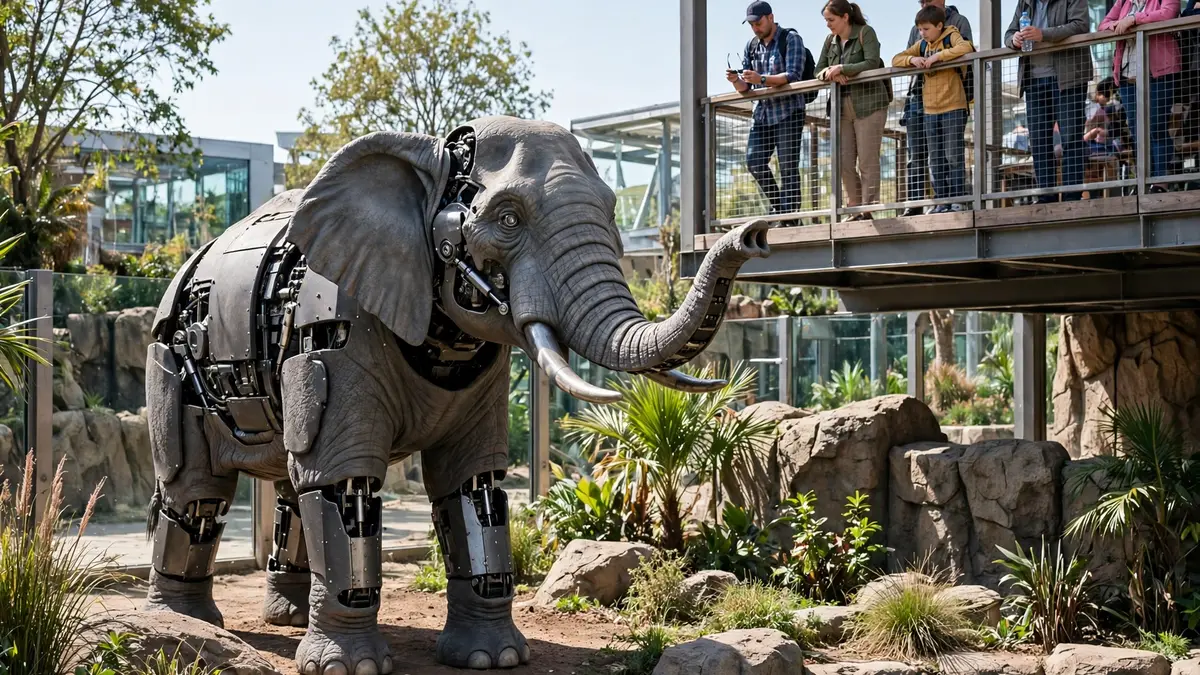

An artificial zoo is a wildlife attraction that shows animals without keeping live animals in enclosures, using holograms, animatronic robots, virtual reality and other technology instead. If you are wondering whether an artificial zoo is a real place you can visit, a kind of museum, or simply a clever name for a video game, the short answer is that it is a real, walk-through attraction, and several now operate in cities around the world. Visitors walk through themed rooms and tunnels, watch life-sized digital or mechanical animals move and feed, and learn about wildlife without any animal being held in captivity.
The idea is still young, and the attractions differ a great deal: some are built around laser holograms, some around life-sized robots, and some around headsets that place you inside a computer-made savannah. This guide explains what an artificial zoo is, how the main types work, where the best-known examples are, and how the experience compares with a traditional zoo.
Key takeaways
- An artificial zoo shows animals through technology rather than keeping live animals.
- The main types are hologram zoos, robotic and animatronic zoos, virtual reality zoos and augmented reality zoos.
- The first large hologram zoo opened in Brisbane, Australia, in 2023.
- Visits are usually short, often around half an hour to an hour for the main experience.
- No live animals are kept, so there are no enclosures, feeding times or welfare questions about captivity.
- An artificial zoo works best as a complement to nature and wildlife films, not as a replacement for seeing real animals.
What an artificial zoo actually is
An artificial zoo is best understood as a technology-based wildlife attraction. Instead of live animals in enclosures, it presents animals through one or more of four methods: projected holograms, mechanical robots, computer-generated virtual worlds, or digital animals overlaid on the real room through augmented reality. The common thread is that the animals you see are made, not kept. Nothing in the building needs feeding, cleaning or veterinary care, and no animal is confined so that visitors can look at it.
That definition covers a wide range of places. At one end sit the hologram tunnels, where you walk through darkened corridors while laser projectors and special screens create life-sized animals that appear to swim, run or fly around you. At the other end sit simple statue parks, where life-sized models of animals stand outdoors and families walk among them. In between are animatronic exhibitions, where mechanical animals breathe, blink and move their heads, and virtual reality experiences, where a headset takes you into a digital habitat. Some venues combine several of these in one ticket.
How the main types work
Hologram zoos are the best known form. Visitors wear polarised or position-tracked 3D glasses and walk through tunnels lined with screens. Laser projectors throw a slightly different image to each eye, and the system tracks where you are standing, so your brain joins the two images into one three-dimensional scene. The animals appear to float in the air around you, and some venues add wind, temperature changes, scent and surround sound. The sense of scale is convincing: a life-sized whale or elephant passing close by feels large in a way a television picture never does.

Robotic and animatronic zoos work in the opposite way: the animal is a physical object in the room with you. Motors, joints, sensors and programmed movements let a mechanical animal turn its head, open its mouth, breathe and walk in place. The best-known example is the robotic dolphin built by the special effects firm Edge Innovations, which swims in real water and is steered by a human operator. The appeal is presence: you can walk around the animal and see it from every side, which no screen can offer.
Virtual reality zoos replace the room rather than the animal. You put on a headset, and the world around you becomes a computer-made habitat, a savannah, a reef or a rainforest, with animals moving through it. Some real zoos have added virtual reality as an extra, such as a gorilla trek experience. Augmented reality works differently again: you look at the real room through a visor or a phone screen, and digital animals are added on top of it, so you can still see your family while a digital creature stands beside you.
Where artificial zoos exist
The modern wave began in Brisbane, Australia, where Axiom Holographics opened what is widely described as the first large hologram zoo in 2023. Its tunnels run through themed worlds, including an African savannah, Arctic ice, Australian wildlife and dinosaurs, and the format has since been copied in other Australian cities and licensed abroad. Similar attractions have since appeared in the United States, Canada, Europe, Mexico, Turkey and India, with new venues announced regularly, so a city near you may already have one or be about to get one.
In the United States, Zoocade in Austin, Texas, became the first major hologram zoo in the country, offering a walk of around half an hour through projected habitats. Niagara Falls has its own hologram zoo, aimed at tourists who want an indoor option alongside the falls. Copenhagen has a hologram zoo in Europe, and Istanbul has DigiZoo, which mixes holograms with virtual reality and educational zones about climate. Mexico City hosts a Latin American version with African and other themed worlds. A large new venue, Holozoo Miami, has been announced for Coconut Grove in Florida, with several themed zones and a large indoor footprint.
Artificial zoo compared with a traditional zoo
The honest comparison starts with what each one does well. A traditional zoo shows living animals, and nothing artificial can match the feeling of watching a real animal behave in ways nobody programmed. A real zoo also supports conservation breeding, research and rescue work, which a hologram cannot do. An artificial zoo, on the other hand, can show animals that no zoo could keep: blue whales, dinosaurs, extinct species and animals from habitats too fragile or remote to recreate. It can also show the same animal in several habitats in a single visit, and it raises no questions about captivity, enclosure size or animal welfare.
| Feature | Artificial zoo | Traditional zoo |
|---|---|---|
| Animals shown | Digital, robotic or projected animals | Live animals in enclosures |
| Species possible | Any, including whales and dinosaurs | Only species that can be kept safely |
| Typical visit length | Often half an hour to an hour | Usually half a day or more |
| Weather | Indoors, so weather does not matter | Mostly outdoors, so weather matters |
| Animal welfare | No live animals, so no captivity | Depends on the zoo and its standards |
| Learning | Guided digital scenes and facts | Live behaviour, keepers and signs |
What a visit is like, and who it suits
A typical hologram zoo visit starts with 3D glasses and a walk through a dark tunnel. The first animals are usually the showpieces: elephants, lions or whales shown at life size, with sound and light doing much of the work. Later rooms change habitat, so you might move from savannah to ocean to Arctic ice in a few minutes. Some venues add interactive zones where children can feed digital fish, trigger an animal’s movement or step into a virtual reality chamber. The pace is set by the group ahead of you, and the whole route is usually step-free and indoors.
Children tend to enjoy artificial zoos most, especially between the ages of about five and twelve, when the scale and spectacle carry the experience. Teenagers and adults often enjoy it too, but their reaction depends on what they expect: if you go looking for a wildlife documentary you can walk through, you will probably be pleased, and if you go expecting a real zoo, you may feel short-changed. People who dislike 3D glasses or dark rooms may find a hologram tunnel tiring, so check the venue’s guidance on age and motion sensitivity before booking.
Your artificial zoo checklist
Use this list before you book, so the visit matches what you expect.
- Check which format the venue uses: hologram tunnel, robots, virtual reality or a mix.
- Confirm whether the venue is permanent or a touring exhibition with a closing date.
- Look up the length of the main experience, so you can plan the rest of your day.
- Check age guidance for headsets and 3D glasses, especially for young children.
- Ask whether glasses are provided or whether you need to bring your own.
- Book timed tickets in advance where the venue asks for them, as sessions can sell out.
- Check step-free access, seating and rest areas if anyone in your group needs them.
- Read the venue’s own description of the animals and habitats on show, not just the headline.
- Plan for a short visit, and pair it with another attraction nearby if you want a full day out.
- Talk with children afterwards about what was real and what was made, so the visit teaches as well as entertains.
Frequently asked questions
What is an artificial zoo?
An artificial zoo is a wildlife attraction that shows animals through technology, such as holograms, animatronic robots, virtual reality or augmented reality, rather than keeping live animals in enclosures. Visitors walk through themed rooms or wear headsets, and the animals they see are digital or mechanical.
Are there any real animals in an artificial zoo?
Usually there are none. That is the point of the format: the animals are projections, robots or computer-made images, so no live animal is kept in captivity. Some venues sit inside a larger attraction that does have live animals, so it is worth checking the details of the place you plan to visit.
Where was the first hologram zoo?
The first large hologram zoo is widely credited to Brisbane, Australia, where Axiom Holographics opened its Hologram Zoo in 2023. Similar venues have since opened in the United States, Canada, Europe, Mexico, Turkey and India, and more are announced regularly.
How long does an artificial zoo visit take?
It depends on the format, but the main hologram walk is often around half an hour, and a full visit with interactive zones and virtual reality extras may take an hour or so. That is shorter than a traditional zoo visit, so many visitors pair it with another attraction on the same day.
Is an artificial zoo good for children?
Many children enjoy it a great deal, especially the life-sized animals and the chance to walk through changing habitats. Check the venue’s age guidance first, since 3D glasses and virtual reality headsets are not suitable for very young children, and some children find dark tunnels or loud sound effects unsettling.
Is an artificial zoo better than a real zoo?
It is different rather than better. An artificial zoo can show whales, dinosaurs and extinct animals, and it raises no captivity questions, but it cannot show real animal behaviour or support conservation breeding. Many people get the most from treating the two as complements: the artificial zoo for spectacle and imagination, and the real zoo, wildlife park or nature reserve for living animals.
The bottom line
An artificial zoo is a real attraction built on a simple idea: show the wonder of wildlife without keeping animals in enclosures. Hologram tunnels, animatronic animals and virtual reality each do that in a different way, and the best visits are the ones where you know which format you are buying before you arrive. Go for the spectacle, then balance it with the real thing, whether that is a wildlife park, a nature reserve or a good documentary. For more ideas for days out, see our guide to Saguaro National Park, our round-up of the best places to visit in Norway, and our guide to the best places to visit in spring.