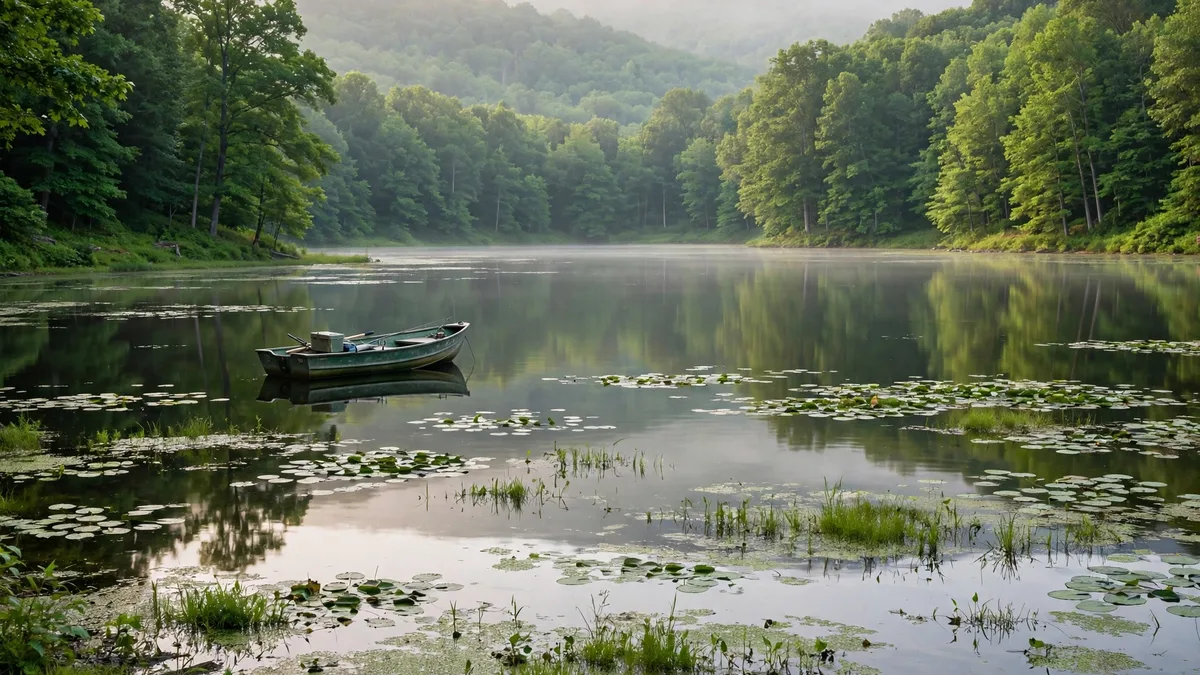

Anna Lake invasive species are a real concern for anyone who fishes, boats or swims on Lake Anna in Virginia, and hydrilla is the plant that comes up most often. Hydrilla is a fast-growing underwater weed that forms dense mats, tangles propellers, crowds out native plants and changes the habitat that fish depend on. Virginia has funded hydrilla control on Lake Anna for years, alongside work on Lake Gaston and Smith Mountain Lake, because the plant interferes with recreation and damages fish and wildlife habitat.
Lake Anna is a large reservoir in central Virginia, built to supply cooling water for the North Anna power station, and it is one of the most heavily used lakes in the state, with homes, marinas, public ramps and a busy fishing scene. This guide explains which invasive species are documented in the lake, which ones are a concern in Virginia waters more broadly, how they spread, and what lake users can do to help.
Key takeaways
- Hydrilla is the invasive species most associated with Lake Anna.
- Virginia has funded hydrilla control on the lake for years.
- Zebra mussels have not been recorded in Lake Anna, according to monitoring.
- Other invaders, such as Eurasian watermilfoil, are found in Virginia waters generally.
- Boats, trailers and bait buckets are the main ways species move between lakes.
- Cleaning, draining and drying a boat after use is the simplest defence.
What makes a species invasive
A species counts as invasive when it arrives from somewhere else, establishes itself, and causes harm to the environment, the economy or recreation. Not every non-native species qualifies: many introduced plants and animals settle in quietly and cause no trouble. The problem species are the ones that spread fast, outcompete native life, and change the habitat around them.
In a lake, the damage takes several forms. Submerged weeds such as hydrilla grow into thick mats that block sunlight, reduce oxygen in the water, and make it hard for fish to hunt and for boats to move. They also give mosquitoes somewhere to breed, and they can clog water intakes. Fish and shellfish invaders change the food web instead, eating native species or filtering out the plankton that young fish depend on.
Lakes are especially vulnerable because water connects everything. A fragment of weed caught on a trailer, a bucket of bait water tipped into a new lake, or an aquarium plant dumped at a boat ramp can all start a new infestation. Once a submerged plant is established across a large reservoir, removing it entirely is rarely possible, and the work turns into long-term management instead.
Hydrilla in Lake Anna
Hydrilla is a submerged plant with whorled leaves and toothed edges, and it grows with remarkable speed in warm, nutrient-rich water. It spreads by fragments: a single stem broken off by a propeller can drift away, take root and start a new bed. In Lake Anna it has been a management concern for years, and Virginia budget measures have repeatedly set aside money for hydrilla control on the lake, describing the plant as one that interferes with recreation, destroys fish and wildlife habitat and can affect water delivery systems.
Control work on the lake is organised around a hydrilla management plan drawn up with the Lake Anna Advisory Committee, and local reports describe contractors treating areas identified by residents and lake surveys, with the stated aim of management rather than eradication. That distinction matters, because hydrilla also provides cover for fish and filters the water, so the goal is to keep it at levels that allow boating, swimming and fishing without stripping the lake of habitat altogether.
For lake users, hydrilla shows itself as dense green growth just below the surface, especially in shallow coves and along shorelines. It tangles fishing lines, fouls propellers and makes swimming unpleasant. If you find your propeller wrapped in weed, stop and clear it by hand rather than powering through, since chopping the plant into pieces only spreads it further.
Other species to know about
Hydrilla is the documented problem in Lake Anna, but it is not the only invader in Virginia waters, and knowing the wider cast helps you recognise trouble early. Eurasian watermilfoil is another submerged plant found in lakes and reservoirs across the state, forming the same kind of dense mats as hydrilla. Curlyleaf pondweed is also widespread in Virginia lakes, and water chestnut, a floating plant with spiny nuts, is found in tidal rivers and ponds, including tributaries of the Chesapeake.
Among animals, the zebra mussel is the one that worries lake managers most, because it attaches to pipes, boats and docks in dense colonies and filters plankton out of the water, starving native fish and mussels. It has been recorded in Virginia waters, but it has not been observed in Lake Anna: monitoring reported by the lake’s operator has consistently found no zebra mussels there. The related quagga mussel has been detected in some Virginia waters and is being monitored.
Fish invaders include the northern snakehead, a predatory fish found in the Potomac and some tidal waters, and the common carp, which is established in lakes and slow rivers across the state. The Asian clam, a small freshwater shellfish, is also found in rivers and lakes statewide. None of these is documented as a Lake Anna problem, but they illustrate how easily species move once they reach a connected waterway.
| Species | Where it is found | What it does |
|---|---|---|
| Hydrilla | Documented in Lake Anna | Forms dense mats that tangle boats and crowd out natives |
| Eurasian watermilfoil | Lakes and reservoirs across Virginia | Grows into thick beds that block light and hinder boating |
| Curlyleaf pondweed | Lakes and reservoirs across Virginia | Spreads early in the season and dies back in summer |
| Water chestnut | Tidal rivers and ponds in Virginia | Floats in dense mats and produces spiny nuts |
| Zebra mussel | Virginia waters, but not recorded in Lake Anna | Clogs pipes and docks and filters out plankton |
| Northern snakehead | Potomac and some tidal waters | A predatory fish that eats native fish and frogs |
How invasive species spread between lakes
Boats and trailers are the main carriers. Weed fragments catch on propellers, bunks, rollers and anchor lines, and a fragment that survives a drive to another lake can start a new bed. Bilge water, live wells and bait buckets carry microscopic larvae, seeds and small animals, and wet fishing gear can move species just as effectively as a boat can.
People move species in other ways too. Aquarium plants and animals are sometimes released into lakes when owners no longer want them, and bait bought in one place is sometimes carried to another and tipped out at the end of the day. Water gardens and ornamental ponds can also be a source when plants escape into nearby waterways after heavy rain.
The pattern is always the same: a species that is harmless in its home range finds a lake with no natural enemies, plenty of food and the right temperature, and spreads faster than anyone expects. Early detection is the best defence, because a small patch found in spring is far easier to deal with than a mat covering a cove by August.

What lake users can do
The simplest habit is clean, drain and dry. Before leaving a boat ramp, remove all visible plants from the boat, trailer and propeller, drain bilge water, live wells and bait buckets away from the water, and let the boat dry thoroughly before the next launch. Drying is the part people skip, but several days of drying kills most of what a quick rinse misses.
Anglers can help by not moving bait between waters and by disposing of unused bait on land, well away from the shore. Boaters should avoid driving through dense weed beds, since propellers chop plants into fragments that spread. If you keep a boat in the water, check the hull and the waterline regularly for anything attached that does not belong there.
Homeowners on the lake can help by not planting invasive species in water gardens, by keeping fertiliser use down, since excess nutrients feed weed growth, and by reporting new patches of unfamiliar weed to the Virginia Department of Wildlife Resources or the Department of Agriculture and Consumer Services. A photograph, a location and a date make a report far more useful than a vague description.
Your Lake Anna checklist
Use this list every time you visit the lake.
- Learn to recognise hydrilla and the other plants in the table above.
- Inspect the boat, trailer and propeller before and after launching.
- Remove all visible weed fragments and put them in a bin, not back in the water.
- Drain bilge water, live wells and bait buckets away from the lake.
- Let the boat and gear dry fully before the next launch.
- Do not move bait or bait water between lakes.
- Do not release aquarium plants or animals into the lake.
- Avoid driving through dense weed beds.
- Report unfamiliar weed patches with a photo and a location.
- Keep fertiliser use low near the shoreline.
Frequently asked questions
What invasive species are in Lake Anna?
Hydrilla is the invasive species most associated with Lake Anna, and Virginia has funded control work on the lake for years. Zebra mussels have not been recorded in the lake, according to monitoring reported by the lake’s operator. Other invaders are found in Virginia waters generally, but are not documented as Lake Anna problems.
What is hydrilla?
Hydrilla is a fast-growing submerged plant with whorled, toothed leaves. It forms dense mats below the surface that tangle propellers, block sunlight, reduce oxygen and crowd out native plants. It spreads by fragments, so a single stem broken off by a boat can start a new bed.
Can hydrilla be removed from a lake?
Complete removal from a large reservoir is rarely possible, and the work on Lake Anna is framed as management rather than eradication. Control involves treating areas identified by residents and surveys, with the aim of keeping the plant at levels that allow boating, swimming and fishing.
Are zebra mussels in Lake Anna?
No, as far as monitoring shows. Zebra mussels have been recorded in Virginia waters, but monitoring reported by the lake’s operator has consistently found none in Lake Anna. Boaters should still clean and dry their boats, since the mussels spread easily between lakes.
How do invasive species reach a lake?
Mostly on boats and trailers, in bilge water, live wells and bait buckets, and on wet fishing gear. Aquarium releases and bait moved between waters are other routes. A fragment of weed or a bucket of water is all it takes to start a new infestation.
What should I do if I find an unfamiliar plant in the lake?
Do not pull it out and throw it back in the water, since fragments spread. Note the location, take a photograph, and report it to the Virginia Department of Wildlife Resources or the Department of Agriculture and Consumer Services.
The bottom line
Anna Lake invasive species come down to one clear story: hydrilla is the plant that matters most in Lake Anna, Virginia has spent years managing it, and the lake’s users are the first line of defence against the next arrival. Clean, drain and dry your boat, do not move bait or aquarium plants between waters, and report anything unfamiliar with a photo and a location. For more on life around water, see our guide to the best aquarium fish for beginners, our composting dos and don’ts, and our guide to Saguaro National Park.