The dumbbell overhead press for shoulders is one of the most effective exercises for building strong, well-shaped shoulders, and it is a staple of almost every upper-body programme. It trains the deltoids, the three-headed muscles that cap the shoulder, along with the triceps, the upper trapezius, and the core.
Done well, the dumbbell overhead press shoulders routine builds size, strength, and stability in a single movement. Done badly, it puts the shoulders and the lower back in compromised positions. This guide covers the form step by step, the muscles worked, seated versus standing, and the mistakes to avoid.
Key takeaways
- The dumbbell overhead press mainly trains the front and middle deltoids, with help from the triceps, upper traps, and core.
- Start with dumbbells at shoulder height, palms forward, elbows slightly in front of the body.
- Press straight overhead, keep the core braced, and lower the weights slowly and under control.
- Standing presses demand more core and balance, while seated presses let you lift heavier with more control.
- Warm up first, start light, and stop if you feel sharp pain in the shoulder.
What the dumbbell overhead press trains
The shoulder press is the most effective exercise for building overall mass in the shoulders, and the dumbbell version has advantages that a barbell cannot match. Each arm works on its own, so a stronger side cannot carry a weaker one, and the dumbbells allow a more natural path overhead than a fixed bar. The result is balanced development and a freer range of motion.
The deltoids have three heads: the anterior or front deltoid, the middle or lateral deltoid, and the posterior or rear deltoid. When you press overhead, the front and middle heads do most of the work, with the middle head contributing more as the arms move out to the sides. Elbow position changes the emphasis: elbows pointed out to the sides work the middle deltoid more, while elbows in front of the body emphasise the front deltoid.
The supporting cast matters too. The triceps extend the elbows to finish the press at the top, the upper trapezius supports the shoulder blades as the arms move overhead, and the core and upper back brace the torso so you can press a load overhead without losing position.
Best for: building the whole shoulder — front and middle deltoids, with triceps, traps, and core working as support.
How to do the dumbbell overhead press
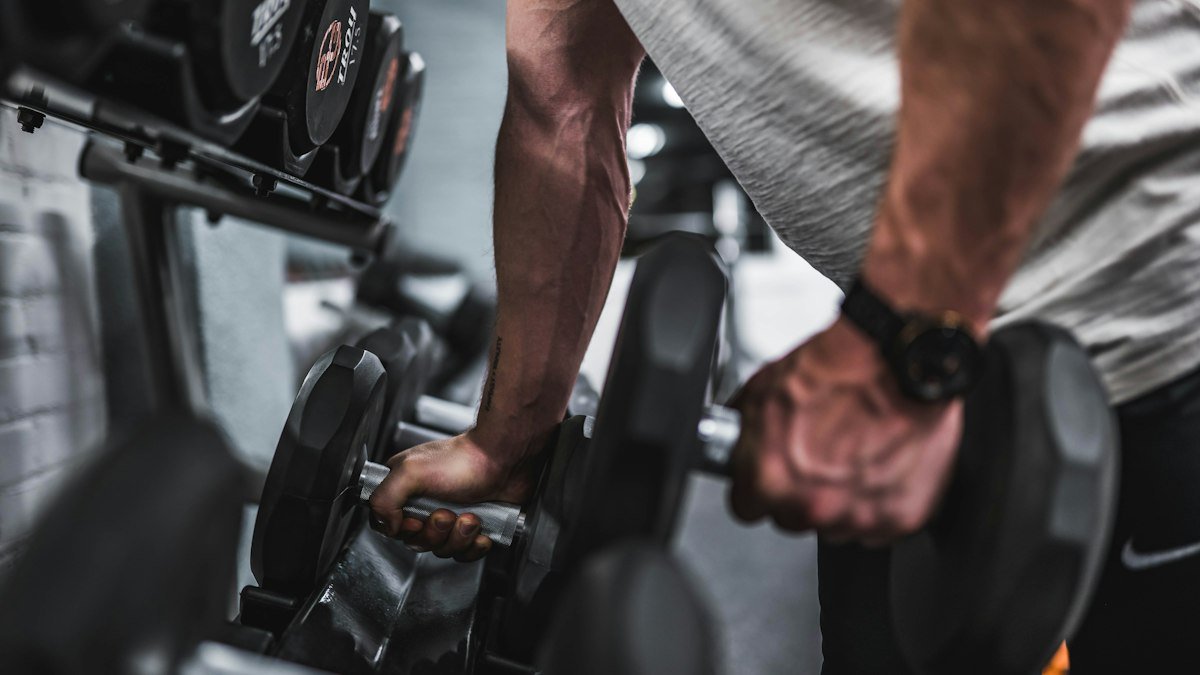
Start by getting the weights into position safely. Stand with your feet about hip width apart and pick up a dumbbell in each hand, either from the rack or from the floor with a straight back and bent knees. Bring the dumbbells to shoulder height with a controlled curl, then rotate your arms until your palms face forward and your elbows point down and slightly forward, roughly under your wrists.
Brace before you press. Pull your ribs down, squeeze your glutes, and keep a tall, neutral spine, so your shoulders do the work instead of your lower back. Take a breath, then drive both dumbbells straight up overhead, keeping your hands directly above your elbows. As the weights pass over your head, let them drift slightly toward each other, finishing nearly touching but not banging together, with your biceps near your ears.
Stop just short of a hard elbow lockout at the top, then lower the weights slowly back to shoulder height on a slow count, keeping tension through the full range. The lowering phase matters as much as the press: dropping the weights fast wastes the work and jars the shoulders.
Best for: beginners and regular lifters alike — the same steps work at any weight, so learn the pattern light before you load it heavy.
Seated or standing: which is better
Standing presses are the classic version, and they ask more of the whole body. Your legs stay slightly bent throughout the set, your core stays engaged, and your glutes help connect your lower body to the press. The standing version is often kinder to the lower back than people expect, because the legs can absorb some of the load, but it is also easier to lean back and turn the press into a chest movement if the weight is too heavy.
Seated presses let you lift more weight and place more overload on the deltoids, because the bench removes balance from the equation. Sit on a bench with back support, keep your feet flat on the floor, and press with the same form as standing. The trade-off is that the bench takes the core and legs out of the movement, so the shoulders do more of the work in isolation, which is exactly what some lifters want.
Neither version is wrong, and most good programmes use both. Standing presses suit full-body days and general strength, while seated presses suit days when the shoulders are the focus and you want to load them hard. If you have lower-back trouble, seated with back support is usually the safer starting point.
Best for: most lifters — standing for full-body strength and balance, seated for heavier shoulder work with back support.
Common mistakes to avoid
The most common mistake is arching the lower back to finish the press. When the weight is too heavy, lifters lean back and let the spine do the work, which loads the lower back and takes the shoulders out of the movement. If your back arches, the weight is too heavy: squeeze your glutes, pull your ribs down, and drop to a weight you can press without leaning.
The second mistake is flaring the elbows too far back or pressing with the wrists bent. Keep your elbows slightly in front of the body and your wrists stacked over your elbows, so the force travels in a straight line. Bent wrists under load are a fast route to sore wrists, and they make the press feel heavier than it is.
The third mistake is rushing the lowering phase or bouncing out of the bottom. The press should be smooth in both directions, with a brief pause at the top and a controlled descent of two to three seconds. A fourth mistake is starting too heavy, which is how most shoulder injuries begin.
Best for: staying injury free — a braced core, stacked wrists, and a slow lowering phase protect the shoulders on every rep.

Variations worth trying
The Arnold press is the best-known variation, named after Arnold Schwarzenegger. It starts with the dumbbells at shoulder height and your palms facing you, then rotates your wrists outward so your palms face forward as you press to the top. The rotation adds range of motion and works the front deltoid through a longer path, and it suits lifters who find the standard press hard on their shoulders.
The single-arm press is the best choice for balance and core work. Press one dumbbell at a time while the other rests at your shoulder, and your core must work hard to keep your torso upright. It also lets you spot a strength difference between your left and right sides. The neutral-grip press, with palms facing each other, is the gentlest on the shoulders.
The push press adds a small leg drive, bending the knees slightly and then driving up to help the weights overhead. It lets you lift more weight, but it is a different exercise from a strict press, and it should not replace strict pressing for most lifters.
Best for: variety with a purpose — the Arnold press for range of motion, single-arm for balance, and neutral grip for sensitive shoulders.
| Variation | How it differs | Best for |
|---|---|---|
| Standard press | Palms forward, both arms together | Overall shoulder size and strength |
| Seated press | Bench with back support | Heavier loading with more control |
| Arnold press | Palms rotate as you press | Extra range of motion and front deltoid work |
| Single-arm press | One arm at a time | Balance, core work, and fixing imbalances |
| Neutral-grip press | Palms facing each other | Gentler on sensitive shoulders |
| Push press | Small leg drive assists the lift | Overloading the top of the movement |
Your first session: a checklist
The dumbbell overhead press rewards a careful start. Work through the points below before your first set, and repeat them every session until they are habit.
- Warm up for five to ten minutes, including arm circles and light shoulder movements.
- Start with a light weight you can press for twelve controlled reps.
- Set your feet hip width apart, brace your core, and squeeze your glutes.
- Keep your elbows slightly in front of the body and your wrists stacked over them.
- Press straight overhead and lower slowly, taking two to three seconds on the way down.
- Stop if you feel sharp pain, and speak to a coach or clinician before training through it.
For more practical guides, the roundup of the best water bottles covers hydration for training, and the guide to the best tea brands is a good read for a calm drink after a session. The guide to the best thermoses for coffee keeps a hot drink warm on the way to the gym.
Frequently asked questions
What muscles does the dumbbell overhead press work?
It mainly works the front and middle deltoids, the muscles that cap the shoulder. The triceps extend the elbows at the top, the upper trapezius supports the shoulder blades, and the core and upper back stabilise the torso. The rear deltoid works as a stabiliser rather than a main driver.
Is the dumbbell overhead press good for shoulders?
Yes, it is one of the best exercises for shoulder size and strength, and it is a staple of most upper-body programmes. The dumbbell version has the advantage that each arm works on its own, so a stronger side cannot carry a weaker one.
Should I do the overhead press seated or standing?
Both work. Standing presses demand more core and balance and suit full-body strength days, while seated presses let you lift heavier with more control and suit days when the shoulders are the focus. If you have lower-back trouble, seated with back support is usually the safer starting point.
How many sets and reps should I do?
Three to four sets of eight to twelve repetitions is a good starting point for strength and shape. Pick a weight you can press for every rep with full control and no arch in your lower back, then add load gradually over weeks as the reps become easier.
Why do my shoulders hurt when I press overhead?
Common causes are a weight that is too heavy, elbows flared too far back, bent wrists, or a lack of warm-up. Drop the weight, check your form, and warm up properly. If pain is sharp or persistent, stop and speak to a qualified coach or clinician.
What is the Arnold press?
The Arnold press starts with the dumbbells at shoulder height and your palms facing you, then rotates your wrists outward so your palms face forward as you press to the top. It adds range of motion and works the front deltoid through a longer path, and it suits lifters who find the standard press hard on their shoulders.
The bottom line
The dumbbell overhead press for shoulders is a simple, powerful exercise: dumbbells at shoulder height, core braced, press straight overhead, and lower slowly. It builds the front and middle deltoids, with the triceps, traps, and core in support, and it works seated or standing, at any level, with a weight you can control.
Start light, warm up first, keep your core braced and your wrists stacked, and add weight only when every rep is clean. Please train safely: warm up before every session, stop if you feel sharp pain, and speak to a qualified coach or clinician if pain persists or you have an existing shoulder condition.