
A puppy vaccine schedule starts when a puppy is 6 to 8 weeks old, with the first core vaccines given as one combination shot, and repeats every 2 to 4 weeks until the puppy is at least 16 weeks old. The repeated doses are needed because antibodies from the mother protect a young puppy but also block vaccines, and they fade at different rates. This guide sets out the schedule recommended by the American Animal Hospital Association, explains which shots are core and which depend on lifestyle, and covers side effects and the first vet visit.
Key takeaways
- Core vaccines start at 6 to 8 weeks and repeat every 2 to 4 weeks until 16 weeks or older.
- The core combination shot covers distemper, adenovirus and parvovirus, often with parainfluenza.
- Rabies is given once, from 12 to 16 weeks, with timing set by local law.
- Leptospirosis became a core vaccine in the 2024 AAHA update: two doses from 12 weeks.
- Non-core vaccines, such as Bordetella and Lyme, depend on where the puppy lives and what it does.
- A puppy is not fully protected until about two weeks after the last dose.
What is a puppy vaccine schedule?
A puppy vaccine schedule is the timetable of injections that protects a puppy against the serious infectious diseases of dogs. Puppies are born with some protection from their mother, in the first milk, but that protection fades over the first weeks of life, and while it lasts it can stop a vaccine from working. That is why a single shot is not enough.
The schedule most vets follow in North America comes from the American Animal Hospital Association, whose canine vaccination guidelines were published in 2022 and updated in 2024, together with the 2024 guidelines of the World Small Animal Veterinary Association. The two agree on the shape of the schedule. Your vet will adapt it to your puppy, your area and the law where you live.
The core vaccines every puppy needs
Core vaccines are recommended for every dog, whatever its lifestyle, because the diseases they prevent are common, severe or a risk to people as well. For puppies, the core combination is usually given as one injection, known as DHPP or DAPP, which covers distemper, adenovirus, parvovirus and usually parainfluenza. Distemper attacks the lungs, gut and nervous system, and it is often fatal. Parvovirus causes severe vomiting and diarrhoea, and it is especially dangerous for young puppies.
Rabies is also a core vaccine, and the only one usually required by law. Rabies is fatal once symptoms appear, and it can pass to people. The first dose is given once, from 12 to 16 weeks of age, with the timing set by local law. A booster is given one year later, and then every one to three years.
Leptospirosis joined the core list in 2024, when the AAHA moved it from non-core to core for all dogs. It is a bacterial disease spread through water and soil contaminated with the urine of infected animals, and it can damage the kidneys and liver, and can pass to people. The puppy course is two doses, two to four weeks apart, from 12 weeks of age, with a booster within a year and then annually. Vaccination of dogs on Wikipedia explains the two groups.
The puppy vaccine schedule by age
The table below shows the usual schedule, based on the 2022 AAHA guidelines with the 2024 leptospirosis update and the 2024 WSAVA guidelines. A puppy that starts at eight weeks and returns every four weeks gets doses at 8, 12 and 16 weeks, while one that starts at six weeks and returns every three weeks needs more visits.
| Puppy’s age | Core vaccines | Also at this age |
|---|---|---|
| 6 to 8 weeks | First DHPP dose: distemper, adenovirus and parvovirus | First vet check and deworming |
| 10 to 12 weeks | Second DHPP dose | Bordetella if the puppy will meet other dogs |
| From 12 weeks | First leptospirosis dose | First rabies dose, from 3 months of age, as local law requires |
| 14 to 16 weeks | Third DHPP dose, and second leptospirosis dose | Second Lyme or influenza dose if started |
| 16 to 20 weeks | Extra DHPP dose if the last one was before 16 weeks | Start of safe socialisation outdoors |
| About 6 months | WSAVA booster at or after 26 weeks | Spaying or neutering, if planned |
| Within 1 year | Booster of DHPP, leptospirosis and rabies | Annual health check and a review of lifestyle vaccines |

Non-core vaccines: which puppies need them
Non-core vaccines are given only when a puppy’s lifestyle or location makes the disease a real risk, and your vet will decide with you. Bordetella, the main cause of kennel cough, is the most common: a single dose, given into the nose or by mouth, for puppies that will go to daycare, boarding kennels or training classes. Canine influenza is similar, with two doses two to four weeks apart. Lyme disease is a risk where ticks carry it, given as two doses.
The key point is that non-core does not mean unimportant. A puppy that goes to daycare every day needs Bordetella far more than one that rarely leaves its garden, and a puppy in a tick area needs Lyme protection that a city puppy does not. Tell your vet where the puppy will go and who it will meet, and let the vet build the non-core list around that.
What happens at the first vet visit
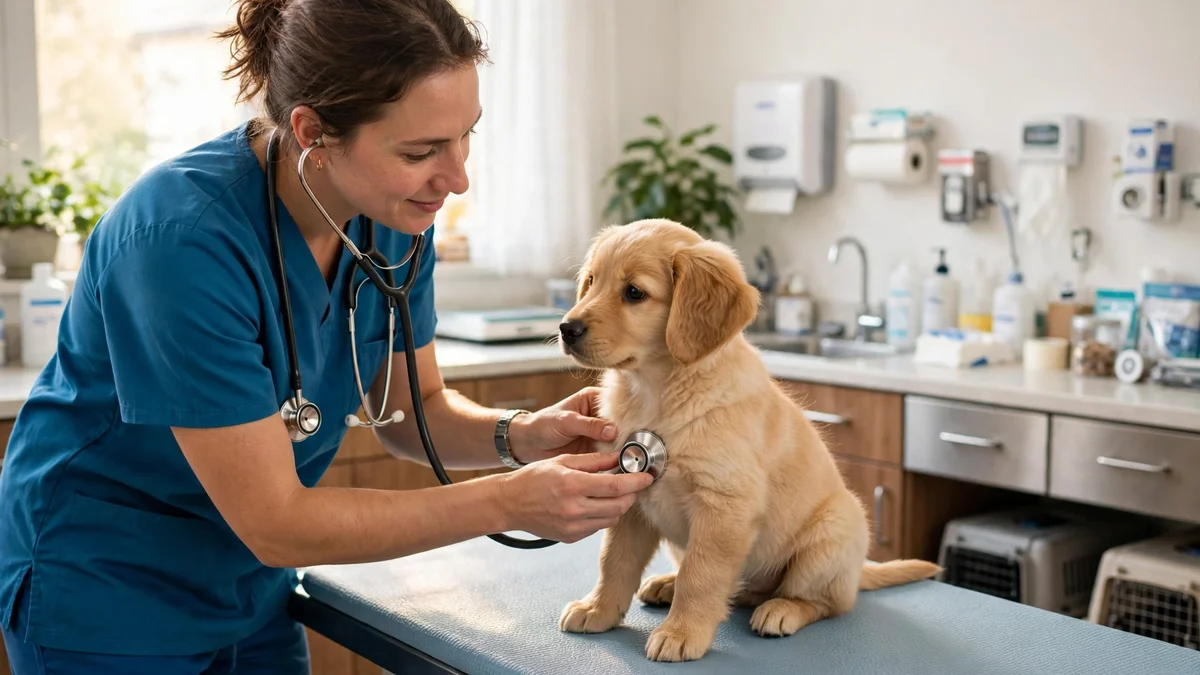
The first vet visit usually happens in the first week after a puppy comes home, and it is about far more than the first injection. The vet will weigh the puppy, listen to its heart and lungs, check its eyes, ears, teeth and coat, and look for parasites. Bring any paperwork from the breeder or rescue, including the dates of any vaccines or worming already given.
Deworming usually starts earlier than vaccination: the Companion Animal Parasite Council recommends worming at 2, 4, 6 and 8 weeks of age, then monthly until six months. Fleas and ticks are covered separately. The vet will also talk about feeding, toilet training, socialisation and microchipping, and will book the next visit.
Socialisation before the vaccines are finished
One of the hardest parts of the schedule is the wait. A puppy is not fully protected until about two weeks after the last dose, which means it is about 18 weeks old before it can safely walk in busy public places. But the weeks between 3 and 14 are the most important period for socialisation, when a puppy learns that the world is safe.
The answer is careful, controlled socialisation. Carry the puppy in your arms or in a sling through busy places, so it can see, hear and smell the world without walking in it. Let it meet healthy, vaccinated dogs that you know, in clean gardens rather than dog parks. Invite visitors to the house, and take the puppy on short car rides.
Side effects and what to watch for
Most puppies feel little more than a brief sting, and many show no reaction at all. The common side effects are mild and short-lived: soreness where the injection was given, a small lump under the skin, tiredness or a slight fever for a day or two.
Serious reactions are rare, but they need a fast response. Call your vet at once if the puppy’s face swells, if it develops hives, if it vomits repeatedly, or if it has difficulty breathing. These signs usually appear within minutes to a few hours of the injection, and they are treatable when caught early.
Records and boosters after the first year
Keep the vaccination record somewhere safe, and take a photograph of it as a backup. You will need it for boarding kennels, daycare, training classes, travel and pet insurance. After the first year, the core vaccines are boosted once, and then every three years. Rabies boosters follow the law, every one to three years, and leptospirosis is boosted annually.
A checklist for the first vet visit
- Book the first visit for the first week after the puppy comes home.
- Bring paperwork from the breeder or rescue, with the dates of any vaccines or worming already given.
- Ask which vaccines are core and which are non-core for your puppy’s lifestyle and area.
- Write down the date of the next visit before you leave, and set a reminder.
- Keep the vaccination record safe and photograph it as a backup.
- Ask about deworming, flea and tick treatment, feeding and microchipping.
- Plan careful socialisation: carry the puppy in busy places and meet only healthy, vaccinated dogs.
- Watch for side effects for a day after each visit, and call the vet if the puppy’s face swells or it struggles to breathe.
Frequently asked questions
When should a puppy get its first vaccines?
At 6 to 8 weeks of age. That is the earliest age the American Animal Hospital Association gives for starting the core vaccines, and the series then repeats every 2 to 4 weeks until the puppy is at least 16 weeks old.
How many rounds of puppy vaccines are there?
At least three core doses between 6 and 16 weeks, and sometimes more. A puppy that starts at 8 weeks and returns every four weeks gets doses at 8, 12 and 16 weeks, while one that starts at 6 weeks and returns every three weeks needs more visits. The last core dose must fall at 16 weeks or older.
What is in the DHPP vaccine?
DHPP, also called DAPP, is one combination injection that covers distemper, adenovirus type 2, parvovirus and usually parainfluenza. Distemper attacks the lungs, gut and nervous system, adenovirus protects against infectious canine hepatitis, and parvovirus causes severe vomiting and diarrhoea.
When does a puppy get its rabies vaccine?
Once, from 12 to 16 weeks of age, with the exact timing set by local law. Rabies is usually required by law, and a booster is given one year after the first dose, then every one to three years.
Can a puppy go outside before its vaccines are finished?
Yes, with care. Carry the puppy in busy places so it can see and hear the world without walking in it, let it meet healthy, vaccinated dogs in clean gardens, and avoid dog parks. A puppy is not fully protected until about two weeks after the last dose.
What are the side effects of puppy vaccines?
Most are mild: soreness at the injection site, a small lump under the skin, tiredness or a slight fever for a day or two. Serious reactions are rare, but call a vet at once if the puppy’s face swells, it develops hives, it vomits repeatedly, or it has difficulty breathing.
The bottom line
A puppy vaccine schedule is a short series of visits that protects a puppy for years: core shots from 6 to 8 weeks, repeated every 2 to 4 weeks until at least 16 weeks, rabies from 12 to 16 weeks, and leptospirosis in two doses from 12 weeks, with boosters in the first year and after that. Book the first vet visit early, keep the record safe, and let your vet adapt the plan to your area. For more on life with a dog, read our guide to can dogs have avocado, our guide to where to meet people, and our guide to the best water bottle.
Note: this article is general information only, not veterinary advice. Vaccine timings and requirements vary by country and by law, so follow your own veterinarian’s plan for your puppy, and call a vet promptly if your puppy seems unwell after a vaccination.