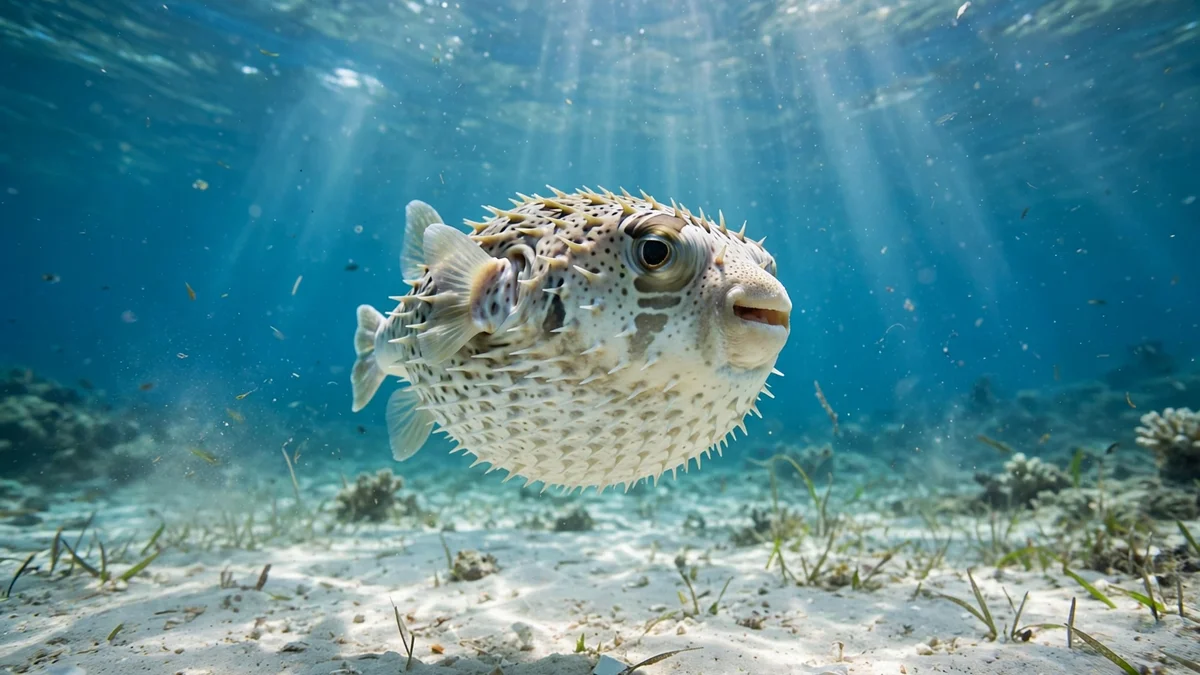

Puffer fish Tetraodontidae are the slow-swimming, round-bodied fish that can inflate themselves into a spiny ball when threatened. Tetraodontidae is the scientific name of their family, a group of roughly 200 species that live in tropical and subtropical seas, with a few in fresh water. They are famous for two things: the way they puff up, and the powerful nerve poison, tetrodotoxin, that many of them carry. This guide explains what the family is, how the fish feed and defend themselves, and why eating one is a risk that should never be taken lightly.
Key takeaways
- Tetraodontidae is a family of about 200 pufferfish species in 27 or 28 genera.
- The name means four teeth: the fish have four fused, beak-like teeth.
- They inflate by filling an elastic stomach with water, or with air out of the water.
- Many species carry tetrodotoxin, a nerve poison with no antidote, mainly in the liver, ovaries and skin.
- The toxin comes from bacteria in their food chain, not from the fish itself.
- Some species are eaten as fugu in Japan, but only by specially licensed chefs.
What is the Tetraodontidae family?
Tetraodontidae is a family of marine and freshwater fish in the order Tetraodontiformes, the same order that includes triggerfish, boxfish and ocean sunfish. The family contains between 193 and 206 species, depending on how the count is made, grouped into 27 or 28 genera. Its members are known by many names: pufferfishes, puffers, balloonfishes, blowfishes, blowers, swellfishes, globefishes, toadfishes and sea squabs, among others. Most live in warm, shallow tropical and subtropical seas, around coral reefs, seagrass beds and sandy bottoms, although a few species live in fresh water, and some move between fresh and salt water.
The name tells you the family’s most distinctive feature. Tetraodontidae comes from the Greek words for four and tooth: the fish have four large teeth, fused into a beak, two above and two below. The beak never stops growing, which is why pufferfish need hard food to wear it down. The family is also known for what it lacks: pufferfish have no pelvic fins, no ribs and no normal scales, and many have rough skin with small spines that lie flat until the fish inflates.
Pufferfish are typically small to medium, and most species grow to between 10 and 30 centimetres long. A few are much larger: the mbu pufferfish of African rivers can grow to more than 50 centimetres. They are slow swimmers, moving with a combination of fin movements, and they rely on eyesight and short bursts of speed to escape trouble.
How pufferfish inflate
Inflation is the pufferfish’s second line of defence, used when a predator has already got close. The fish fills its extremely elastic stomach with water, or with air if it is out of the water, until its body is much larger and almost spherical. The skin stretches, the spines stand out, and the fish becomes too big and too prickly for most predators to swallow. A predator that tries anyway may choke, and one that swallows the fish may find its stomach full of tetrodotoxin.
The first line of defence is simpler: do not be noticed, or do not be caught. Pufferfish have excellent eyesight and can move in short, fast bursts. Many species are camouflaged, with mottled skin that blends into sand or reef, and some carry warning colours. Even the larvae are protected: young pufferfish carry tetrodotoxin on the surface of their skin, which makes predators spit them out.
Inflation looks comical, but it is costly for the fish. Filling the stomach takes energy, and an inflated fish is tired and stressed afterwards: it cannot feed or swim properly. That is why divers are told not to provoke pufferfish into puffing up for a photograph, and why a fish inflated with air at the surface can struggle to sink again.
The beak, the diet and the teeth
A pufferfish eats with its beak. The four fused teeth form a sharp, parrot-like beak that can crush the shells of snails, clams, crabs and other hard-shelled prey. Most pufferfish eat invertebrates: molluscs, crustaceans, worms and the occasional small fish, along with algae and seaweed. The white-spotted pufferfish of the Indo-Pacific is famous for the large geometric circles the males build in the sand to attract females, patterns that can be two metres across.
The beak grows throughout the fish’s life, and hard food keeps it worn down. In home aquariums, keepers feed pufferfish snails and other shelled food for exactly this reason. A pufferfish fed only soft food can develop overgrown teeth that stop it eating, and the teeth then have to be trimmed by a vet.
Well-known pufferfish species
The family is large, but a handful of species are the ones most people meet, whether in an aquarium, on a reef or on a menu. The table below sets out four of them: one lives in African rivers, one in the western Atlantic, one on Indo-Pacific reefs, and one on Japanese dinner tables.
| Species | Where it lives | Size | What makes it notable |
|---|---|---|---|
| Mbu pufferfish | Rivers of the Congo basin in Africa | Over 50 cm | One of the largest freshwater puffers in the world |
| Northern puffer | Western Atlantic, including Chesapeake Bay | Up to about 30 cm | Its flesh is not toxic, and it is eaten locally as a delicacy |
| White-spotted pufferfish | Sandy seabeds of the Indo-Pacific | About 12 cm | Males build large geometric circles in the sand to attract females |
| Tiger puffer, or torafugu | Seas around Japan, Korea and China | Up to about 80 cm | The best-known fugu species, prepared only by licensed chefs |

Tetrodotoxin: the poison in the family
The most dangerous thing about pufferfish is tetrodotoxin, usually shortened to TTX. It is a potent nerve poison that blocks the sodium channels in nerve cells, stopping signals from travelling between nerves and muscles. The result is numbness, then paralysis, and in severe cases death from respiratory failure. It is more than a thousand times more toxic to humans than cyanide, according to some authorities, and the smallest amount thought to be lethal to a person is about two milligrams. There is no antidote.
The toxin is not spread evenly through the fish. In marine species it is most concentrated in the liver and ovaries, with smaller amounts in the intestines and skin, and only traces in the muscle. The level varies with species, place, season and the individual fish, so there is no safe way to judge a fish by looking at it. Cooking, freezing and drying do not destroy tetrodotoxin, which is heat-stable.
The fish do not make the poison themselves. Tetrodotoxin is produced by marine bacteria, and pufferfish pick it up through the food chain. Fish raised on a toxin-free diet grow up non-toxic, and become toxic again if fed food containing the toxin. The fish themselves are highly resistant to it. Symptoms in people begin within twenty minutes to two hours of eating a toxic fish: numbness of the lips and mouth, tingling in the hands and feet, slurred speech, weakness and paralysis. A victim can remain conscious while completely paralysed.
Fugu: the fish that must be prepared by experts
Despite the danger, some pufferfish are eaten as a delicacy. In Japan it is called fugu, in Korea bok, and in China hetun, and the meat of certain species is prized for its firm texture and delicate flavour. Only specially trained and licensed chefs may prepare it, because they know which parts are safe to eat and in what quantity. In Japan, the edible species, parts and fishing areas are set out in law, and chefs train for years.
Even with those controls, people still die. Japan records two or three deaths a year from pufferfish poisoning, most of them from fish caught and prepared at home rather than in restaurants. The northern puffer of Chesapeake Bay is different: its flesh is not toxic, and it is eaten locally as sea squab. The safety of one species says nothing about another, and no amateur should ever prepare a pufferfish.
A checklist for seeing pufferfish safely
- Watch pufferfish in an aquarium or on a reef, and do not touch them or chase them.
- Never provoke a pufferfish into inflating for a photograph; it costs the fish energy and causes stress.
- Do not pick up a pufferfish that has washed up on a beach; it may still carry toxin in its skin and organs.
- Keep your hands away from the beak: it can crack shells, and it can bite.
- Never eat a pufferfish you have caught yourself, and never prepare one at home.
- If you eat fugu, eat it only in a licensed restaurant with a trained chef.
- If someone shows signs of poisoning after eating pufferfish, call emergency services at once and keep the person still.
- If you keep pufferfish as pets, feed them shelled food to wear down their beaks and research the species first.
Frequently asked questions
What does Tetraodontidae mean?
It comes from the Greek words for four and tooth. The fish of this family have four large teeth, fused into a beak, two above and two below. The beak crushes the shells of snails, clams and crabs, and grows throughout the fish’s life.
How many species are in the Tetraodontidae family?
Between 193 and 206 species, grouped into 27 or 28 genera. Most live in tropical and subtropical seas, and a few live in fresh water.
Are all pufferfish poisonous?
No, but most are. The majority of species carry tetrodotoxin, mainly in the liver, ovaries and skin. A few, such as the northern puffer of Chesapeake Bay, have flesh that is not toxic. There is no safe way to tell by looking, so no pufferfish should ever be eaten unless a licensed chef has prepared it.
Can a pufferfish kill a human?
Yes. Tetrodotoxin is a potent nerve poison with no antidote, and the smallest lethal dose for a person is estimated at about two milligrams. Symptoms begin within twenty minutes to two hours, starting with numbness of the lips and mouth, and severe poisoning can cause death from respiratory failure. Cooking does not destroy the toxin.
Do pufferfish inflate with air or water?
Usually water. The fish fills its elastic stomach with water until its body is almost spherical. Out of the water, it fills its stomach with air instead. Inflation is stressful, so it should never be provoked for fun.
What is the difference between a pufferfish and a porcupinefish?
They are close relatives in the same order, but different families. Pufferfish belong to Tetraodontidae, and porcupinefish to Diodontidae. Porcupinefish have longer spines that are always visible, while pufferfish spines are smaller and often lie flat until the fish inflates. Both families inflate.
The bottom line
Puffer fish Tetraodontidae are slow, curious fish with a remarkable set of defences: a crushing beak, skin that can stretch into a spiny ball, and a nerve poison with no antidote. They are worth admiring in an aquarium or on a reef, and worth leaving alone in the water. The danger is easy to avoid: do not touch them, do not make them inflate, and never eat one unless a licensed chef has prepared it. For more on foods that need care, read our guide to can dogs have avocado, our guide to best picnic recipes, and our guide to the best water bottle.
Safety note: tetrodotoxin has no antidote, and cooking, freezing and drying do not destroy it. Never eat a pufferfish you have caught or prepared yourself. If someone develops numbness, tingling or weakness after eating pufferfish, call emergency services immediately.